 Add to Chrome
 Add to Firefox
 Add to Edge
Forecasting elections results via the voter model with stubborn nodes
Sep 22, 2020
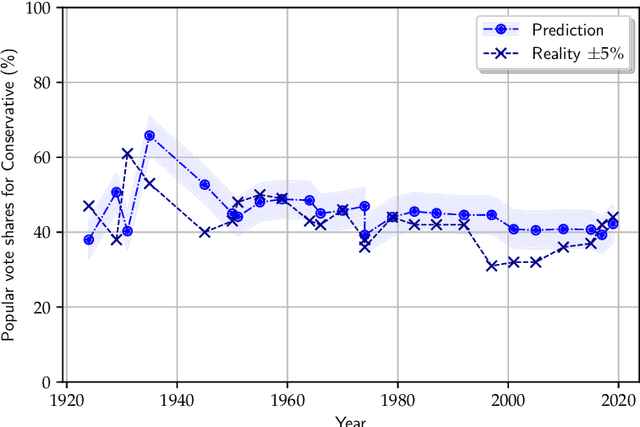
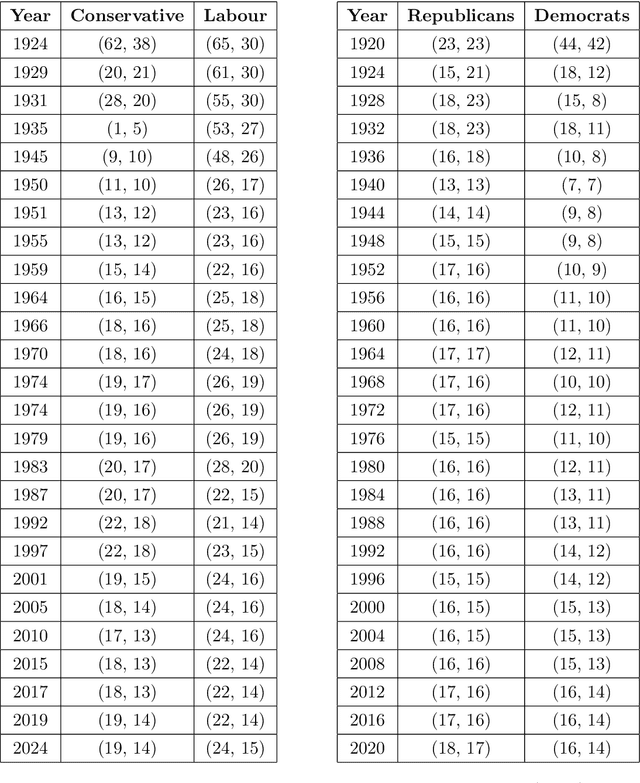
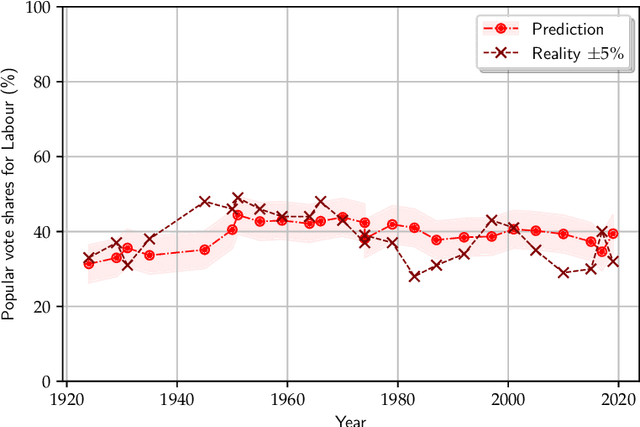
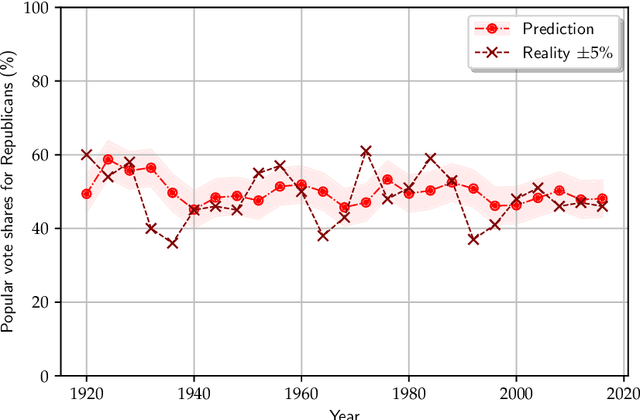
In this paper we propose a novel method to forecast the result of elections using only official results of previous ones. It is based on the voter model with stubborn nodes and uses theoretical results developed in a previous work of ours. We look at popular vote shares for the Conservative and Labour parties in the UK and the Republican and Democrat parties in the US. We are able to perform time-evolving estimates of the model parameters and use these to forecast the vote shares for each party in any election. We obtain a mean absolute error of 4.74\%. As a side product, our parameters estimates provide meaningful insight on the political landscape, informing us on the quantity of voters that are strongly pro and against the considered parties.

How opinions crystallise: an analysis of polarisation in the voter model
Jun 12, 2020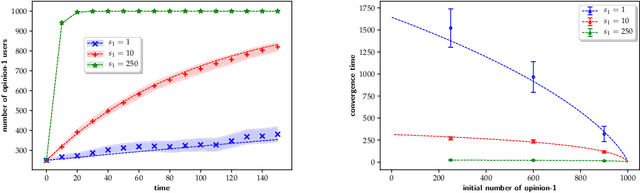
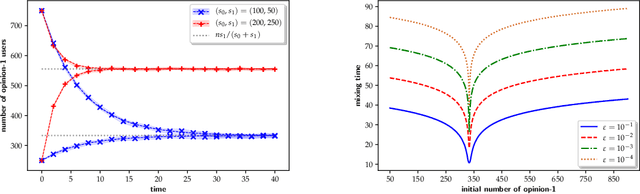
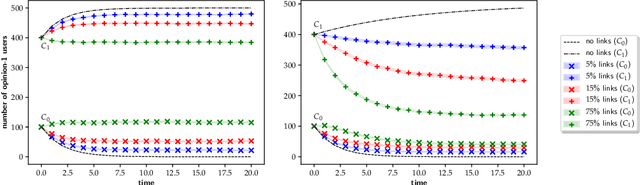
We address the phenomenon of sedimentation of opinions in networks. We investigate how agents who never change their minds ("stubborn") can influence the opinion of a social group and foster the formation of polarised communities. We study the voter model in which users are divided in two camps and repeatedly update their opinions based on others they connect with. Assuming a proportion of the agents are stubborn, the distribution of opinions reaches an equilibrium. We give novel formulas based on Markov Chain analysis to compute the distribution of opinions at any time and speed of convergence to stationary equilibrium. Theoretical results are supported by numerical experiments on synthetic data, and we discuss a strategy to mitigate the polarisation phenomenon.