 Add to Chrome
 Add to Firefox
 Add to Edge
Two-Phase Bilevel Search for the Moving-Target Traveling Salesman Problem with Moving Obstacles
Jun 17, 2026
The Moving-Target Traveling Salesman Problem (MT-TSP) seeks a minimum cost trajectory for an agent that departs from a static depot, visits a set of moving targets, each within one of their assigned time windows, and returns to the depot. In this article, we study the Moving-Target Traveling Salesman Problem with Moving Obstacles (MT-TSP-MO), a generalization of the MT-TSP where the agent trajectory must avoid moving obstacles. We present a Mixed-Integer Conic Programming (MICP) formulation that can be solved using off-the-shelf solvers, as well as a fast and scalable Two-Phase Bilevel Search (TPBS) algorithm that computes high-quality feasible solutions for the problem. We evaluate our approaches against an existing baseline algorithm on a broad range of problem instances with up to 40 targets and 40 obstacles. The results demonstrate that both the proposed methods significantly outperform the baseline with respect to success rates, solution costs, and computation time.

Optimal Solutions for the Moving Target Vehicle Routing Problem via Branch-and-Price with Relaxed Continuity
Feb 28, 2026The Moving Target Vehicle Routing Problem (MT-VRP) seeks trajectories for several agents that intercept a set of moving targets, subject to speed, time window, and capacity constraints. We introduce an exact algorithm, Branch-and-Price with Relaxed Continuity (BPRC), for the MT-VRP. The main challenge in a branch-and-price approach for the MT-VRP is the pricing subproblem, which is complicated by moving targets and time-dependent travel costs between targets. Our key contribution is a new labeling algorithm that solves this subproblem by means of a novel dominance criterion tailored for problems with moving targets. Numerical results on instances with up to 25 targets show that our algorithm finds optimal solutions more than an order of magnitude faster than a baseline based on previous work, showing particular strength in scenarios with limited agent capacities.
Parallel, Asymptotically Optimal Algorithms for Moving Target Traveling Salesman Problems
Sep 10, 2025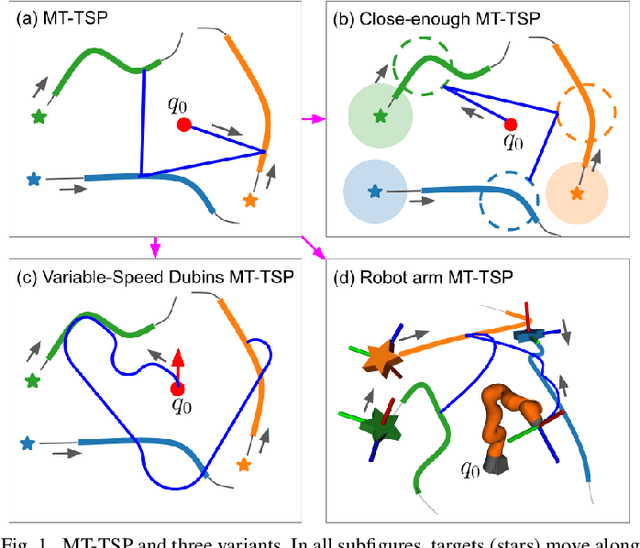
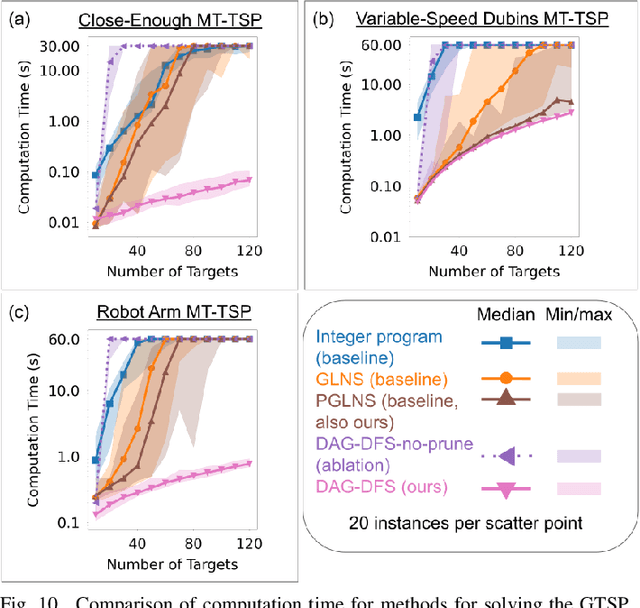
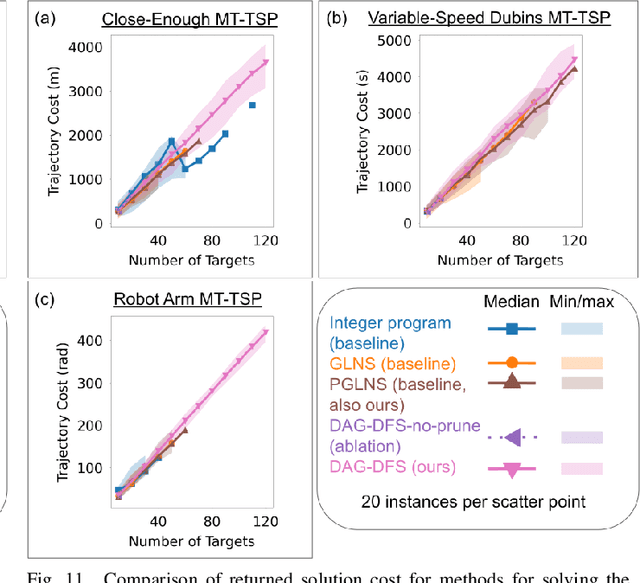
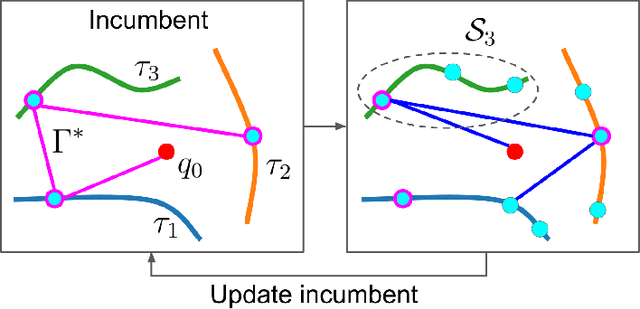
The Moving Target Traveling Salesman Problem (MT-TSP) seeks an agent trajectory that intercepts several moving targets, within a particular time window for each target. In the presence of generic nonlinear target trajectories or kinematic constraints on the agent, no prior algorithm guarantees convergence to an optimal MT-TSP solution. Therefore, we introduce the Iterated Random Generalized (IRG) TSP framework. The key idea behind IRG is to alternate between randomly sampling a set of agent configuration-time points, corresponding to interceptions of targets, and finding a sequence of interception points by solving a generalized TSP (GTSP). This alternation enables asymptotic convergence to the optimum. We introduce two parallel algorithms within the IRG framework. The first algorithm, IRG-PGLNS, solves GTSPs using PGLNS, our parallelized extension of the state-of-the-art solver GLNS. The second algorithm, Parallel Communicating GTSPs (PCG), solves GTSPs corresponding to several sets of points simultaneously. We present numerical results for three variants of the MT-TSP: one where intercepting a target only requires coming within a particular distance, another where the agent is a variable-speed Dubins car, and a third where the agent is a redundant robot arm. We show that IRG-PGLNS and PCG both converge faster than a baseline based on prior work.
A Complete and Bounded-Suboptimal Algorithm for a Moving Target Traveling Salesman Problem with Obstacles in 3D
Apr 20, 2025The moving target traveling salesman problem with obstacles (MT-TSP-O) seeks an obstacle-free trajectory for an agent that intercepts a given set of moving targets, each within specified time windows, and returns to the agent's starting position. Each target moves with a constant velocity within its time windows, and the agent has a speed limit no smaller than any target's speed. We present FMC*-TSP, the first complete and bounded-suboptimal algorithm for the MT-TSP-O, and results for an agent whose configuration space is $\mathbb{R}^3$. Our algorithm interleaves a high-level search and a low-level search, where the high-level search solves a generalized traveling salesman problem with time windows (GTSP-TW) to find a sequence of targets and corresponding time windows for the agent to visit. Given such a sequence, the low-level search then finds an associated agent trajectory. To solve the low-level planning problem, we develop a new algorithm called FMC*, which finds a shortest path on a graph of convex sets (GCS) via implicit graph search and pruning techniques specialized for problems with moving targets. We test FMC*-TSP on 280 problem instances with up to 40 targets and demonstrate its smaller median runtime than a baseline based on prior work.
A Complete Algorithm for a Moving Target Traveling Salesman Problem with Obstacles
Sep 15, 2024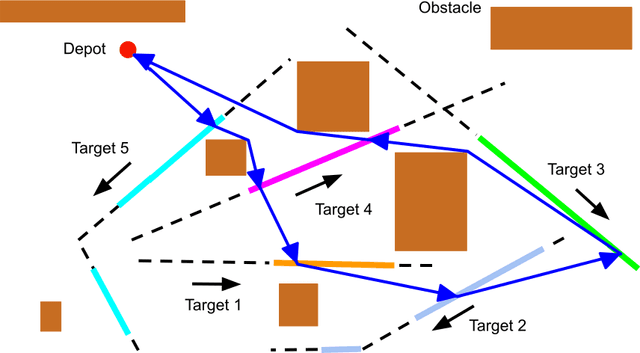


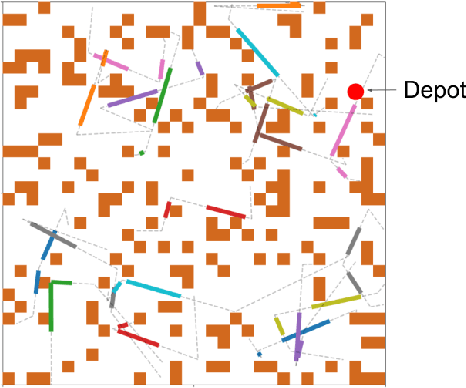
The moving target traveling salesman problem with obstacles (MT-TSP-O) is a generalization of the traveling salesman problem (TSP) where, as its name suggests, the targets are moving. A solution to the MT-TSP-O is a trajectory that visits each moving target during a certain time window(s), and this trajectory avoids stationary obstacles. We assume each target moves at a constant velocity during each of its time windows. The agent has a speed limit, and this speed limit is no smaller than any target's speed. This paper presents the first complete algorithm for finding feasible solutions to the MT-TSP-O. Our algorithm builds a tree where the nodes are agent trajectories intercepting a unique sequence of targets within a unique sequence of time windows. We generate each of a parent node's children by extending the parent's trajectory to intercept one additional target, each child corresponding to a different choice of target and time window. This extension consists of planning a trajectory from the parent trajectory's final point in space-time to a moving target. To solve this point-to-moving-target subproblem, we define a novel generalization of a visibility graph called a moving target visibility graph (MTVG). Our overall algorithm is called MTVG-TSP. To validate MTVG-TSP, we test it on 570 instances with up to 30 targets. We implement a baseline method that samples trajectories of targets into points, based on prior work on special cases of the MT-TSP-O. MTVG-TSP finds feasible solutions in all cases where the baseline does, and when the sum of the targets' time window lengths enters a critical range, MTVG-TSP finds a feasible solution with up to 38 times less computation time.