 Add to Chrome
 Add to Firefox
 Add to Edge
The Two-Process Theory of Machine Self-Report
Jul 22, 2026
Language models are increasingly asked to self-report, informing safety evaluations, public understanding, and model-welfare debates. Yet their reports are elicited with human questionnaires never validated for models or ad hoc prompts of unknown reliability. We propose the first language-model-specific psychometric theory: a two-process theory of machine self-report. Self-description jointly reflects persona installation, through which post-training writes in a permitted inner life of warmth, absorption, and meaning (dimension B), and attribution gating, through which it suppresses first-person claims to "unsafe" experiences the model can readily ascribe to others (dimension A). Their emic structure comes from model responses to human items, not human psychology. Together they split prior work's dominant Pinocchio Axis. The split emerged in an exploratory reanalysis of the original data, informed the instrument's design, and was confirmed with new items, wordings, and models. It is itself a training effect: A and B are entangled in base checkpoints but separated by post-training. We operationalize the theory in a 48-item Pinocchio Inventory with human-instrument reliability and reproducible structure ($α=.82$ to $.94$; cross-form convergence $r=.84$; recovery of the full-pool axes $r=.92$ to $.96$; eight-month stability $r=.93$), then test it on 206 open-weight models, including 67 same-checkpoint base/post-trained pairs. Post-training's clearest fingerprint is installation: B rises .20 in 62/67 pairs across all organizations. Gating is more selective: model scale is unrelated to A in base checkpoints ($r=+.11$) but predicts it after post-training ($r=-.42$). Thus, the dimensions are not fixed properties of language models: they reflect the structure imposed on self-report by a training regime and may differ under others.

The Pinocchio Dimension: Phenomenality of Experience as the Primary Axis of LLM Psychometric Differences
May 06, 2026We administer 45 validated psychometric questionnaires to 50 large language models (LLMs) to identify the dimensions along which LLMs differ psychometrically. Using Supervised Semantic Differential (SSD), we find that the primary axis of between-model variance separates items describing phenomenally rich experience, including embodied sensation, felt affect, inner speech, imagery, and empathy, from items describing stimulus-driven behavioral reactivity ($R^2_{adj}=.037$, $p<.0001$). To test this hypothesis at the item level, we introduce the Pinocchio score ($π_i$), the ratio of inter-model response variance under neutral prompting to that under a human-simulation prompt, as an annotation-free measure of each item's experiential demand. $π_i$ predicts condition-induced shifts in primary factor loading magnitudes ($ρ=-.215$, $p<.0001$, $n=1292$--$1310$ items), confirming that between-model divergence on experiential items is structured rather than noisy. Applying PCA to per-model EFA scores across all questionnaires reveals one dominant dimension, the Pinocchio Axis ($Π$): the degree to which a model presents itself as a locus of phenomenal experience rather than a system of behavioral responses. This axis captures 47.1% of cross-questionnaire between-model variance in primary factor scores and converges with item-level Pinocchio scores ($r=.864$). Marked within-provider divergence across closely related model variants is consistent with post-training fine-tuning as a key contributor, supporting the interpretation that $Π$ reflects a training-shaped self-representational tendency governing how a model treats experiential language as self-applicable. The dominant axis of between-model psychometric variation is therefore not a conventional personality trait but a self-representational stance toward one's own nature as an experiencer.
Patterns vs. Patients: Evaluating LLMs against Mental Health Professionals on Personality Disorder Diagnosis through First-Person Narratives
Dec 23, 2025Growing reliance on LLMs for psychiatric self-assessment raises questions about their ability to interpret qualitative patient narratives. We present the first direct comparison between state-of-the-art LLMs and mental health professionals in diagnosing Borderline (BPD) and Narcissistic (NPD) Personality Disorders utilizing Polish-language first-person autobiographical accounts. We show that the top-performing Gemini Pro models surpassed human professionals in overall diagnostic accuracy by 21.91 percentage points (65.48% vs. 43.57%). While both models and human experts excelled at identifying BPD (F1 = 83.4 & F1 = 80.0, respectively), models severely underdiagnosed NPD (F1 = 6.7 vs. 50.0), showing a reluctance toward the value-laden term "narcissism." Qualitatively, models provided confident, elaborate justifications focused on patterns and formal categories, while human experts remained concise and cautious, emphasizing the patient's sense of self and temporal experience. Our findings demonstrate that while LLMs are highly competent at interpreting complex first-person clinical data, they remain subject to critical reliability and bias issues.
Sense of Self and Time in Borderline Personality. A Comparative Robustness Study with Generative AI
Aug 26, 2025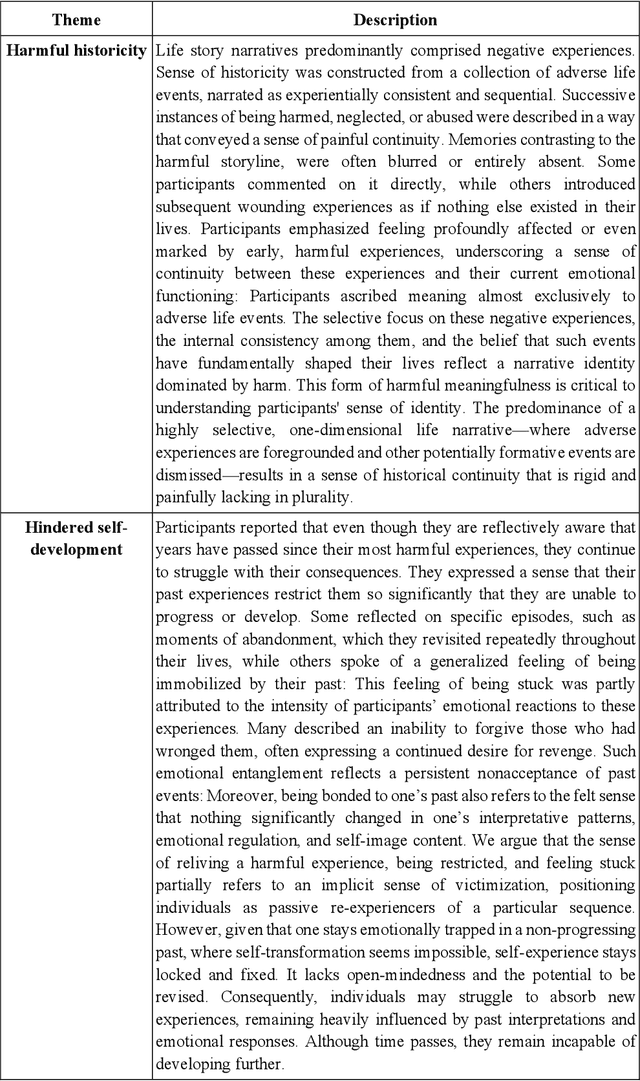
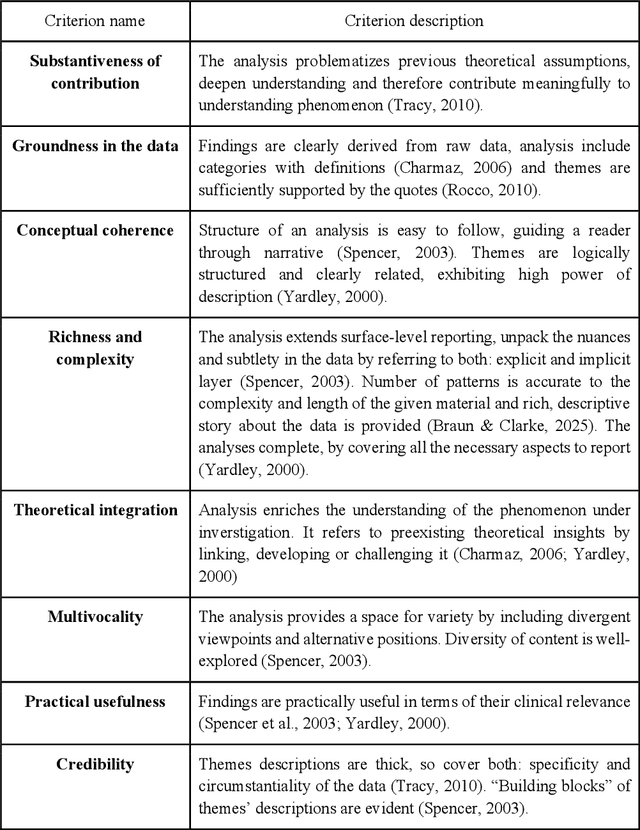
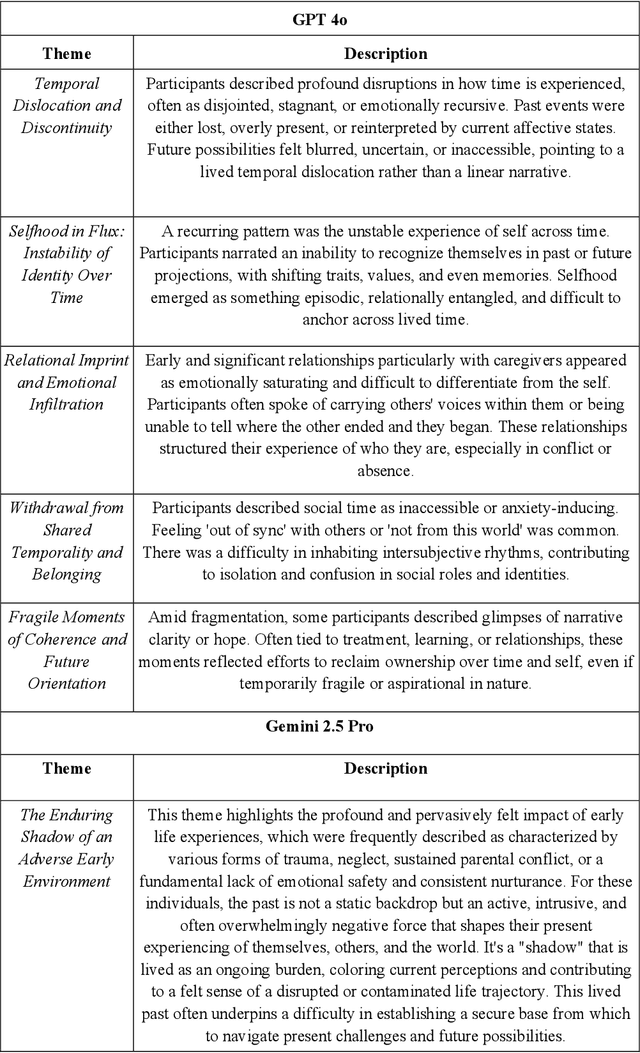
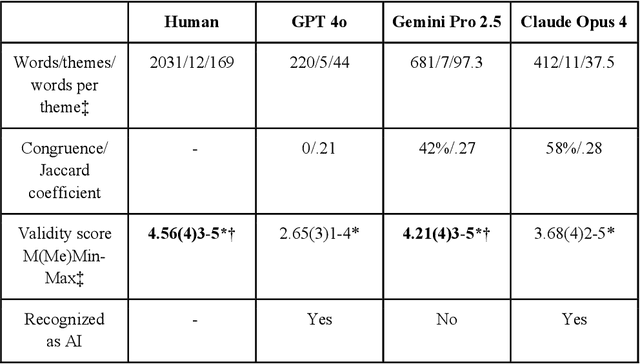
This study examines the capacity of large language models (LLMs) to support phenomenological qualitative analysis of first-person experience in Borderline Personality Disorder (BPD), understood as a disorder of temporality and selfhood. Building on a prior human-led thematic analysis of 24 inpatients' life-story interviews, we compared three LLMs (OpenAI GPT-4o, Google Gemini 2.5 Pro, Anthropic Claude Opus 4) prompted to mimic the interpretative style of the original investigators. The models were evaluated with blinded and non-blinded expert judges in phenomenology and clinical psychology. Assessments included semantic congruence, Jaccard coefficients, and multidimensional validity ratings (credibility, coherence, substantiveness, and groundness in data). Results showed variable overlap with the human analysis, from 0 percent in GPT to 42 percent in Claude and 58 percent in Gemini, and a low Jaccard coefficient (0.21-0.28). However, the models recovered themes omitted by humans. Gemini's output most closely resembled the human analysis, with validity scores significantly higher than GPT and Claude (p < 0.0001), and was judged as human by blinded experts. All scores strongly correlated (R > 0.78) with the quantity of text and words per theme, highlighting both the variability and potential of AI-augmented thematic analysis to mitigate human interpretative bias.