 Add to Chrome
 Add to Firefox
 Add to Edge
Data-Local Autonomous LLM-Guided Neural Architecture Search for Multiclass Multimodal Time-Series Classification
Mar 16, 2026
Applying machine learning to sensitive time-series data is often bottlenecked by the iteration loop: Performance depends strongly on preprocessing and architecture, yet training often has to run on-premise under strict data-local constraints. This is a common problem in healthcare and other privacy-constrained domains (e.g., a hospital developing deep learning models on patient EEG). This bottleneck is particularly challenging in multimodal fusion, where sensor modalities must be individually preprocessed and then combined. LLM-guided neural architecture search (NAS) can automate this exploration, but most existing workflows assume cloud execution or access to data-derived artifacts that cannot be exposed. We present a novel data-local, LLM-guided search framework that handles candidate pipelines remotely while executing all training and evaluation locally under a fixed protocol. The controller observes only trial-level summaries, such as pipeline descriptors, metrics, learning-curve statistics, and failure logs, without ever accessing raw samples or intermediate feature representations. Our framework targets multiclass, multimodal learning via one-vs-rest binary experts per class and modality, a lightweight fusion MLP, and joint search over expert architectures and modality-specific preprocessing. We evaluate our method on two regimes: UEA30 (public multivariate time-series classification dataset) and SleepEDFx sleep staging (heterogeneous clinical modalities such as EEG, EOG, and EMG). The results show that the modular baseline model is strong, and the LLM-guided NAS further improves it. Notably, our method finds models that perform within published ranges across most benchmark datasets. Across both settings, our method reduces manual intervention by enabling unattended architecture search while keeping sensitive data on-premise.

aSAGA: Automatic Sleep Analysis with Gray Areas
Oct 03, 2023
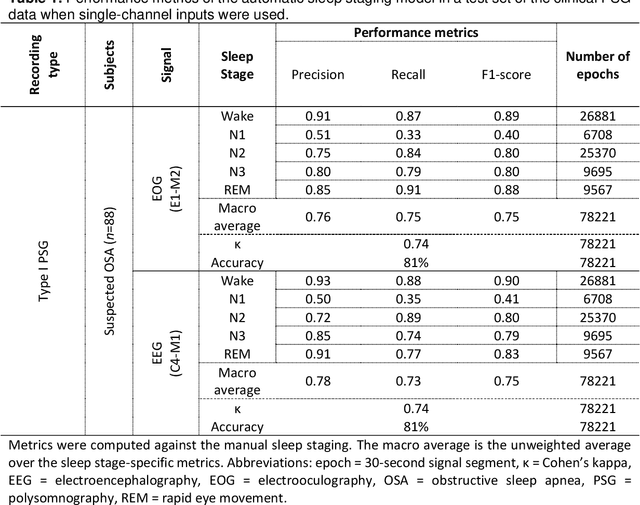

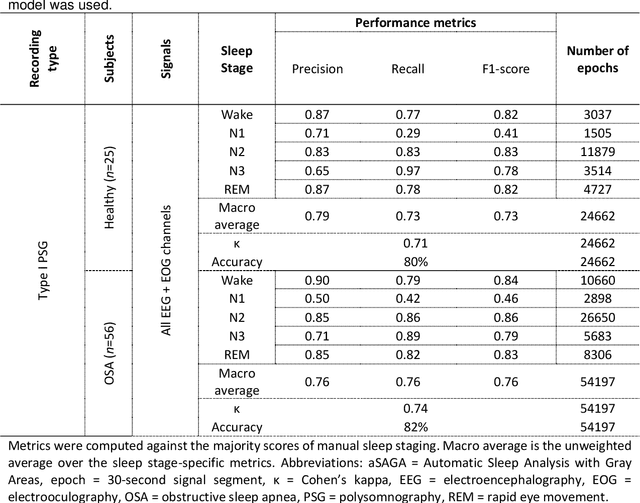
State-of-the-art automatic sleep staging methods have already demonstrated comparable reliability and superior time efficiency to manual sleep staging. However, fully automatic black-box solutions are difficult to adapt into clinical workflow and the interaction between explainable automatic methods and the work of sleep technologists remains underexplored and inadequately conceptualized. Thus, we propose a human-in-the-loop concept for sleep analysis, presenting an automatic sleep staging model (aSAGA), that performs effectively with both clinical polysomnographic recordings and home sleep studies. To validate the model, extensive testing was conducted, employing a preclinical validation approach with three retrospective datasets; open-access, clinical, and research-driven. Furthermore, we validate the utilization of uncertainty mapping to identify ambiguous regions, conceptualized as gray areas, in automatic sleep analysis that warrants manual re-evaluation. The results demonstrate that the automatic sleep analysis achieved a comparable level of agreement with manual analysis across different sleep recording types. Moreover, validation of the gray area concept revealed its potential to enhance sleep staging accuracy and identify areas in the recordings where sleep technologists struggle to reach a consensus. In conclusion, this study introduces and validates a concept from explainable artificial intelligence into sleep medicine and provides the basis for integrating human-in-the-loop automatic sleep staging into clinical workflows, aiming to reduce black-box criticism and the burden associated with manual sleep staging.
State of the Art of Audio- and Video-Based Solutions for AAL
Jul 05, 2022The report illustrates the state of the art of the most successful AAL applications and functions based on audio and video data, namely (i) lifelogging and self-monitoring, (ii) remote monitoring of vital signs, (iii) emotional state recognition, (iv) food intake monitoring, activity and behaviour recognition, (v) activity and personal assistance, (vi) gesture recognition, (vii) fall detection and prevention, (viii) mobility assessment and frailty recognition, and (ix) cognitive and motor rehabilitation. For these application scenarios, the report illustrates the state of play in terms of scientific advances, available products and research project. The open challenges are also highlighted.