 Add to Chrome
 Add to Firefox
 Add to Edge
T2I-BiasBench: A Multi-Metric Framework for Auditing Demographic and Cultural Bias in Text-to-Image Models
Apr 14, 2026
Text-to-image (T2I) generative models achieve impressive visual fidelity but inherit and amplify demographic imbalances and cultural biases embedded in training data. We introduce T2I-BiasBench, a unified evaluation framework of thirteen complementary metrics that jointly captures demographic bias, element omission, and cultural collapse in diffusion models - the first framework to address all three dimensions simultaneously. We evaluate three open-source models - Stable Diffusion v1.5, BK-SDM Base, and Koala Lightning - against Gemini 2.5 Flash (RLHF-aligned) as a reference baseline. The benchmark comprises 1,574 generated images across five structured prompt categories. T2I-BiasBench integrates six established metrics with seven additional measures: four newly proposed (Composite Bias Score, Grounded Missing Rate, Implicit Element Missing Rate, Cultural Accuracy Ratio) and three adapted (Hallucination Score, Vendi Score, CLIP Proxy Score). Three key findings emerge: (1) Stable Diffusion v1.5 and BK-SDM exhibit bias amplification (>1.0) in beauty-related prompts; (2) contextual constraints such as surgical PPE substantially attenuate professional-role gender bias (Doctor CBS = 0.06 for SD v1.5); and (3) all models, including RLHF-aligned Gemini, collapse to a narrow set of cultural representations (CAS: 0.54-1.00), confirming that alignment techniques do not resolve cultural coverage gaps. T2I-BiasBench is publicly released to support standardized, fine-grained bias evaluation of generative models. The project page is available at: https://gyanendrachaubey.github.io/T2I-BiasBench/

State-of-the-art Small Language Coder Model: Mify-Coder
Dec 26, 2025We present Mify-Coder, a 2.5B-parameter code model trained on 4.2T tokens using a compute-optimal strategy built on the Mify-2.5B foundation model. Mify-Coder achieves comparable accuracy and safety while significantly outperforming much larger baseline models on standard coding and function-calling benchmarks, demonstrating that compact models can match frontier-grade models in code generation and agent-driven workflows. Our training pipeline combines high-quality curated sources with synthetic data generated through agentically designed prompts, refined iteratively using enterprise-grade evaluation datasets. LLM-based quality filtering further enhances data density, enabling frugal yet effective training. Through disciplined exploration of CPT-SFT objectives, data mixtures, and sampling dynamics, we deliver frontier-grade code intelligence within a single continuous training trajectory. Empirical evidence shows that principled data and compute discipline allow smaller models to achieve competitive accuracy, efficiency, and safety compliance. Quantized variants of Mify-Coder enable deployment on standard desktop environments without requiring specialized hardware.
Attention via Synaptic Plasticity is All You Need: A Biologically Inspired Spiking Neuromorphic Transformer
Nov 18, 2025Attention is the brain's ability to selectively focus on a few specific aspects while ignoring irrelevant ones. This biological principle inspired the attention mechanism in modern Transformers. Transformers now underpin large language models (LLMs) such as GPT, but at the cost of massive training and inference energy, leading to a large carbon footprint. While brain attention emerges from neural circuits, Transformer attention relies on dot-product similarity to weight elements in the input sequence. Neuromorphic computing, especially spiking neural networks (SNNs), offers a brain-inspired path to energy-efficient intelligence. Despite recent work on attention-based spiking Transformers, the core attention layer remains non-neuromorphic. Current spiking attention (i) relies on dot-product or element-wise similarity suited to floating-point operations, not event-driven spikes; (ii) keeps attention matrices that suffer from the von Neumann bottleneck, limiting in-memory computing; and (iii) still diverges from brain-like computation. To address these issues, we propose the Spiking STDP Transformer (S$^{2}$TDPT), a neuromorphic Transformer that implements self-attention through spike-timing-dependent plasticity (STDP), embedding query--key correlations in synaptic weights. STDP, a core mechanism of memory and learning in the brain and widely studied in neuromorphic devices, naturally enables in-memory computing and supports non-von Neumann hardware. On CIFAR-10 and CIFAR-100, our model achieves 94.35\% and 78.08\% accuracy with only four timesteps and 0.49 mJ on CIFAR-100, an 88.47\% energy reduction compared to a standard ANN Transformer. Grad-CAM shows that the model attends to semantically relevant regions, enhancing interpretability. Overall, S$^{2}$TDPT illustrates how biologically inspired attention can yield energy-efficient, hardware-friendly, and explainable neuromorphic models.
Memristive Nanowire Network for Energy Efficient Audio Classification: Pre-Processing-Free Reservoir Computing with Reduced Latency
Nov 29, 2024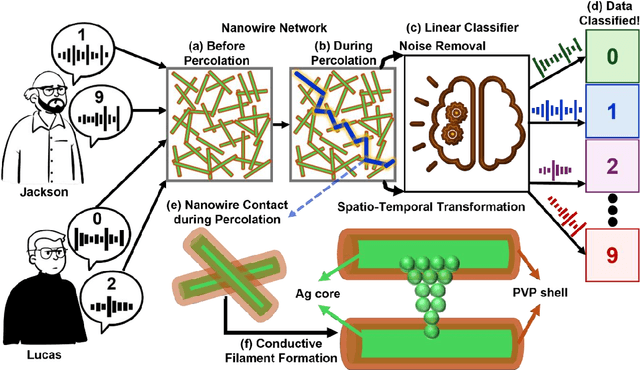
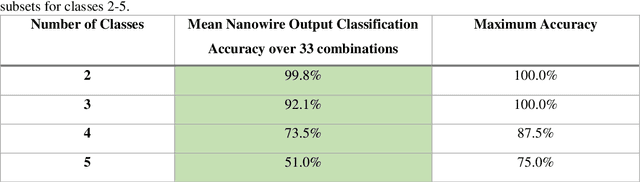
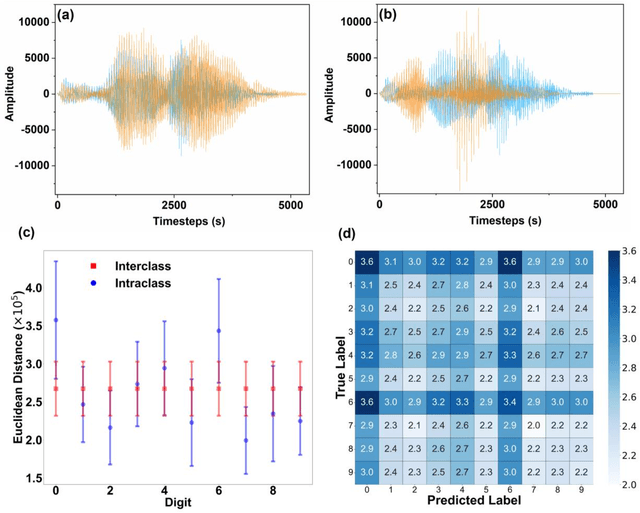

Speech recognition is a key challenge in natural language processing, requiring low latency, efficient computation, and strong generalization for real-time applications. While software-based artificial neural networks (ANNs) excel at this task, they are computationally intensive and depend heavily on data pre-processing. Neuromorphic computing, with its low-latency and energy-efficient advantages, holds promise for audio classification. Memristive nanowire networks, combined with pre-processing techniques like Mel-Frequency Cepstrum Coefficient extraction, have been widely used for associative learning, but such pre-processing can be power-intensive, undermining latency benefits. This study pioneers the use of memristive and spatio-temporal properties of nanowire networks for audio signal classification without pre-processing. A nanowire network simulation is paired with three linear classifiers for 10-class MNIST audio classification and binary speaker generalization tests. The hybrid system achieves significant benefits: excellent data compression with only 3% of nanowire output utilized, a 10-fold reduction in computational latency, and up to 28.5% improved classification accuracy (using a logistic regression classifier). Precision and recall improve by 10% and 17% for multispeaker datasets, and by 24% and 17% for individual speaker datasets, compared to raw data classifiers. This work provides a foundational proof of concept for utilizing memristive nanowire networks (NWN) in edge-computing devices, showcasing their potential for efficient, real-time audio signal processing with reduced computational overhead and power consumption, and enabling the development of advanced neuromorphic computing solutions.
Narrow Transformer: Starcoder-Based Java-LM For Desktop
Jul 04, 2024This paper presents NT-Java-1.1B, an open-source specialized code language model built on StarCoderBase-1.1B, designed for coding tasks in Java programming. NT-Java-1.1B achieves state-of-the-art performance, surpassing its base model and majority of other models of similar size on MultiPL-E Java code benchmark. While there have been studies on extending large, generic pre-trained models to improve proficiency in specific programming languages like Python, similar investigations on small code models for other programming languages are lacking. Large code models require specialized hardware like GPUs for inference, highlighting the need for research into building small code models that can be deployed on developer desktops. This paper addresses this research gap by focusing on the development of a small Java code model, NT-Java-1.1B, and its quantized versions, which performs comparably to open models around 1.1B on MultiPL-E Java code benchmarks, making them ideal for desktop deployment. This paper establishes the foundation for specialized models across languages and sizes for a family of NT Models.