 Add to Chrome
 Add to Firefox
 Add to Edge
Lyapunov-Guided Training for Hardware-Safe Neural Networks Under Fixed-Point Arithmetic
Jul 05, 2026
Low-precision neural networks are attractive for resource-constrained hardware, but fixed-point arithmetic introduces failure modes that are often hidden by idealised quantisation models. In particular, two's-complement overflow wrapping can corrupt hidden activations by changing both their magnitude and sign, leading to unstable numerical error propagation and severe accuracy degradation. This paper proposes a Lyapunov-stabilised quantisation framework for low-precision neural networks operating under hardware-style wrapping arithmetic. The hidden-state energy is monitored through a layerwise Lyapunov function, and a monotone projection is applied to enforce bounded and non-increasing state evolution across depth. The method is evaluated on MNIST using a compact patch-based transformer under post-training quantisation and quantisation-aware training with fixed-point bit-widths from 4 to 16 bits. Monte Carlo results show that unconstrained wrapped quantisation-aware training collapses to near-chance accuracy across 6-16 bits, with activation overflow rates exceeding 11%. In contrast, the proposed monotone Lyapunov projection suppresses activation overflow to below 0.012% and restores stable low-precision learning, achieving 86.55% accuracy at 12 bits. These results demonstrate that Lyapunov-based state control can act as a hardware-aware stabilisation mechanism for reliable fixed-point neural inference and training.

Empirical Minimal-Realisation Compression of Deep Neural Networks via Controllability-Observability Tests
Jul 05, 2026Deep neural networks often contain substantial hidden-state redundancy, but most compression methods operate directly on weights, neurons, or quantised representations without explicitly characterising the dynamical role of internal states. This paper proposes a controllability-observability framework for empirical state-order reduction of deep neural networks. By viewing a trained network as a depth-indexed nonlinear dynamical system, we construct data-driven reachability, observability, and balanced Gramians from hidden-state snapshots and output Jacobians. The resulting A/B/C tests estimate layer-wise reachable, observable, and jointly reachable--observable ranks. These ranks are then used not only as diagnostic measures of hidden-state redundancy, but also as actual compressed layer widths for realised reduced networks. Experiments on MNIST and CIFAR-10 compare the proposed balanced realisation against projection-based reduction, unstructured pruning, structured pruning, low-rank SVD, dynamic INT8 quantisation, and linear baselines. On MNIST, a four-layer SiLU DNN is reduced from state order 1024 to 277, giving 72.95% state compression and 73.48% parameter compression, while maintaining 95.45% accuracy compared with 96.60% for the full model. On CIFAR-10, a larger SiLU DNN is reduced from state order 4608 to 1339, giving 70.94% state compression and 83.09% parameter compression, while preserving accuracy from 54.45% to 54.44% and reducing CUDA inference latency by approximately 3X. The results show that balanced reachable-observable ranks provide a principled empirical minimal-realisation criterion for designing compact neural architectures with little or no loss in accuracy.
Audio-Visual Speech Enhancement: Architectural Design and Deployment Strategies
Aug 11, 2025This paper introduces a new AI-based Audio-Visual Speech Enhancement (AVSE) system and presents a comparative performance analysis of different deployment architectures. The proposed AVSE system employs convolutional neural networks (CNNs) for spectral feature extraction and long short-term memory (LSTM) networks for temporal modeling, enabling robust speech enhancement through multimodal fusion of audio and visual cues. Multiple deployment scenarios are investigated, including cloud-based, edge-assisted, and standalone device implementations. Their performance is evaluated in terms of speech quality improvement, latency, and computational overhead. Real-world experiments are conducted across various network conditions, including Ethernet, Wi-Fi, 4G, and 5G, to analyze the trade-offs between processing delay, communication latency, and perceptual speech quality. The results show that while cloud deployment achieves the highest enhancement quality, edge-assisted architectures offer the best balance between latency and intelligibility, meeting real-time requirements under 5G and Wi-Fi 6 conditions. These findings provide practical guidelines for selecting and optimizing AVSE deployment architectures in diverse applications, including assistive hearing devices, telepresence, and industrial communications.
Antenna Health-Aware Selective Beamforming for Hardware-Constrained DFRC Systems II
Dec 23, 2024This study introduces an innovative beamforming design approach that incorporates the reliability of antenna array elements into the optimization process, termed "antenna health-aware selective beamforming". This method strategically focuses transmission power on more reliable antenna elements, thus enhancing system resilience and operational integrity. By integrating antenna health information and individual power constraints, our research leverages advanced optimization techniques such as the Group Proximal-Gradient Dual Ascent (GPGDA) to efficiently address nonconvex challenges in sparse array selection. Applying the proposed technique to a Dual-Functional Radar-Communication (DFRC) system, our findings highlight that increasing the sparsity promotion weight ($\rho_s$) generally boosts spectral efficiency and communication data rate, achieving perfect system reliability at higher $\rho_s$ values but also revealing a performance threshold beyond which further sparsity is detrimental. This underscores the importance of balanced sparsity in beamforming for optimizing performance, particularly in critical communication and defense applications where uninterrupted operation is crucial. Additionally, our analysis of the time complexity and power consumption associated with GPGDA underscores the need for optimizing computational resources in practical implementations.
Efficient Dual-Blind Deconvolution for Joint Radar-Communication Systems Using ADMM: Enhancing Channel Estimation and Signal Recovery in 5G mmWave Networks
Sep 28, 2024This paper introduces an innovative framework to address the dual-blind deconvolution challenge within joint radar-communication (JRC) systems, leveraging the Alternating Direction Method of Multipliers (ADMM) to estimate unknown radar channels G (or communication channel H) and transmitted signals X under convex constraints. The approach iteratively refines G (or H) and X estimates alongside auxiliary and dual variables, employing proximal operators to manage potential non-smoothness in the constraint functions. This method stands out for its computational efficiency and adaptability to a wide array of signal processing and communication problems where blind deconvolution is pivotal. Performance analysis reveals a notable reduction in communication mismatch and demonstrates significant improvements in key system metrics such as the Signal-to-Interference-plus-Noise Ratio (SINR), spectrum efficiency, and radar mutual information, particularly within the context of 5G millimeter-wave (mmWave) systems. These results underscore the proposed framework's potential to enhance the synergy between radar and communication functions, promoting more effective spectrum utilisation and environmental sensing capabilities in next-generation wireless technologies.
Context-Aware CSI Tracking and Path Loss Prediction Using Machine Learning and Dynamical Systems
Jul 29, 2024
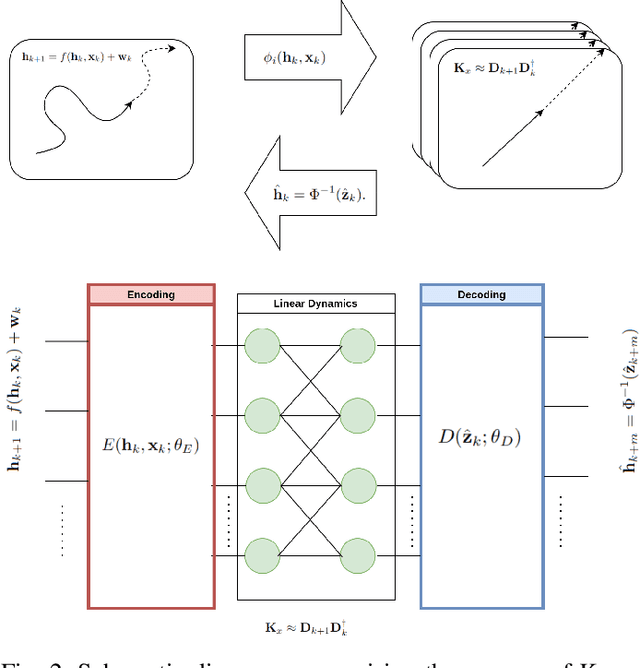


In this paper, we present an advanced model for Channel State Information (CSI) tracking, leveraging a dynamical system approach to adapt CSI dynamically based on exogenous contextual information. This methodology allows for continuous updates to the Channel Knowledge Map (CKM), enhancing communication reliability and responsiveness in dynamic environments. To generate realistic and comprehensive datasets for training and evaluation, we developed a new MATLAB simulator that models radio wave propagation in urban environments. We address the challenge of real-time CKM adaptation using online learning of the Koopman operator, a technique that forecasts channel behaviour by exploiting dynamical system properties. Our approach supports real-time updates with high accuracy and efficiency, as demonstrated by experiments with varying window sizes for the Koopman Autoencoder model. A window size of 100 was found to offer the best balance between prediction accuracy (RMSE: 1.8323 +- 1.1071, MAE: 0.3780 +- 0.2221) and computational efficiency (training time: 231.1 +- 82.5 ms, prediction time: 109.0 +- 55.7 ms). Additionally, we introduce a moving window mechanism to address privacy and security concerns by updating the Koopman operator within the window and purging input data thereafter, minimising data retention and storage risks. This ensures the CKM remains accurate and relevant while maintaining stringent data privacy standards. Our findings suggest that this approach can significantly improve the resilience and security of communication systems, making them highly adaptable to environmental changes without compromising user privacy.
Trade-offs in Reliability and Performance Using Selective Beamforming for Ultra-Massive MIMO
Jul 29, 2024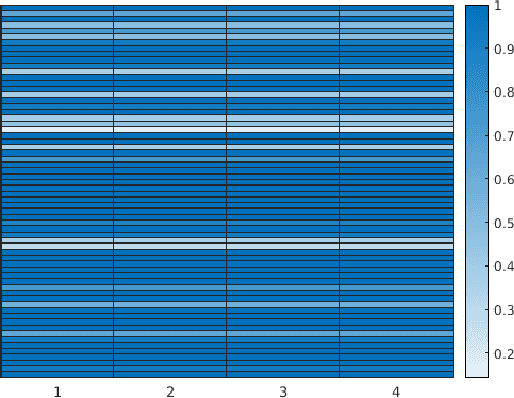
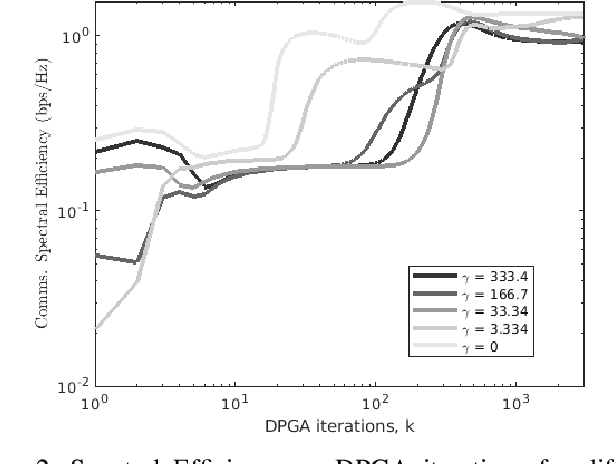
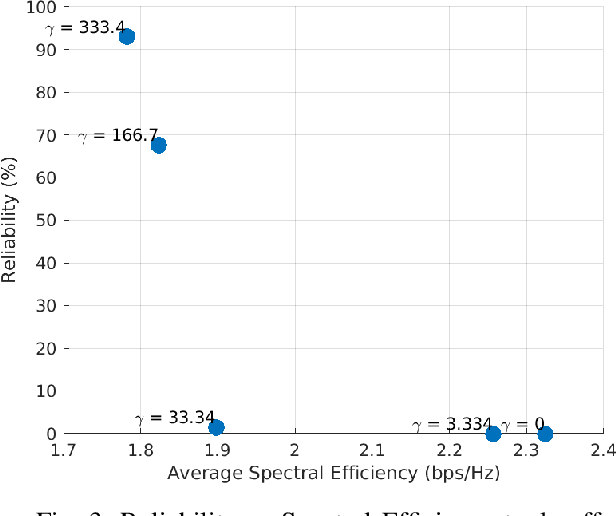
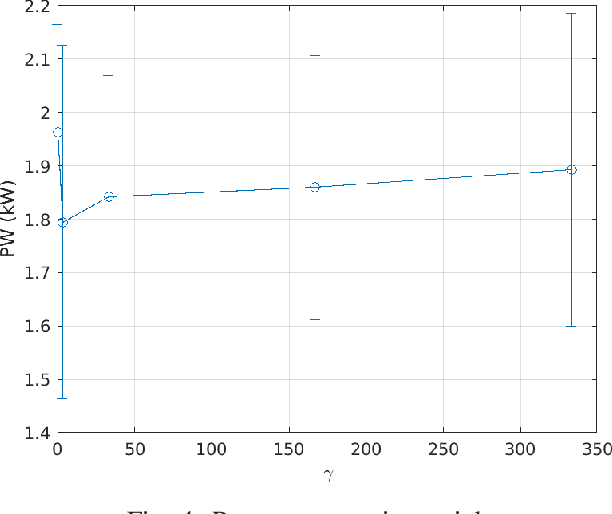
This paper addresses the optimisation challenges in Ultra-Massive MIMO communication systems, focusing on array selection and beamforming in dynamic and diverse operational contexts. We introduce a novel array selection criterion that incorporates antenna health information into the optimisation process, distinguishing our approach from traditional methods. Our methodology employs dual proximal-gradient ascent to effectively tackle the constrained non-convex and non-smooth nature of sparse array selection problems. A central feature of our strategy is the implementation of proportional fairness among communication users, aligning with system resource limitations while ensuring minimum rate requirements for all users. This approach not only enhances system efficiency and responsiveness but also ensures equitable resource distribution. Extensive simulations validate the effectiveness of the proposed solutions in optimising Ultra-Massive MIMO system performance, demonstrating their applicability in complex communication scenarios. Our findings reveal key trade-offs influenced by the sparsity promotion weight ({\gamma}). As {\gamma} increases, spectral efficiency (SE) and communication rate (Ri) decrease, while beamforming matrix density (BMD) reduces and antenna reliability (RL) significantly improves. These results highlight the critical balance between performance and reliability, essential for the practical deployment of Ultra-Massive MIMO systems. This work advances the field by providing innovative solutions and new insights into array selection and beamforming optimization, setting a foundation for future research in Ultra-Massive MIMO communication systems.
Reconfigurable FPGA-Based Solvers For Sparse Satellite Control
Jun 01, 2024


This paper introduces a novel reconfigurable and power-efficient FPGA (Field-Programmable Gate Array) implementation of an operator splitting algorithm for Non-Terrestial Network's (NTN) relay satellites model predictive orientation control (MPC). Our approach ensures system stability and introduces an innovative reconfigurable bit-width FPGA-based optimization solver. To demonstrate its efficacy, we employ a real FPGA-In-the-Loop hardware setup to control simulated satellite dynamics. Furthermore, we conduct an in-depth comparative analysis, examining various fixed-point configurations to evaluate the combined system's closed-loop performance and power efficiency, providing a holistic understanding of the proposed implementation's advantages.
Improved Convergence Bounds For Operator Splitting Algorithms With Rare Extreme Errors
Jul 04, 2023In this paper, we improve upon our previous work[24,22] and establish convergence bounds on the objective function values of approximate proximal-gradient descent (AxPGD), approximate accelerated proximal-gradient descent (AxAPGD) and approximate proximal ADMM (AxWLM-ADMM) schemes. We consider approximation errors that manifest rare extreme events and we propagate their effects through iterations. We establish probabilistic asymptotic and non-asymptotic convergence bounds as functions of the range (upper/lower bounds) and variance of approximation errors. We use the derived bound to assess AxPGD in a sparse model predictive control of a spacecraft system and compare its accuracy with previously derived bounds.
A Low-Power Hardware-Friendly Optimisation Algorithm With Absolute Numerical Stability and Convergence Guarantees
Jun 29, 2023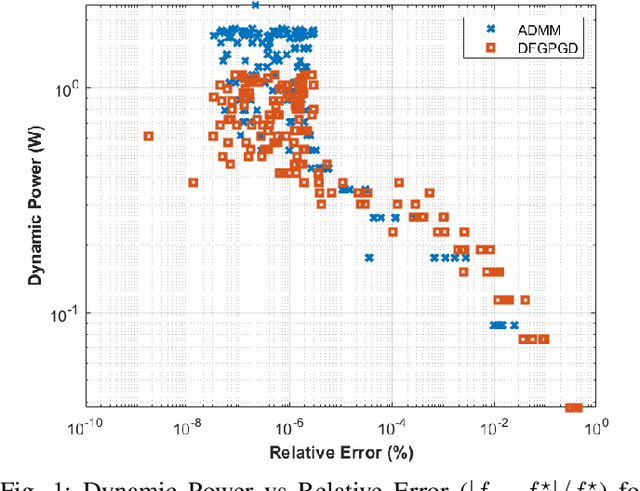

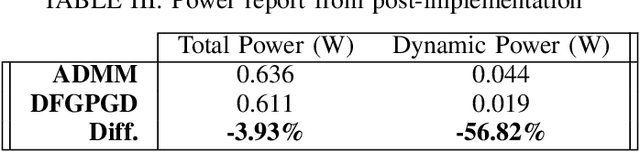
We propose Dual-Feedback Generalized Proximal Gradient Descent (DFGPGD) as a new, hardware-friendly, operator splitting algorithm. We then establish convergence guarantees under approximate computational errors and we derive theoretical criteria for the numerical stability of DFGPGD based on absolute stability of dynamical systems. We also propose a new generalized proximal ADMM that can be used to instantiate most of existing proximal-based composite optimization solvers. We implement DFGPGD and ADMM on FPGA ZCU106 board and compare them in light of FPGA's timing as well as resource utilization and power efficiency. We also perform a full-stack, application-to-hardware, comparison between approximate versions of DFGPGD and ADMM based on dynamic power/error rate trade-off, which is a new hardware-application combined metric.