 Add to Chrome
 Add to Firefox
 Add to Edge
Breaking the Ice: Analyzing Cold Start Latency in vLLM
Jun 05, 2026
As scalable inference services become popular, the cold start latency of an inference engine becomes important. Today, vLLM has evolved into the de facto inference engine of choice for many inference workloads. Although popular, due to its complexity and rapid evolution, there has not been a systematic study of its startup latency. With major architectural innovations such as the V1 API and the introduction of torch.compile, this paper presents the first detailed performance characterization of vLLM startup latency. We break down the startup process into six foundational steps and demonstrate that it is predominantly CPU bound. Each step exhibits consistent and interpretable scaling trends with respect to model-level and system-level parameters, enabling fine-grained attribution of latency sources. Building on these insights, we develop a lightweight analytical model that accurately predicts vLLM startup latency for a given hardware configuration, providing actionable guidance for resource planning in large-scale inference environments. All benchmarking datasets, analysis tools, and prediction scripts are open sourced at https://github.com/upb-cn/vllm-startup-profiler.

Exploring GPU-to-GPU Communication: Insights into Supercomputer Interconnects
Aug 26, 2024


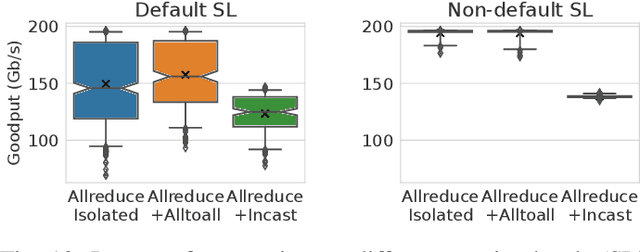
Multi-GPU nodes are increasingly common in the rapidly evolving landscape of exascale supercomputers. On these systems, GPUs on the same node are connected through dedicated networks, with bandwidths up to a few terabits per second. However, gauging performance expectations and maximizing system efficiency is challenging due to different technologies, design options, and software layers. This paper comprehensively characterizes three supercomputers - Alps, Leonardo, and LUMI - each with a unique architecture and design. We focus on performance evaluation of intra-node and inter-node interconnects on up to 4096 GPUs, using a mix of intra-node and inter-node benchmarks. By analyzing its limitations and opportunities, we aim to offer practical guidance to researchers, system architects, and software developers dealing with multi-GPU supercomputing. Our results show that there is untapped bandwidth, and there are still many opportunities for optimization, ranging from network to software optimization.