 Add to Chrome
 Add to Firefox
 Add to Edge
Raising Bars, Not Parameters: LilMoo Compact Language Model for Hindi
Mar 03, 2026
The dominance of large multilingual foundation models has widened linguistic inequalities in Natural Language Processing (NLP), often leaving low-resource languages underrepresented. This paper introduces LilMoo, a 0.6-billion-parameter Hindi language model trained entirely from scratch to address this gap. Unlike prior Hindi models that rely on continual pretraining from opaque multilingual foundations, LilMoo is developed through a fully transparent and reproducible pipeline optimized for limited compute environments. We construct a high-quality Hindi corpus (GigaLekh) filtered through both heuristic and learned (LLM-as-a-judge) methods, complemented by bilingual augmentation with curated English data. Using this dataset, we explore various training recipes for small-scale language models. Across comprehensive evaluation suites, LilMoo consistently outperforms comparably sized multilingual baselines such as Qwen2.5-0.5B and Qwen3-0.6B, demonstrating that well-designed language-specific pretraining can rival large multilingual models at the sub-billion-parameter range.

Tucano 2 Cool: Better Open Source LLMs for Portuguese
Mar 03, 2026We present Tucano 2, a fully open suite of large language models (LLMs) with 0.5-3.7 billion parameters, designed to address certain gaps in open-source development for Portuguese LLMs. Following our previous works, we now extend our dataset, GigaVerbo-v2, to a new degree of quality and scale, while also introducing a new synthetic dataset, GigaVerbo-v2 Synth, aimed at filling missing gaps in GigaVerbo-v2, and two post-training datasets, GigaVerbo-v2 SFT and GigaVerbo-v2 Preferences, that allow Portuguese LLMs to be trained in domains like retrieval augmented generation, coding, tool use, chain-of-thought reasoning, and many other domains of interest. Through extensive ablation studies, we design both pretraining and continual pretraining recipes for the Tucano 2 suite (Base, Instruct, and Think), which achieve state-of-the-art performance on several Portuguese-language modeling benchmarks. We also extend and refine the evaluation harness introduced in our earlier work, yielding a comprehensive evaluation suite that provides strong signals across different pretraining, continual pretraining, and post-training regimes. All artifacts associated with Tucano 2 are openly released, including training recipes, logs, and source code, ensuring that our work is reproducible, accessible, and extendable by the broader Portuguese NLP community.
Tucano: Advancing Neural Text Generation for Portuguese
Nov 12, 2024Significant advances have been made in natural language processing in recent years. However, our current deep learning approach to language modeling requires substantial resources in terms of data and computation. One of the side effects of this data-hungry paradigm is the current schism between languages, separating those considered high-resource, where most of the development happens and resources are available, and the low-resource ones, which struggle to attain the same level of performance and autonomy. This study aims to introduce a new set of resources to stimulate the future development of neural text generation in Portuguese. In this work, we document the development of GigaVerbo, a concatenation of deduplicated Portuguese text corpora amounting to 200 billion tokens. Via this corpus, we trained a series of decoder-transformers named Tucano. Our models perform equal or superior to other Portuguese and multilingual language models of similar size in several Portuguese benchmarks. The evaluation of our models also reveals that model performance on many currently available benchmarks used by the Portuguese NLP community has little to no correlation with the scaling of token ingestion during training, highlighting the limitations of such evaluations when it comes to the assessment of Portuguese generative language models. All derivatives of our study are openly released on GitHub and Hugging Face. See https://nkluge-correa.github.io/Tucano/
TeenyTinyLlama: open-source tiny language models trained in Brazilian Portuguese
Jan 30, 2024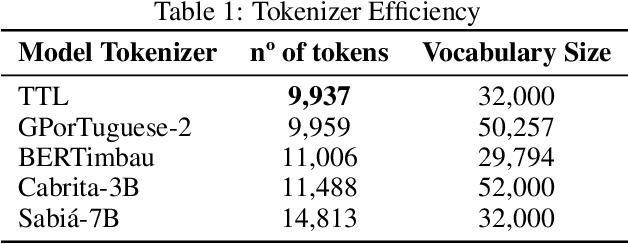
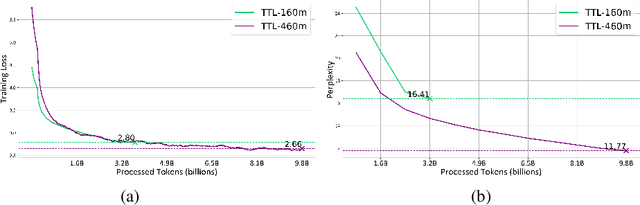

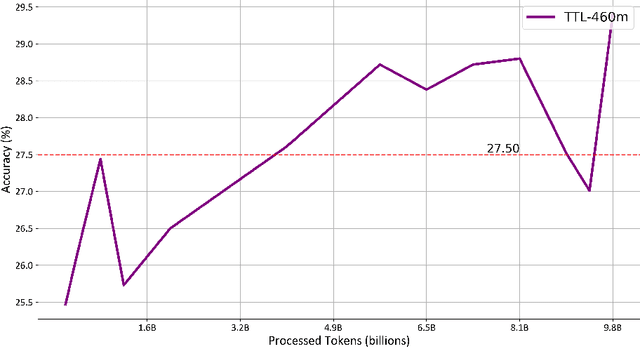
Large language models (LLMs) have significantly advanced natural language processing, but their progress has yet to be equal across languages. While most LLMs are trained in high-resource languages like English, multilingual models generally underperform monolingual ones. Additionally, aspects of their multilingual foundation sometimes restrict the byproducts they produce, like computational demands and licensing regimes. In this study, we document the development of open-foundation models tailored for use in low-resource settings, their limitations, and their benefits. This is the TeenyTinyLlama pair: two compact models for Brazilian Portuguese text generation. We release them under the permissive Apache 2.0 license on GitHub and Hugging Face for community use and further development. See https://github.com/Nkluge-correa/TeenyTinyLlama