 Add to Chrome
 Add to Firefox
 Add to Edge
PGE-SAM: Prompt-Guided Feature Enhancement for Interactive Segmentation under Degradation
Jun 29, 2026
Segment Anything Model (SAM) has revolutionized promptable image segmentation with strong zero-shot generalization. However, its performance degrades substantially under real-world imaging artifacts such as noise, blur, and compression. Existing methods restore features globally without focusing on segmentation-relevant regions and neglect SAM's iterative refinement mechanism, leading to suboptimal performance in interactive settings. We propose Prompt-Guided Feature Enhancement SAM (PGE-SAM), a framework that explicitly leverages user prompts and prior mask predictions to spatially guide the feature restoration process toward regions of interest through a Prompt Guidance Generator. To recover fine-grained details lost under degradation, we introduce Multi-Scale Features Interaction to incorporate low-level encoder features, along with a Foreground Reconstruction Loss that restricts feature-level supervision to the segmentation target. Furthermore, we present DM-Seg, a benchmark for interactive segmentation on degraded medical images, spanning multiple imaging modalities with both general and modality-specific degradations at varying severity levels. Extensive experiments demonstrate that PGE-SAM achieves SOTA robustness on both medical and natural image domains across multiple degradation levels, while maintaining generalization to clean images and adding less than one-fifth of the parameters of prior methods.

Conversation Understanding using Relational Temporal Graph Neural Networks with Auxiliary Cross-Modality Interaction
Nov 08, 2023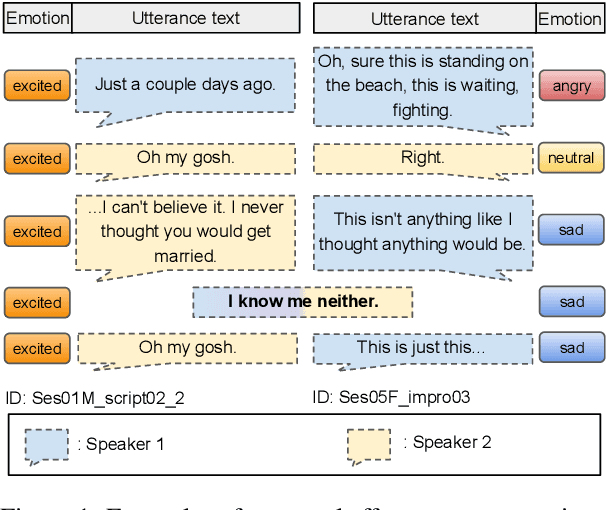
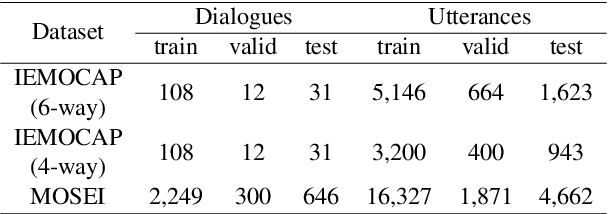
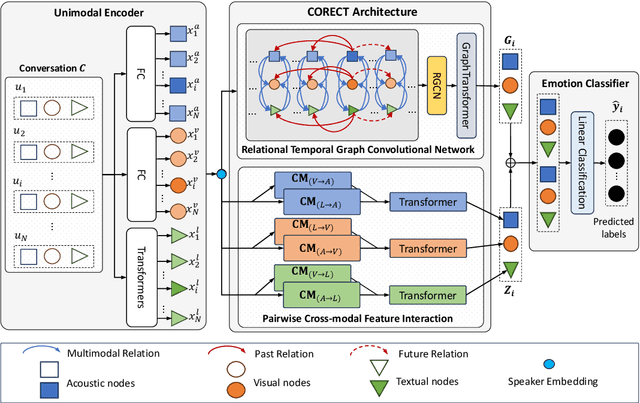
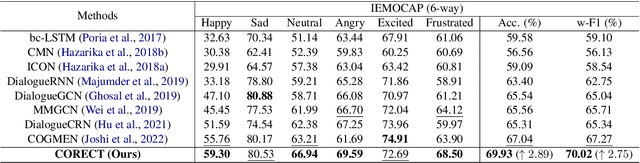
Emotion recognition is a crucial task for human conversation understanding. It becomes more challenging with the notion of multimodal data, e.g., language, voice, and facial expressions. As a typical solution, the global- and the local context information are exploited to predict the emotional label for every single sentence, i.e., utterance, in the dialogue. Specifically, the global representation could be captured via modeling of cross-modal interactions at the conversation level. The local one is often inferred using the temporal information of speakers or emotional shifts, which neglects vital factors at the utterance level. Additionally, most existing approaches take fused features of multiple modalities in an unified input without leveraging modality-specific representations. Motivating from these problems, we propose the Relational Temporal Graph Neural Network with Auxiliary Cross-Modality Interaction (CORECT), an novel neural network framework that effectively captures conversation-level cross-modality interactions and utterance-level temporal dependencies with the modality-specific manner for conversation understanding. Extensive experiments demonstrate the effectiveness of CORECT via its state-of-the-art results on the IEMOCAP and CMU-MOSEI datasets for the multimodal ERC task.