 Add to Chrome
 Add to Firefox
 Add to Edge
Bayesian Experimental Design via Score Matching
Jul 09, 2026
Policy-based approaches to Bayesian experimental design (BED) allow the learning of deep policy networks that adaptively make intelligent design decisions based on previously collected data. However, the training of such policies is often held back by a fundamental challenge: the double intractability of the expected information gain (EIG). This necessitates expensive or complex approximations that restrict the effort one can invest in optimising the policy itself. To address this, we show that the double intractability of the EIG can be isolated from the policy learning by first solving a score matching problem that is independent of the policy used, then using the learned score approximation to train the policy in a singly intractable manner. This turns the key multiplicative cost into an additive one and reduces the computational burden on the policy training itself, making it far cheaper to train the policy multiple times when needed, e.g. for architecture search, hyperparameter tuning, or avoiding local optima. In our experiments we train multiple competitive policies without inducing a multiplicative cost in likelihood evaluations, which can increase performance by allowing us to select the best policy even without performing hyperparameter or architecture searches.

Action-BED: Task-Driven Bayesian Experimental Design with Singly Intractable Objectives
Jun 22, 2026Bayesian experimental design (BED) has traditionally been based on maximising expected uncertainty reductions from prior to posterior. A major shortfall of this approach is that it leads to doubly intractable objectives that are difficult to optimise, while customising them to particular downstream tasks of interest can also be difficult. Following first principles decision theory, we demonstrate that BED can alternatively be formulated in terms of an expected future loss (EFL) on downstream actions, providing a simple and naturally task-driven framework. Critically, we then show that all such EFLs can be rearranged into singly intractable objectives that can be jointly optimised with respect to both the design policy and a downstream action policy using stochastic gradients, an approach we refer to as ACTION-BED. This formulation further sidesteps the need for any explicit posterior or marginal likelihood estimation and is naturally implicit, requiring only the ability to sample from the joint model over model parameters and data, and evaluate the downstream loss function. It thus allows design policies to be learned more effectively, efficiently, and simply than existing methods, while providing easy customisation to different downstream tasks and losses.
Particle Denoising Diffusion Sampler
Feb 09, 2024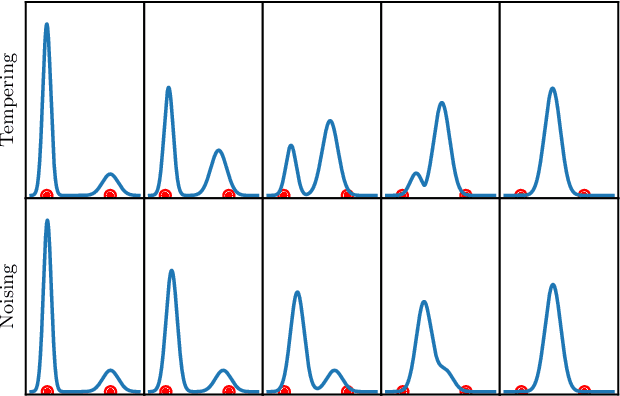
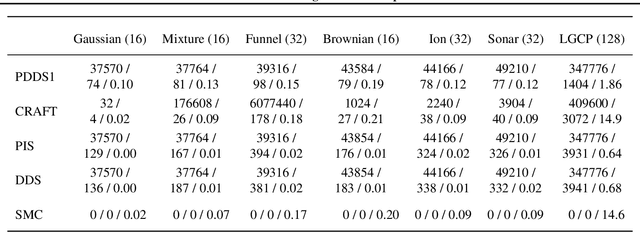
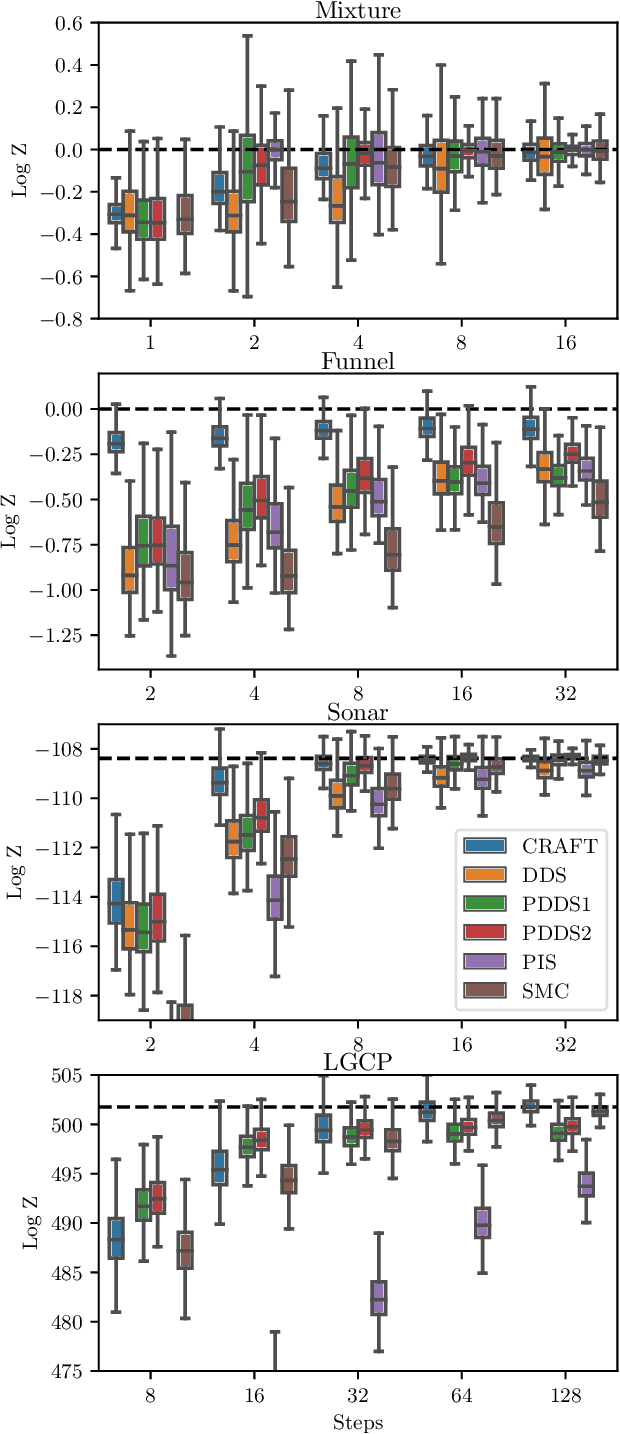
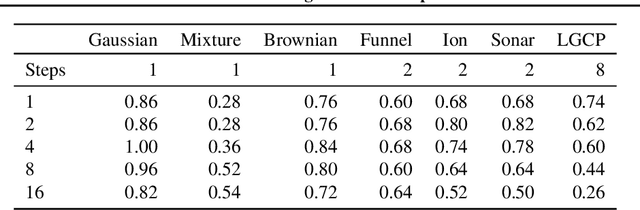
Denoising diffusion models have become ubiquitous for generative modeling. The core idea is to transport the data distribution to a Gaussian by using a diffusion. Approximate samples from the data distribution are then obtained by estimating the time-reversal of this diffusion using score matching ideas. We follow here a similar strategy to sample from unnormalized probability densities and compute their normalizing constants. However, the time-reversed diffusion is here simulated by using an original iterative particle scheme relying on a novel score matching loss. Contrary to standard denoising diffusion models, the resulting Particle Denoising Diffusion Sampler (PDDS) provides asymptotically consistent estimates under mild assumptions. We demonstrate PDDS on multimodal and high dimensional sampling tasks.
Spectral Diffusion Processes
Sep 28, 2022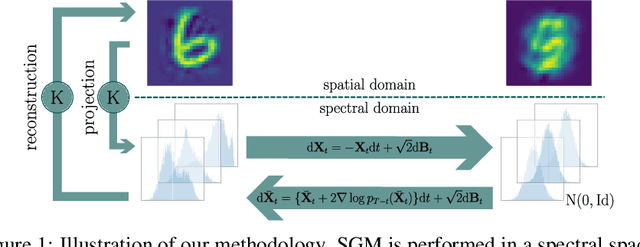
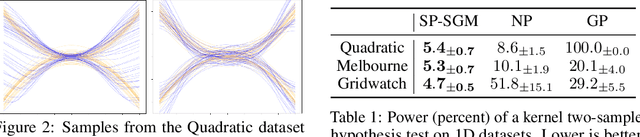
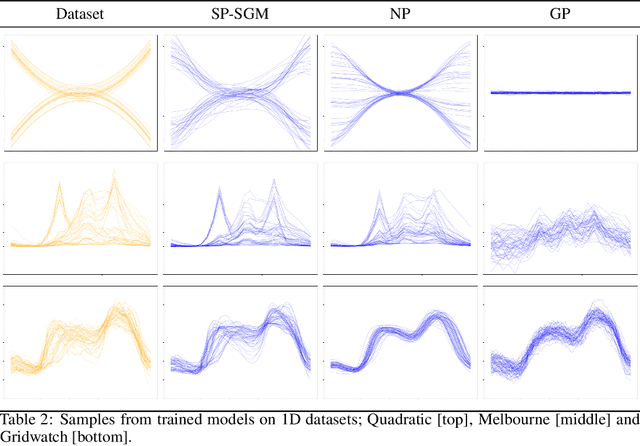

Score-based generative modelling (SGM) has proven to be a very effective method for modelling densities on finite-dimensional spaces. In this work we propose to extend this methodology to learn generative models over functional spaces. To do so, we represent functional data in spectral space to dissociate the stochastic part of the processes from their space-time part. Using dimensionality reduction techniques we then sample from their stochastic component using finite dimensional SGM. We demonstrate our method's effectiveness for modelling various multimodal datasets.