 Add to Chrome
 Add to Firefox
 Add to Edge
Scan-Adaptive Dynamic MRI Undersampling Using a Dictionary of Efficiently Learned Patterns
Feb 17, 2026
Cardiac MRI is limited by long acquisition times, which can lead to patient discomfort and motion artifacts. We aim to accelerate Cartesian dynamic cardiac MRI by learning efficient, scan-adaptive undersampling patterns that preserve diagnostic image quality. We develop a learning-based framework for designing scan- or slice-adaptive Cartesian undersampling masks tailored to dynamic cardiac MRI. Undersampling patterns are optimized using fully sampled training dynamic time-series data. At inference time, a nearest-neighbor search in low-frequency $k$-space selects an optimized mask from a dictionary of learned patterns. Our learned sampling approach improves reconstruction quality across multiple acceleration factors on public and in-house cardiac MRI datasets, including PSNR gains of 2-3 dB, reduced NMSE, improved SSIM, and higher radiologist ratings. The proposed scan-adaptive sampling framework enables faster and higher-quality dynamic cardiac MRI by adapting $k$-space sampling to individual scans.

Patient-Adaptive and Learned MRI Data Undersampling Using Neighborhood Clustering
Dec 13, 2023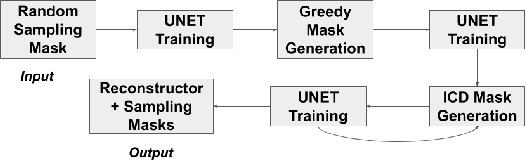

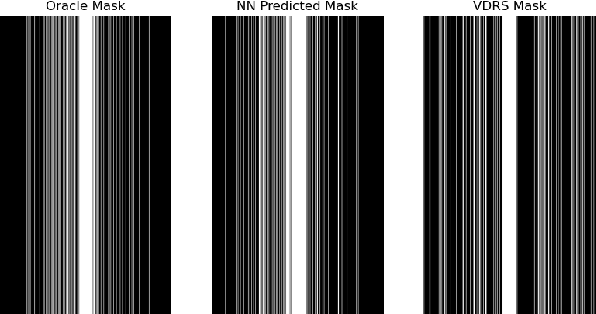
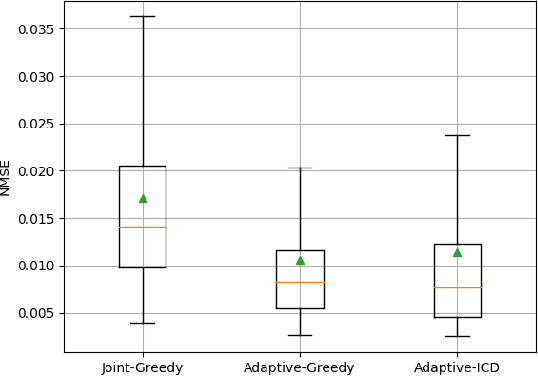
There has been much recent interest in adapting undersampled trajectories in MRI based on training data. In this work, we propose a novel patient-adaptive MRI sampling algorithm based on grouping scans within a training set. Scan-adaptive sampling patterns are optimized together with an image reconstruction network for the training scans. The training optimization alternates between determining the best sampling pattern for each scan (based on a greedy search or iterative coordinate descent (ICD)) and training a reconstructor across the dataset. The eventual scan-adaptive sampling patterns on the training set are used as labels to predict sampling design using nearest neighbor search at test time. The proposed algorithm is applied to the fastMRI knee multicoil dataset and demonstrates improved performance over several baselines.