 Add to Chrome
 Add to Firefox
 Add to Edge
The Energy Footprint of LLM-Based Environmental Analysis: LLMs and Domain Products
Mar 31, 2026
As large language models (LLMs) are increasingly used in domain-specific applications, including climate change and environmental research, understanding their energy footprint has become an important concern. The growing adoption of retrieval-augmented (RAG) systems for climate-domain specific analysis raises a key question: how does the energy consumption of domain-specific RAG workflows compare with that of direct generic LLM usage? Prior research has focused on standalone model calls or coarse token-based estimates, while leaving the energy implications of deployed application workflows insufficiently understood. In this paper, we assess the inference-time energy consumption of two LLM-based climate analysis chatbots (ChatNetZero and ChatNDC) compared to the generic GPT-4o-mini model. We estimate energy use under actual user queries by decomposing each workflow into retrieval, generation, and hallucination-checking components. We also test across different times of day and geographic access locations. Our results show that the energy consumption of domain-specific RAG systems depends strongly on their design. More agentic pipelines substantially increase inference-time energy use, particularly when used for additional accuracy or verification checks, although they may not yield proportional gains in response quality. While more research is needed to further test these initial findings more robustly across models, environments and prompting structures, this study provides a new understanding on how the design of domain-specific LLM products affects both the energy footprint and quality of output.

How are cities pledging net zero? A computational approach to analyzing subnational climate strategies
Dec 14, 2021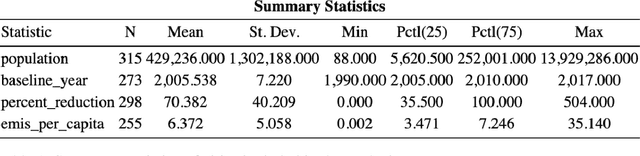
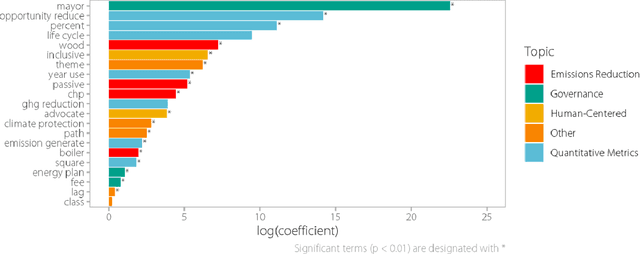
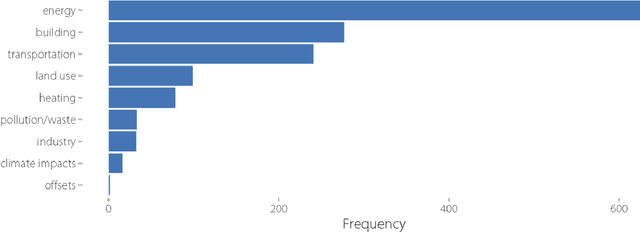
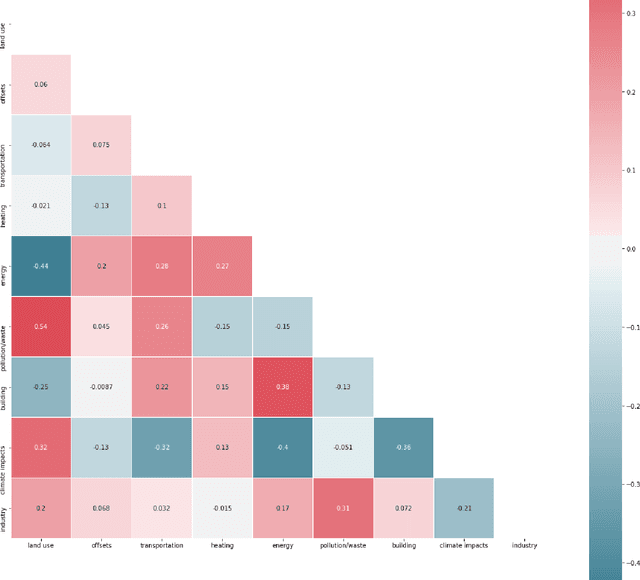
Cities have become primary actors on climate change and are increasingly setting goals aimed at net-zero emissions. The rapid proliferation of subnational governments "racing to zero" emissions and articulating their own climate mitigation plans warrants closer examination to understand how these actors intend to meet these goals. The scattered, incomplete and heterogeneous nature of city climate policy documents, however, has made their systemic analysis challenging. We analyze 318 climate action documents from cities that have pledged net-zero targets or joined a transnational climate initiative with this goal using machine learning-based natural language processing (NLP) techniques. We use these approaches to accomplish two primary goals: 1) determine text patterns that predict "ambitious" net-zero targets, where we define an ambitious target as one that encompasses a subnational government's economy-wide emissions; and 2) perform a sectoral analysis to identify patterns and trade-offs in climate action themes (i.e., land-use, industry, buildings, etc.). We find that cities that have defined ambitious climate actions tend to emphasize quantitative metrics and specific high-emitting sectors in their plans, supported by mentions of governance and citizen participation. Cities predominantly emphasize energy-related actions in their plans, particularly in the buildings, transport and heating sectors, but often at the expense of other sectors, including land-use and climate impacts. The method presented in this paper provides a replicable, scalable approach to analyzing climate action plans and a first step towards facilitating cross-city learning.