 Add to Chrome
 Add to Firefox
 Add to Edge
Vision Tiny Recursion Model (ViTRM): Parameter-Efficient Image Classification via Recursive State Refinement
Mar 19, 2026
The success of deep learning in computer vision has been driven by models of increasing scale, from deep Convolutional Neural Networks (CNN) to large Vision Transformers (ViT). While effective, these architectures are parameter-intensive and demand significant computational resources, limiting deployment in resource-constrained environments. Inspired by Tiny Recursive Models (TRM), which show that small recursive networks can solve complex reasoning tasks through iterative state refinement, we introduce the \textbf{Vision Tiny Recursion Model (ViTRM)}: a parameter-efficient architecture that replaces the $L$-layer ViT encoder with a single tiny $k$-layer block ($k{=}3$) applied recursively $N$ times. Despite using up to $6 \times $ and $84 \times$ fewer parameters than CNN based models and ViT respectively, ViTRM maintains competitive performance on CIFAR-10 and CIFAR-100. This demonstrates that recursive computation is a viable, parameter-efficient alternative to architectural depth in vision.

Generating Tabular Data Using Heterogeneous Sequential Feature Forest Flow Matching
Oct 20, 2024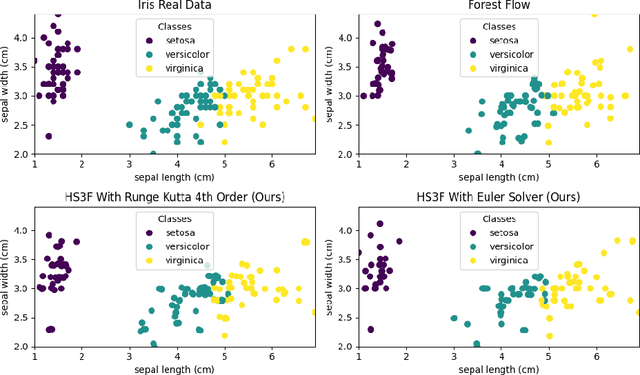

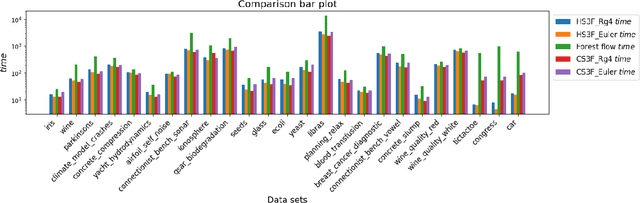

Privacy and regulatory constraints make data generation vital to advancing machine learning without relying on real-world datasets. A leading approach for tabular data generation is the Forest Flow (FF) method, which combines Flow Matching with XGBoost. Despite its good performance, FF is slow and makes errors when treating categorical variables as one-hot continuous features. It is also highly sensitive to small changes in the initial conditions of the ordinary differential equation (ODE). To overcome these limitations, we develop Heterogeneous Sequential Feature Forest Flow (HS3F). Our method generates data sequentially (feature-by-feature), reducing the dependency on noisy initial conditions through the additional information from previously generated features. Furthermore, it generates categorical variables using multinomial sampling (from an XGBoost classifier) instead of flow matching, improving generation speed. We also use a Runge-Kutta 4th order (Rg4) ODE solver for improved performance over the Euler solver used in FF. Our experiments with 25 datasets reveal that HS3F produces higher quality and more diverse synthetic data than FF, especially for categorical variables. It also generates data 21-27 times faster for datasets with $\geq20%$ categorical variables. HS3F further demonstrates enhanced robustness to affine transformation in flow ODE initial conditions compared to FF. This study not only validates the HS3F but also unveils promising new strategies to advance generative models.