 Add to Chrome
 Add to Firefox
 Add to Edge
Topological Data Analysis for High-Dimensional Dynamic Process Monitoring
Jun 18, 2026
Real-time process monitoring requires methods that extract actionable information from high-dimensional time-series data. In this work, we present a new approach for process monitoring that combines tools of topological data analysis (TDA) and machine learning. In the proposed approach, we represent multivariate time-series data as manifolds and use topological descriptors to summarize the structure of such data; we then use a neural ordinary differential equation to learn the dynamic evolution of the topological structure of the system. Using real data from an industrial process, we show that this trajectory-based event detection approach is effective at detecting diverse types of events. We contrast this approach against reconstruction-based approaches such as principal component analysis and autoencoders and against a trajectory-based approach that uses Koopman autoencoders.

Physics-Constrained Machine Learning for Chemical Engineering
Aug 28, 2025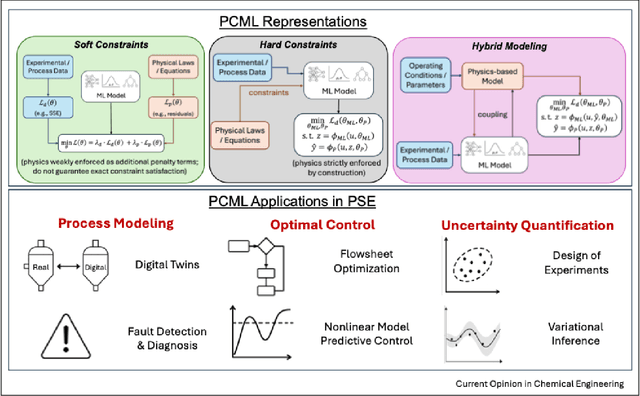
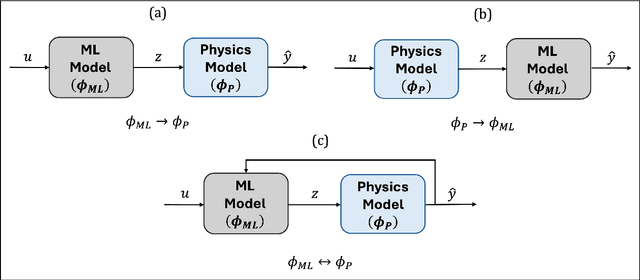
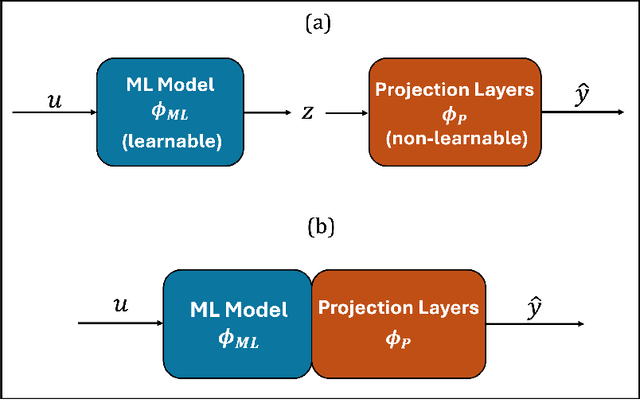
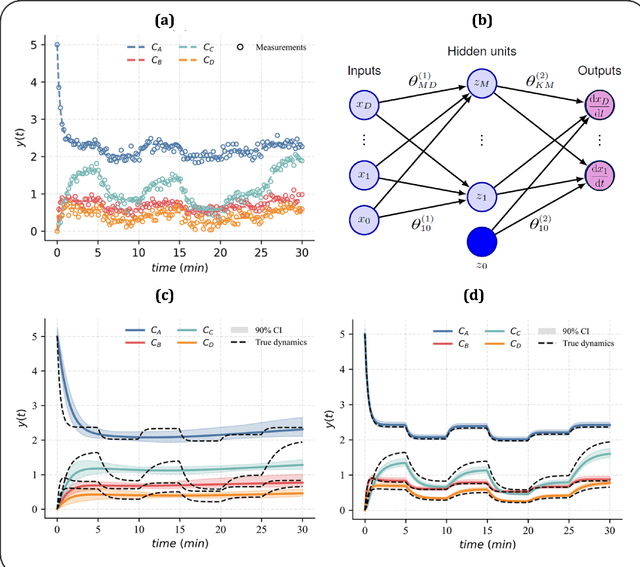
Physics-constrained machine learning (PCML) combines physical models with data-driven approaches to improve reliability, generalizability, and interpretability. Although PCML has shown significant benefits in diverse scientific and engineering domains, technical and intellectual challenges hinder its applicability in complex chemical engineering applications. Key difficulties include determining the amount and type of physical knowledge to embed, designing effective fusion strategies with ML, scaling models to large datasets and simulators, and quantifying predictive uncertainty. This perspective summarizes recent developments and highlights challenges/opportunities in applying PCML to chemical engineering, emphasizing on closed-loop experimental design, real-time dynamics and control, and handling of multi-scale phenomena.