 Add to Chrome
 Add to Firefox
 Add to Edge
Data-Driven Hamiltonian Reduction for Superconducting Qubits via Meta-Learning
Apr 27, 2026
We introduce HAML (Hamiltonian Adaptation via Meta-Learning), a framework for fast online adaptation of effective Hamiltonian models of superconducting quantum processors. HAML proceeds in two phases. A supervised training phase uses an ensemble of simulated devices to learn an offline map from control inputs and device parameters to effective Hamiltonian coefficients. An online adaptation phase then uses a small number of hardware-accessible measurements to identify the unknown parameters of a new device. By training directly against effective two-qubit coefficients extracted from full multi-mode simulations, HAML implicitly learns the reduction from full multi-mode Hamiltonians to effective qubit descriptions without invoking perturbation theory. We further show that a variance-maximizing greedy selection of measurement configurations boosts online adaptation efficiency. We demonstrate HAML on a transmon-coupler-transmon system, recovering effective two-qubit coefficients across a wide range of operating regimes, including parameter regions where Schrieffer-Wolff perturbation theory (SWPT) breaks down. This establishes a scalable, sample-efficient approach to Hamiltonian reduction and characterization for near-term quantum processors, with direct implications for calibration, control, and error mitigation.

Universal Dynamics with Globally Controlled Analog Quantum Simulators
Aug 26, 2025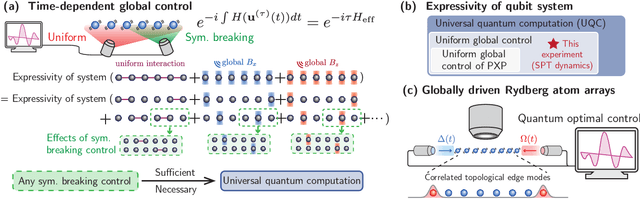
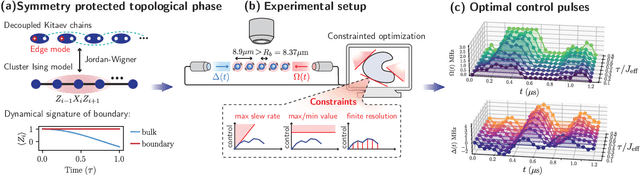
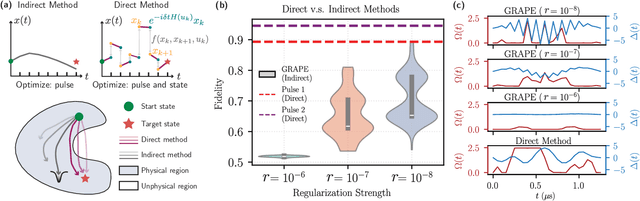
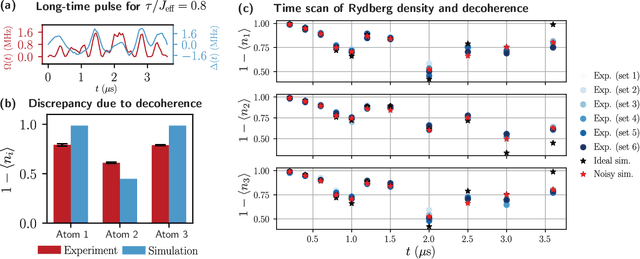
Analog quantum simulators with global control fields have emerged as powerful platforms for exploring complex quantum phenomena. Recent breakthroughs, such as the coherent control of thousands of atoms, highlight the growing potential for quantum applications at scale. Despite these advances, a fundamental theoretical question remains unresolved: to what extent can such systems realize universal quantum dynamics under global control? Here we establish a necessary and sufficient condition for universal quantum computation using only global pulse control, proving that a broad class of analog quantum simulators is, in fact, universal. We further extend this framework to fermionic and bosonic systems, including modern platforms such as ultracold atoms in optical superlattices. Crucially, to connect the theoretical possibility with experimental reality, we introduce a new control technique into the experiment - direct quantum optimal control. This method enables the synthesis of complex effective Hamiltonians and allows us to incorporate realistic hardware constraints. To show its practical power, we experimentally engineer three-body interactions outside the blockade regime and demonstrate topological dynamics on a Rydberg atom array. Using the new control framework, we overcome key experimental challenges, including hardware limitations and atom position fluctuations in the non-blockade regime, by identifying smooth, short-duration pulses that achieve high-fidelity dynamics. Experimental measurements reveal dynamical signatures of symmetry-protected-topological edge modes, confirming both the expressivity and feasibility of our approach. Our work opens a new avenue for quantum simulation beyond native hardware Hamiltonians, enabling the engineering of effective multi-body interactions and advancing the frontier of quantum information processing with globally-controlled analog platforms.