 Add to Chrome
 Add to Firefox
 Add to Edge
From Text to Test: AI-Generated Control Software for Materials Science Instruments
Jun 25, 2024
Large language models (LLMs) are transforming the landscape of chemistry and materials science. Recent examples of LLM-accelerated experimental research include virtual assistants for parsing synthesis recipes from the literature, or using the extracted knowledge to guide synthesis and characterization. Despite these advancements, their application is constrained to labs with automated instruments and control software, leaving much of materials science reliant on manual processes. Here, we demonstrate the rapid deployment of a Python-based control module for a Keithley 2400 electrical source measure unit using ChatGPT-4. Through iterative refinement, we achieved effective instrument management with minimal human intervention. Additionally, a user-friendly graphical user interface (GUI) was created, effectively linking all instrument controls to interactive screen elements. Finally, we integrated this AI-crafted instrument control software with a high-performance stochastic optimization algorithm to facilitate rapid and automated extraction of electronic device parameters related to semiconductor charge transport mechanisms from current-voltage (IV) measurement data. This integration resulted in a comprehensive open-source toolkit for semiconductor device characterization and analysis using IV curve measurements. We demonstrate the application of these tools by acquiring, analyzing, and parameterizing IV data from a Pt/Cr$_2$O$_3$:Mg/$\beta$-Ga$_2$O$_3$ heterojunction diode, a novel stack for high-power and high-temperature electronic devices. This approach underscores the powerful synergy between LLMs and the development of instruments for scientific inquiry, showcasing a path for further acceleration in materials science.

Autonomous sputter synthesis of thin film nitrides with composition controlled by Bayesian optimization of optical plasma emission
May 25, 2023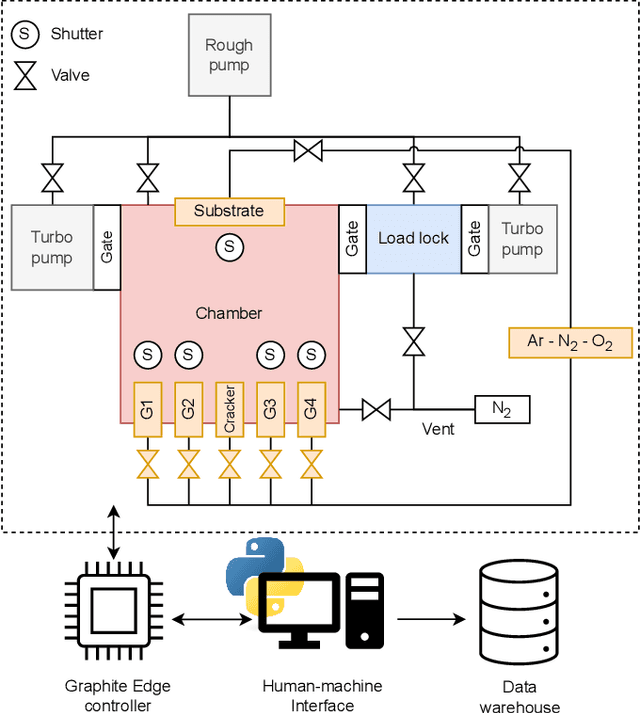
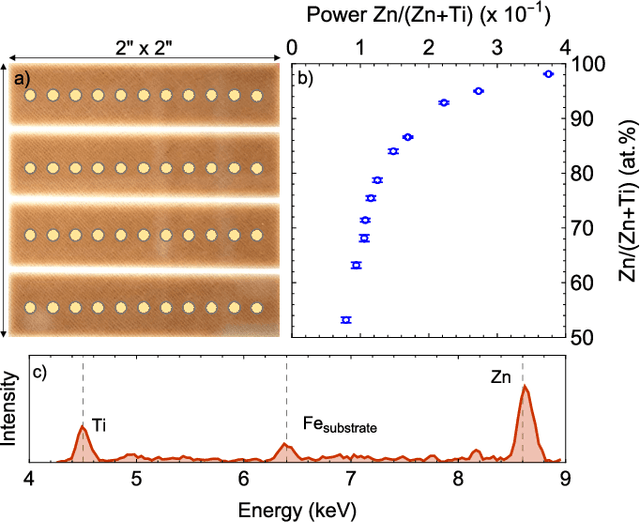
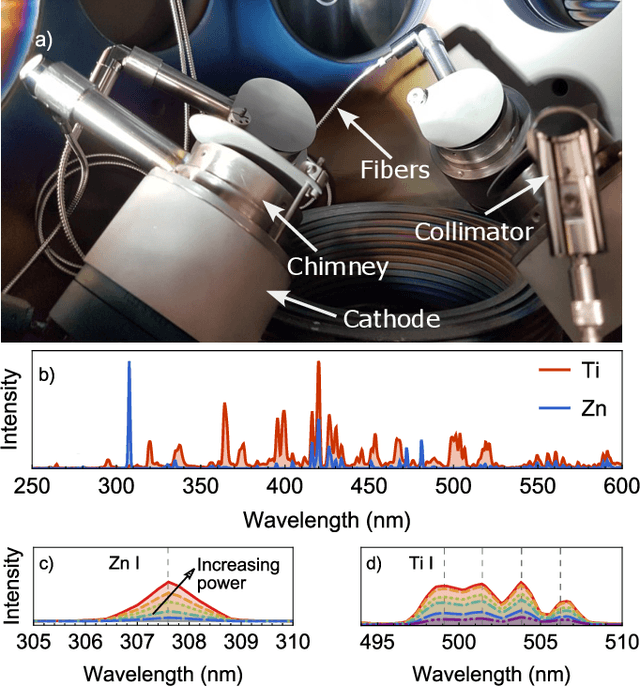
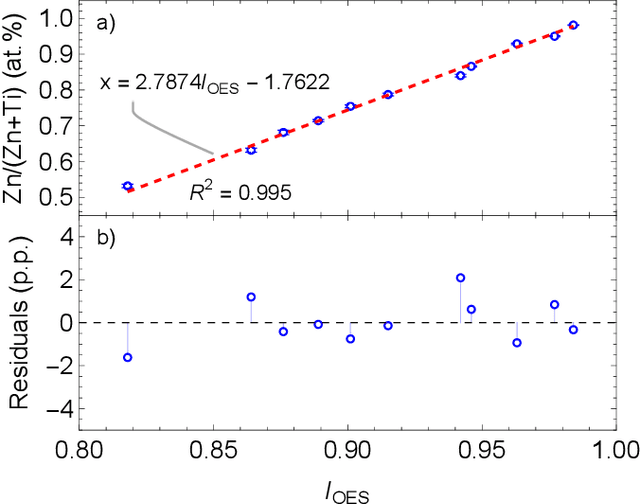
Autonomous experimentation has emerged as an efficient approach to accelerate the pace of materials discovery. Although instruments for autonomous synthesis have become popular in molecular and polymer science, solution processing of hybrid materials and nanoparticles, examples of autonomous tools for physical vapour deposition are scarce yet important for the semiconductor industry. Here, we report the design and implementation of an autonomous instrument for sputter deposition of thin films with controlled composition, leveraging a highly automated sputtering reactor custom-controlled by Python, optical emission spectroscopy (OES), and Bayesian optimization algorithm. We modeled film composition, measured by x-ray fluorescence, as a linear function of emission lines monitored during the co-sputtering from elemental Zn and Ti targets in N$_2$ atmosphere. A Bayesian control algorithm, informed by OES, navigates the space of sputtering power to fabricate films with user-defined composition, by minimizing the absolute error between desired and measured emission signals. We validated our approach by autonomously fabricating Zn$_x$Ti$_{1-x}$N$_y$ films with deviations from the targeted cation composition within relative 3.5 %, even for 15 nm thin films, demonstrating that the proposed approach can reliably synthesize thin films with specific composition and minimal human interference. Moreover, the proposed method can be extended to more difficult synthesis experiments where plasma intensity depends non-linearly on pressure, or the elemental sticking coefficients strongly depend on the substrate temperature.