 Add to Chrome
 Add to Firefox
 Add to Edge
Localizing RL-Induced Tool Use to a Single Crosscoder Feature
Jun 25, 2026
Fine-tuning through RL reshapes the internal representations of language models to enable agentic behaviors such as tool use, yet the mechanistic basis of these changes remains poorly understood. While RL substantially improves structured tool-call generation, it is unclear which features emerge, which are preserved, and whether identified features can be leveraged for retraining-free behavioral control. In this work, we show that $\textit{Dedicated Feature Crosscoders (DFC)}$ isolate a compact set of RL-specific features that mediate tool-calling capability in $\texttt{Qwen2.5-3B}$. Across a $48$-crosscoder hyperparameter sweep, encode-decode reconstruction improves the RL model's tool correctness by $+31.1 \pm {9.7}$ pp and passively transfers tool-calling ability to the frozen base model by $+6.8 \pm 5.0$ pp which we call a $\textit{capability spillover}$. Our findings show that DFC partitioning concentrates RL-introduced capability into a minimal, steerable feature set that enables runtime behavioral control of agentic LLMs.

Paraphrasing Attack Resilience of Various AI-Generated Text Detection Methods
May 14, 2026The recent large-scale emergence of LLMs has left an open space for dealing with their consequences, such as plagiarism or the spread of false information on the Internet. Coupling this with the rise of AI detector bypassing tools, reliable machine-generated text detection is in increasingly high demand. We investigate the paraphrasing attack resilience of various machine-generated text detection methods, evaluating three approaches: fine-tuned RoBERTa, Binoculars, and text feature analysis, along with their ensembles using Random Forest classifiers. We discovered that Binoculars-inclusive ensembles yield the strongest results, but they also suffer the most significant losses during attacks. In this paper, we present the dichotomy of performance versus resilience in the world of AI text detection, which complicates the current perception of reliability among state-of-the-art techniques.
Kolmogorov Complexity Bounds for LLM Steganography and a Perplexity-Based Detection Proxy
Mar 23, 2026Large language models can rewrite text to embed hidden payloads while preserving surface-level meaning, a capability that opens covert channels between cooperating AI systems and poses challenges for alignment monitoring. We study the information-theoretic cost of such embedding. Our main result is that any steganographic scheme that preserves the semantic load of a covertext~$M_1$ while encoding a payload~$P$ into a stegotext~$M_2$ must satisfy $K(M_2) \geq K(M_1) + K(P) - O(\log n)$, where $K$ denotes Kolmogorov complexity and $n$ is the combined message length. A corollary is that any non-trivial payload forces a strict complexity increase in the stegotext, regardless of how cleverly the encoder distributes the signal. Because Kolmogorov complexity is uncomputable, we ask whether practical proxies can detect this predicted increase. Drawing on the classical correspondence between lossless compression and Kolmogorov complexity, we argue that language-model perplexity occupies an analogous role in the probabilistic regime and propose the Binoculars perplexity-ratio score as one such proxy. Preliminary experiments with a color-based LLM steganographic scheme support the theoretical prediction: a paired $t$-test over 300 samples yields $t = 5.11$, $p < 10^{-6}$.
Don't Forget It! Conditional Sparse Autoencoder Clamping Works for Unlearning
Mar 14, 2025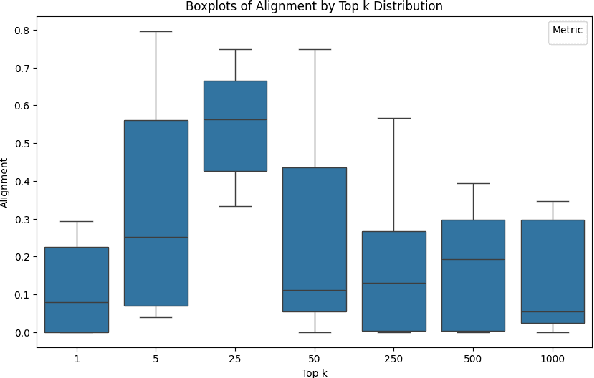

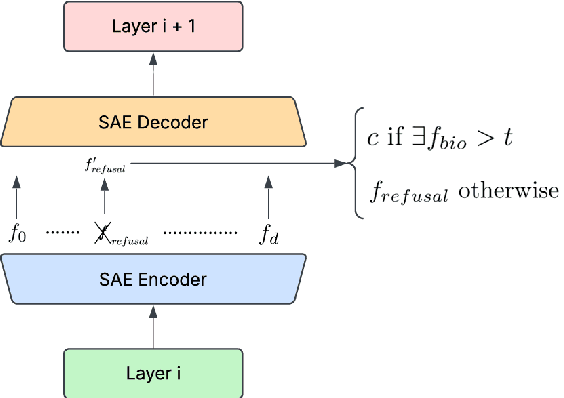

Recent developments in Large Language Model (LLM) capabilities have brought great potential but also posed new risks. For example, LLMs with knowledge of bioweapons, advanced chemistry, or cyberattacks could cause violence if placed in the wrong hands or during malfunctions. Because of their nature as near-black boxes, intuitive interpretation of LLM internals remains an open research question, preventing developers from easily controlling model behavior and capabilities. The use of Sparse Autoencoders (SAEs) has recently emerged as a potential method of unraveling representations of concepts in LLMs internals, and has allowed developers to steer model outputs by directly modifying the hidden activations. In this paper, we use SAEs to identify unwanted concepts from the Weapons of Mass Destruction Proxy (WMDP) dataset within gemma-2-2b internals and use feature steering to reduce the model's ability to answer harmful questions while retaining its performance on harmless queries. Our results bring back optimism to the viability of SAE-based explicit knowledge unlearning techniques.