 Add to Chrome
 Add to Firefox
 Add to Edge
MagPlus: Bridging Micro-to-Regular Facial Expressions through Learnable Magnification
Jun 11, 2026
Facial micro-expressions are subtle and short-lived facial movements that provide important cues about genuine human emotions. However, modeling and generating them remains difficult because annotated micro-expression data is limited and the underlying facial motions are extremely weak. Existing micro-expression generation methods therefore often suffer from limited quality, weak robustness, and poor generalization. We propose MagPlus, a transferable micro-expression processing pipeline that connects micro-expression analysis with standard facial animation models. Instead of training a dedicated generator from scratch, MagPlus learns to magnify subtle facial motions into the range of regular facial expressions, transforming micro-expressions into signals that are compatible with existing facial expression processing models. The magnified sequence is then used by a standard facial expression model for tasks such as transfer and synthesis. A complementary DeMagPlus module then restores the generated motion back to realistic micro-expression intensity levels while preserving the synthesized dynamics. We evaluate the framework using four facial animation models: FOMM, FSRT, MetaPortrait, and EmoPortraits. None of these models are trained on micro-expression data. Experiments show that MagPlus-DeMagPlus enables pretrained macro-expression models to generate more realistic micro-expression motion without retraining the backbones.

SBP-Net: Learning Thin Structure Reconstruction with Sliding-Box Projections
Jun 02, 2026Reconstructing thin 3D structures is challenging due to their sparsity, scale variation, and complex geometry. Such structures arise in a wide range of domains, including medical imaging of vascular systems and industrial pipe systems. While recent neural methods perform well on dense surfaces, they often fail to recover fine thin geometries. We propose a reconstruction approach based on local depth projections, which provide an efficient and informative 2D representation of thin structures. Specifically, we traverse the 3D model with a sliding box to generate local orthographic depth projections, which are processed by a neural network to reconstruct missing thin structures in 2D. The local reconstructions are subsequently fused back into the 3D model to produce a coherent and detailed shape. Experiments on pulmonary artery reconstruction from CT volumes and industrial pipeline recovery from synthetic and real scans demonstrate improved preservation of fine structural details over existing methods.
VNT-Net: Rotational Invariant Vector Neuron Transformers
May 25, 2022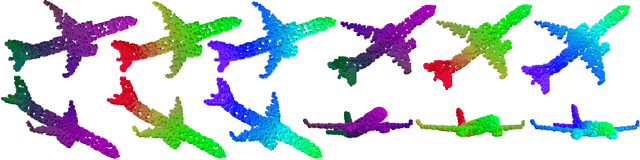
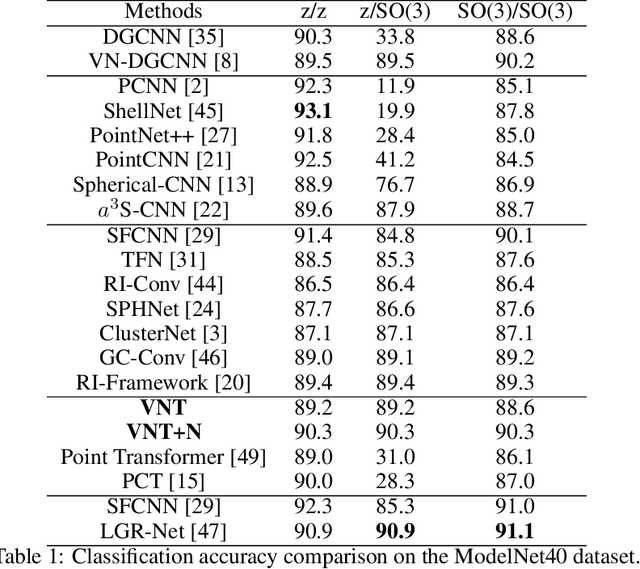
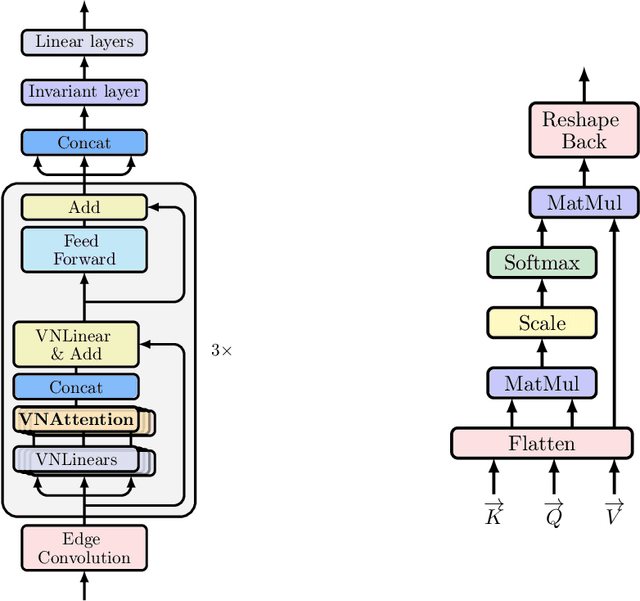
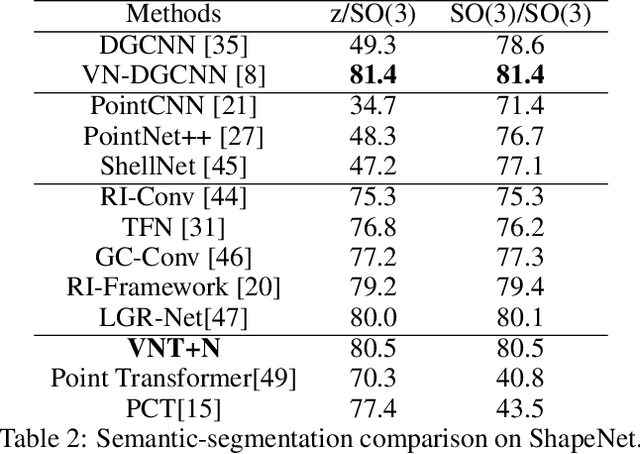
Learning 3D point sets with rotational invariance is an important and challenging problem in machine learning. Through rotational invariant architectures, 3D point cloud neural networks are relieved from requiring a canonical global pose and from exhaustive data augmentation with all possible rotations. In this work, we introduce a rotational invariant neural network by combining recently introduced vector neurons with self-attention layers to build a point cloud vector neuron transformer network (VNT-Net). Vector neurons are known for their simplicity and versatility in representing SO(3) actions and are thereby incorporated in common neural operations. Similarly, Transformer architectures have gained popularity and recently were shown successful for images by applying directly on sequences of image patches and achieving superior performance and convergence. In order to benefit from both worlds, we combine the two structures by mainly showing how to adapt the multi-headed attention layers to comply with vector neurons operations. Through this adaptation attention layers become SO(3) and the overall network becomes rotational invariant. Experiments demonstrate that our network efficiently handles 3D point cloud objects in arbitrary poses. We also show that our network achieves higher accuracy when compared to related state-of-the-art methods and requires less training due to a smaller number of hyperparameters in common classification and segmentation tasks.
Multi-modal 3D Shape Reconstruction Under Calibration Uncertainty using Parametric Level Set Methods
Apr 23, 2019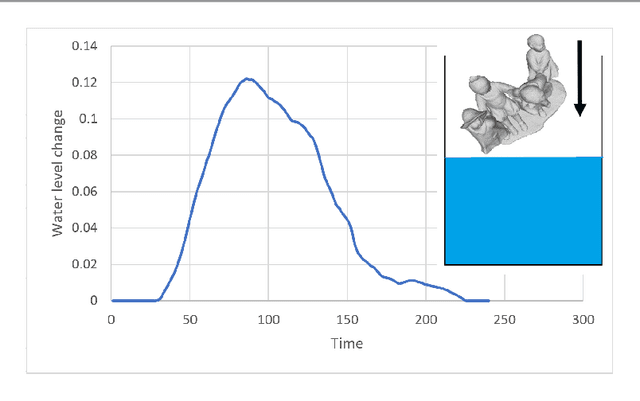
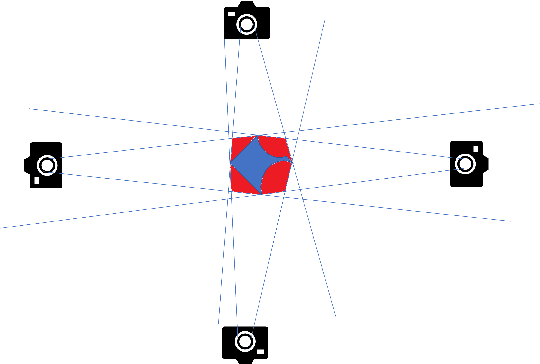
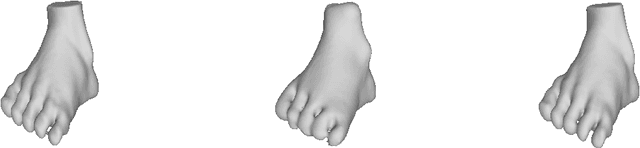
We consider the problem of 3D shape reconstruction from multi-modal data, given uncertain calibration parameters. Typically, 3D data modalities can be in diverse forms such as sparse point sets, volumetric slices, 2D photos and so on. To jointly process these data modalities, we exploit a parametric level set method that utilizes ellipsoidal radial basis functions. This method not only allows us to analytically and compactly represent the object, it also confers on us the ability to overcome calibration related noise that originates from inaccurate acquisition parameters. This essentially implicit regularization leads to a highly robust and scalable reconstruction, surpassing other traditional methods. In our results we first demonstrate the ability of the method to compactly represent complex objects. We then show that our reconstruction method is robust both to a small number of measurements and to noise in the acquisition parameters. Finally, we demonstrate our reconstruction abilities from diverse modalities such as volume slices obtained from liquid displacement (similar to CTscans and XRays), and visual measurements obtained from shape silhouettes.
A Non-linear Differential CNN-Rendering Module for 3D Data Enhancement
Apr 09, 2019
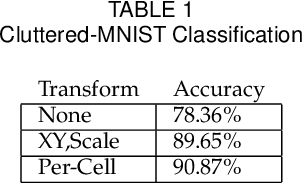
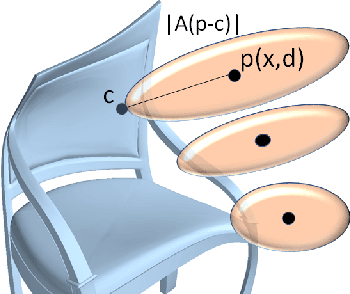
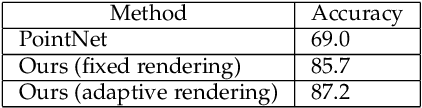
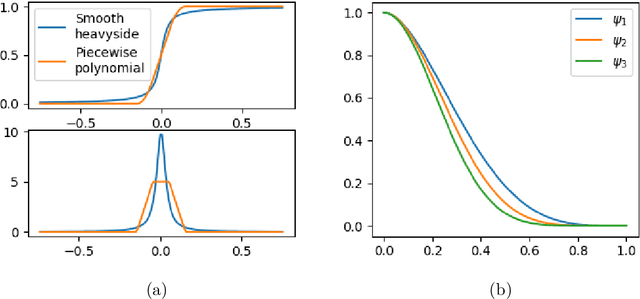
In this work we introduce a differential rendering module which allows neural networks to efficiently process cluttered data. The module is composed of continuous piecewise differentiable functions defined as a sensor array of cells embedded in 3D space. Our module is learnable and can be easily integrated into neural networks allowing to optimize data rendering towards specific learning tasks using gradient based methods in an end-to-end fashion. Essentially, the module's sensor cells are allowed to transform independently and locally focus and sense different parts of the 3D data. Thus, through their optimization process, cells learn to focus on important parts of the data, bypassing occlusions, clutter and noise. Since sensor cells originally lie on a grid, this equals to a highly non-linear rendering of the scene into a 2D image. Our module performs especially well in presence of clutter and occlusions. Similarly, it deals well with non-linear deformations and improves classification accuracy through proper rendering of the data. In our experiments, we apply our module to demonstrate efficient localization and classification tasks in cluttered data both 2D and 3D.