 Add to Chrome
 Add to Firefox
 Add to Edge
CLaC@FinMMEval 2026 Task 3: Sentiment-Augmented Deep Reinforcement Learning for Active Trading -- An Alpha-Reward Approach
Jul 17, 2026
This paper presents our system for Task 3 of the CLEF 2026 FinMMEval Lab, which requires daily long, flat, or short trading decisions for Bitcoin (BTC) and Tesla (TSLA) using news and historical market data. We formulate the problem as a discrete-action Markov Decision Process and compare four deep reinforcement learning algorithms: Policy Gradient (PG), Proximal Policy Optimization (PPO), Deep Q-Learning (DQL), and Deep Deterministic Policy Gradient (DDPG). The agents use technical indicators, cyclical calendar encodings, and daily news sentiment scores produced by LLaMA 3.2 1B. To reduce overfitting and align training with the objective of outperforming buy-and-hold, we introduce an alpha reward based on excess market return and randomize episode start dates. Hyperparameters are optimized with Ray Tune over 180 trials per algorithm-asset pair, with early stopping and model selection based on validation Sharpe ratio. On the CLEF Task 3 test set, DDPG achieves the strongest overall performance. DQL was selected a priori for the live endpoint because it obtained the highest validation Sharpe ratio, with selection performed without access to the test period. For TSLA, DDPG and DQL achieve cumulative returns of 54.96% and 52.62%, respectively, compared with 16.45% for buy-and-hold. For BTC, DDPG achieves a positive return of 1.58% while buy-and-hold declines by -34.27%. The results also reveal a substantial validation-to-test generalization gap, highlighting the difficulty of transferring policies selected in bull-market conditions to a bear-market regime.

Deep Hedging with Market Impact
Feb 22, 2024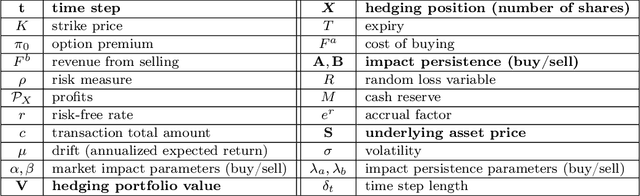
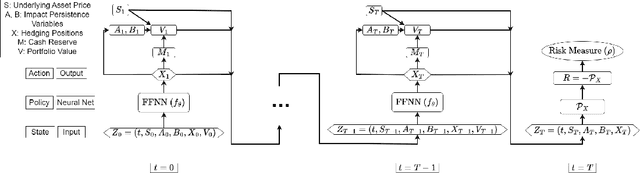
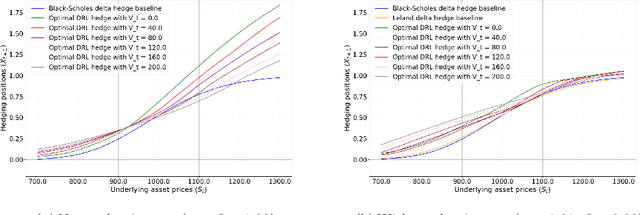
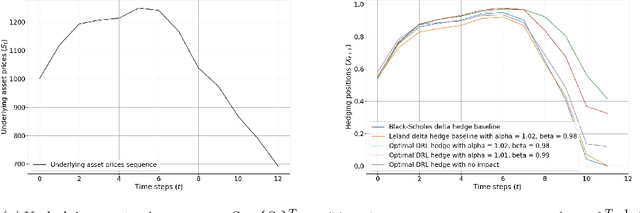
Dynamic hedging is the practice of periodically transacting financial instruments to offset the risk caused by an investment or a liability. Dynamic hedging optimization can be framed as a sequential decision problem; thus, Reinforcement Learning (RL) models were recently proposed to tackle this task. However, existing RL works for hedging do not consider market impact caused by the finite liquidity of traded instruments. Integrating such feature can be crucial to achieve optimal performance when hedging options on stocks with limited liquidity. In this paper, we propose a novel general market impact dynamic hedging model based on Deep Reinforcement Learning (DRL) that considers several realistic features such as convex market impacts, and impact persistence through time. The optimal policy obtained from the DRL model is analysed using several option hedging simulations and compared to commonly used procedures such as delta hedging. Results show our DRL model behaves better in contexts of low liquidity by, among others: 1) learning the extent to which portfolio rebalancing actions should be dampened or delayed to avoid high costs, 2) factoring in the impact of features not considered by conventional approaches, such as previous hedging errors through the portfolio value, and the underlying asset's drift (i.e. the magnitude of its expected return).