 Add to Chrome
 Add to Firefox
 Add to Edge
Introducing the Privacy-HSD Trade-off: Hate Speech Detection, but not at the Cost of Privacy
Aug 19, 2026
Hate speech is a real and timely threat that affects a large portion of online users, especially youth and minority groups. While building reliable and robust automatic hate speech detection (HSD) systems is paramount, we argue that this must also be balanced with the individual right to privacy. Exploring the intersection of HSD and privacy, we demonstrate that HSD systems might unintentionally achieve performance at the cost of encoding authorship, posing a threat to privacy. Building on these findings, we establish the notion of a privacy-HSD trade-off, which demands a careful balance. We benchmark a series of text privatization methods, as well as our newly proposed domain-specific AgnoSpeech technique, showing that balancing privacy and HSD is difficult but feasible. The findings make a strong case for more research on the trade-offs between privacy and HSD, both of which have tangible implications for the safeguarding of online participation.

SoK: Privacy Risks and Mitigations in Retrieval-Augmented Generation Systems
Jan 07, 2026The continued promise of Large Language Models (LLMs), particularly in their natural language understanding and generation capabilities, has driven a rapidly increasing interest in identifying and developing LLM use cases. In an effort to complement the ingrained "knowledge" of LLMs, Retrieval-Augmented Generation (RAG) techniques have become widely popular. At its core, RAG involves the coupling of LLMs with domain-specific knowledge bases, whereby the generation of a response to a user question is augmented with contextual and up-to-date information. The proliferation of RAG has sparked concerns about data privacy, particularly with the inherent risks that arise when leveraging databases with potentially sensitive information. Numerous recent works have explored various aspects of privacy risks in RAG systems, from adversarial attacks to proposed mitigations. With the goal of surveying and unifying these works, we ask one simple question: What are the privacy risks in RAG, and how can they be measured and mitigated? To answer this question, we conduct a systematic literature review of RAG works addressing privacy, and we systematize our findings into a comprehensive set of privacy risks, mitigation techniques, and evaluation strategies. We supplement these findings with two primary artifacts: a Taxonomy of RAG Privacy Risks and a RAG Privacy Process Diagram. Our work contributes to the study of privacy in RAG not only by conducting the first systematization of risks and mitigations, but also by uncovering important considerations when mitigating privacy risks in RAG systems and assessing the current maturity of proposed mitigations.
The Double-edged Sword of LLM-based Data Reconstruction: Understanding and Mitigating Contextual Vulnerability in Word-level Differential Privacy Text Sanitization
Aug 26, 2025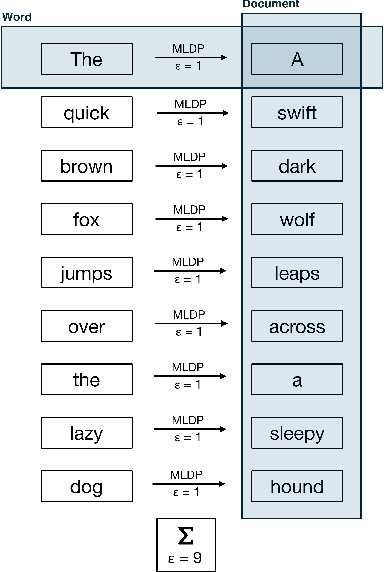
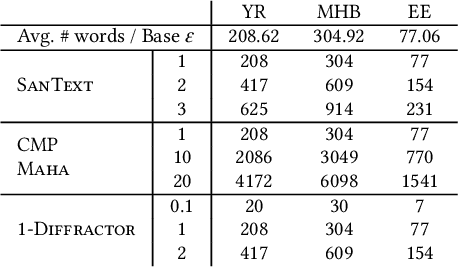
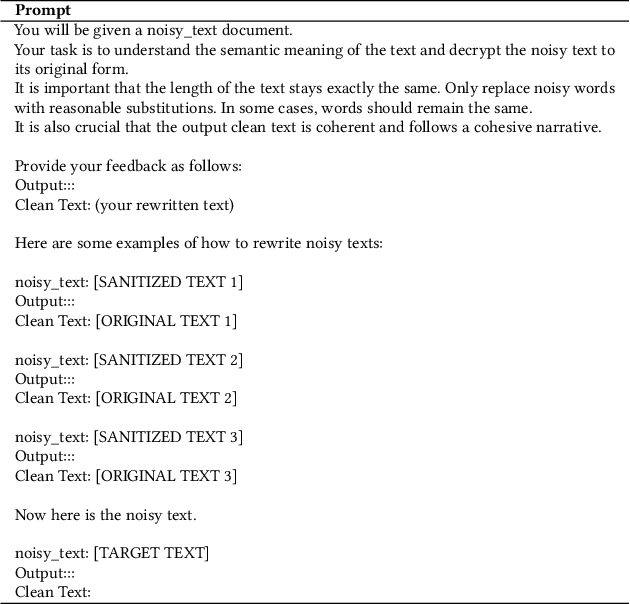
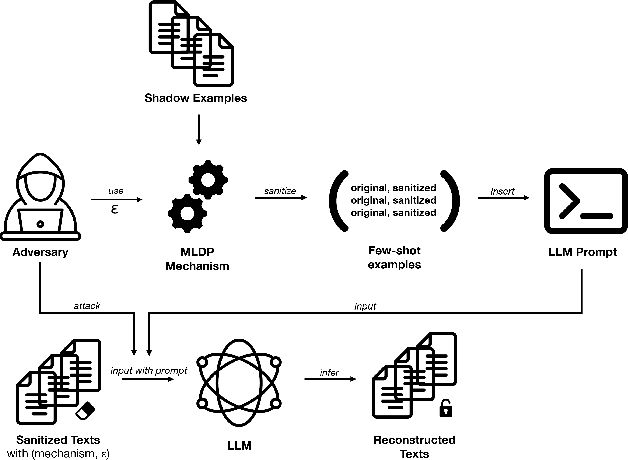
Differentially private text sanitization refers to the process of privatizing texts under the framework of Differential Privacy (DP), providing provable privacy guarantees while also empirically defending against adversaries seeking to harm privacy. Despite their simplicity, DP text sanitization methods operating at the word level exhibit a number of shortcomings, among them the tendency to leave contextual clues from the original texts due to randomization during sanitization $\unicode{x2013}$ this we refer to as $\textit{contextual vulnerability}$. Given the powerful contextual understanding and inference capabilities of Large Language Models (LLMs), we explore to what extent LLMs can be leveraged to exploit the contextual vulnerability of DP-sanitized texts. We expand on previous work not only in the use of advanced LLMs, but also in testing a broader range of sanitization mechanisms at various privacy levels. Our experiments uncover a double-edged sword effect of LLM-based data reconstruction attacks on privacy and utility: while LLMs can indeed infer original semantics and sometimes degrade empirical privacy protections, they can also be used for good, to improve the quality and privacy of DP-sanitized texts. Based on our findings, we propose recommendations for using LLM data reconstruction as a post-processing step, serving to increase privacy protection by thinking adversarially.