 Add to Chrome
 Add to Firefox
 Add to Edge
AI-Mediated Explainable Regulation for Justice
Mar 31, 2026
Present practice of deciding on regulation faces numerous problems that make adopted regulations static, unexplained, unduly influenced by powerful interest groups, and stained with a perception of illegitimacy. These well-known problems with the regulatory process can lead to injustice and have substantial negative effects on society and democracy. We discuss a new approach that utilizes distributed artificial intelligence (AI) to make a regulatory recommendation that is explainable and adaptable by design. We outline the main components of a system that can implement this approach and show how it would resolve the problems with the present regulatory system. This approach models and reasons about stakeholder preferences with separate preference models, while it aggregates these preferences in a value sensitive way. Such recommendations can be updated due to changes in facts or in values and are inherently explainable. We suggest how stakeholders can make their preferences known to the system and how they can verify whether they were properly considered in the regulatory decision. The resulting system promises to support regulatory justice, legitimacy, and compliance.

The AI Co-Ethnographer: How Far Can Automation Take Qualitative Research?
Apr 21, 2025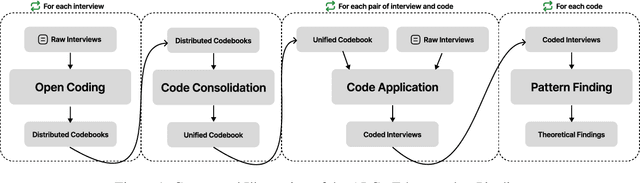
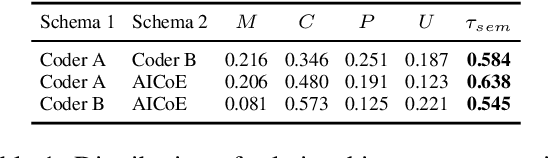
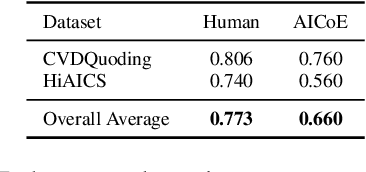
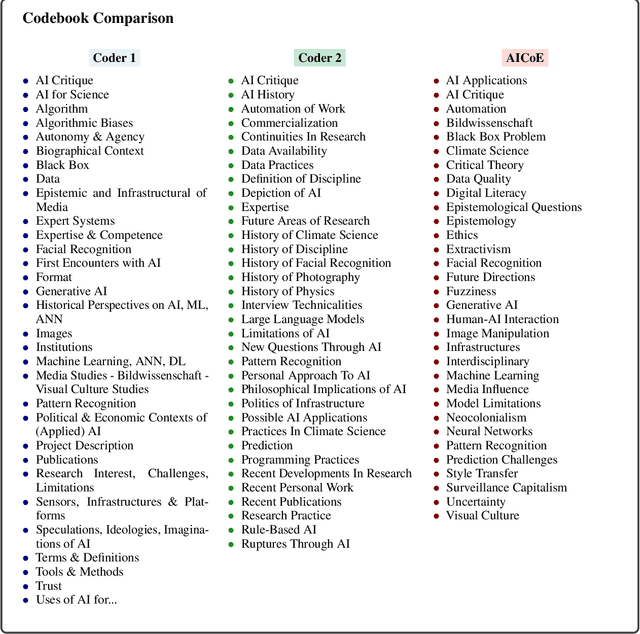
Qualitative research often involves labor-intensive processes that are difficult to scale while preserving analytical depth. This paper introduces The AI Co-Ethnographer (AICoE), a novel end-to-end pipeline developed for qualitative research and designed to move beyond the limitations of simply automating code assignments, offering a more integrated approach. AICoE organizes the entire process, encompassing open coding, code consolidation, code application, and even pattern discovery, leading to a comprehensive analysis of qualitative data.
From Speech to Summary: A Comprehensive Survey of Speech Summarization
Apr 10, 2025Speech summarization has become an essential tool for efficiently managing and accessing the growing volume of spoken and audiovisual content. However, despite its increasing importance, speech summarization is still not clearly defined and intersects with several research areas, including speech recognition, text summarization, and specific applications like meeting summarization. This survey not only examines existing datasets and evaluation methodologies, which are crucial for assessing the effectiveness of summarization approaches but also synthesizes recent developments in the field, highlighting the shift from traditional systems to advanced models like fine-tuned cascaded architectures and end-to-end solutions.