 Add to Chrome
 Add to Firefox
 Add to Edge
Associative Emotional Learning in Convolutional Neural Networks
Jul 21, 2026
Associative emotional learning enables organisms to adaptively link pleasant or unpleasant outcomes to the presence of predictive stimuli. Whereas computational models such as the Rescorla-Wagner model have shed light on this important function, the limitations of these models are also known, especially when they are applied to neural data. The advent of deep neural networks has opened another avenue for modeling associative emotional learning. In this work we proposed a deep neural network model of visual valence processing, consisting of a visual module that encodes complex natural scenes and a module that recognizes their emotional significance in terms of valence, a key dimension of emotion, and tested a novel Pavlovian learning paradigm on the model. The results showed that with learning, the model reproduced several observations from human associative learning studies, including association formation and generalization, and that the neural representations of the conditioned and the unconditioned stimuli became increasingly aligned both at the single unit and at the neural population level. Comparison between the model and human experimental data provided further validation of our approach. This study thus suggests that deep neural network models, when combined with appropriate learning algorithms, can be used to model behavioral and neural signatures of associative emotion/valence learning.

Unsupervised Foveal Vision Neural Networks with Top-Down Attention
Oct 18, 2020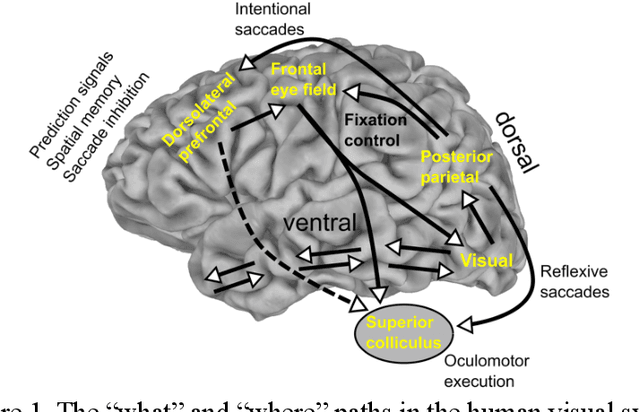
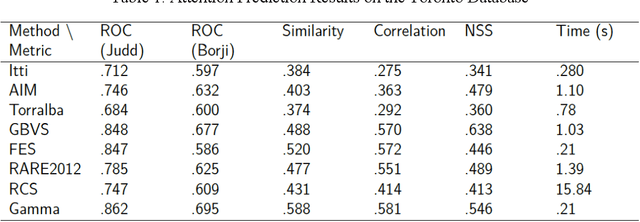
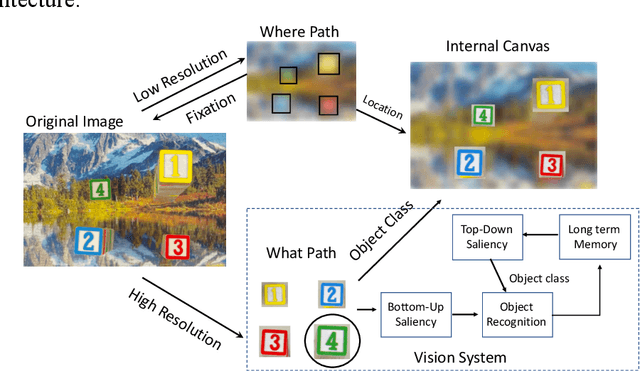
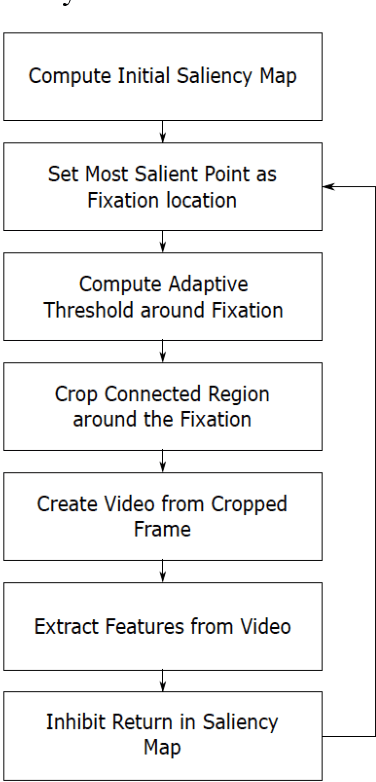
Deep learning architectures are an extremely powerful tool for recognizing and classifying images. However, they require supervised learning and normally work on vectors the size of image pixels and produce the best results when trained on millions of object images. To help mitigate these issues, we propose the fusion of bottom-up saliency and top-down attention employing only unsupervised learning techniques, which helps the object recognition module to focus on relevant data and learn important features that can later be fine-tuned for a specific task. In addition, by utilizing only relevant portions of the data, the training speed can be greatly improved. We test the performance of the proposed Gamma saliency technique on the Toronto and CAT2000 databases, and the foveated vision in the Street View House Numbers (SVHN) database. The results in foveated vision show that Gamma saliency is comparable to the best and computationally faster. The results in SVHN show that our unsupervised cognitive architecture is comparable to fully supervised methods and that the Gamma saliency also improves CNN performance if desired. We also develop a topdown attention mechanism based on the Gamma saliency applied to the top layer of CNNs to improve scene understanding in multi-object images or images with strong background clutter. When we compare the results with human observers in an image dataset of animals occluded in natural scenes, we show that topdown attention is capable of disambiguating object from background and improves system performance beyond the level of human observers.