 Add to Chrome
 Add to Firefox
 Add to Edge
How many stations are sufficient? Exploring the effect of urban weather station density reduction on imputation accuracy of air temperature and humidity
Nov 10, 2025
Urban weather station networks (WSNs) are widely used to monitor urban weather and climate patterns and aid urban planning. However, maintaining WSNs is expensive and labor-intensive. Here, we present a step-wise station removal procedure to thin an existing WSN in Freiburg, Germany, and analyze the ability of WSN subsets to reproduce air temperature and humidity patterns of the entire original WSN for a year following a simulated reduction of WSN density. We found that substantial reductions in station numbers after one year of full deployment are possible while retaining high predictive accuracy. A reduction from 42 to 4 stations, for instance, increased mean prediction RMSEs from 0.69 K to 0.83 K for air temperature and from 3.8% to 4.4% for relative humidity, corresponding to RMSE increases of only 20% and 16%, respectively. Predictive accuracy is worse for remote stations in forests than for stations in built-up or open settings, but consistently better than a state-of-the-art numerical urban land-surface model (Surface Urban Energy and Water Balance Scheme). Stations located at the edges between built-up and rural areas are most valuable when reconstructing city-wide climate characteristics. Our study demonstrates the potential of thinning WSNs to maximize the efficient allocation of financial and personnel-related resources in urban climate research.

Climate-sensitive Urban Planning through Optimization of Tree Placements
Oct 09, 2023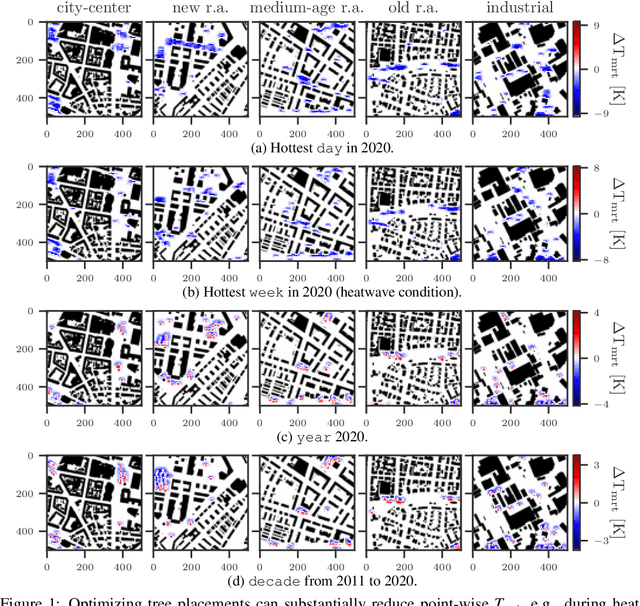
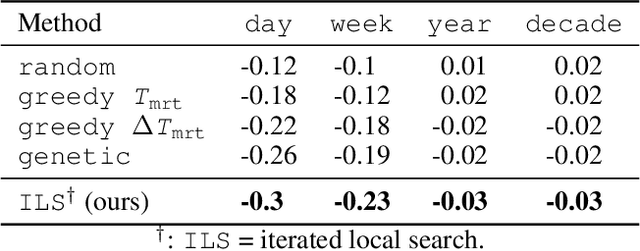
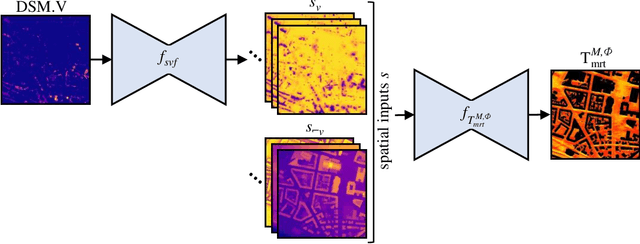
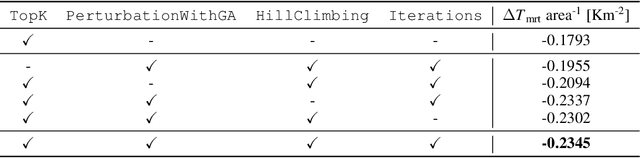
Climate change is increasing the intensity and frequency of many extreme weather events, including heatwaves, which results in increased thermal discomfort and mortality rates. While global mitigation action is undoubtedly necessary, so is climate adaptation, e.g., through climate-sensitive urban planning. Among the most promising strategies is harnessing the benefits of urban trees in shading and cooling pedestrian-level environments. Our work investigates the challenge of optimal placement of such trees. Physical simulations can estimate the radiative and thermal impact of trees on human thermal comfort but induce high computational costs. This rules out optimization of tree placements over large areas and considering effects over longer time scales. Hence, we employ neural networks to simulate the point-wise mean radiant temperatures--a driving factor of outdoor human thermal comfort--across various time scales, spanning from daily variations to extended time scales of heatwave events and even decades. To optimize tree placements, we harness the innate local effect of trees within the iterated local search framework with tailored adaptations. We show the efficacy of our approach across a wide spectrum of study areas and time scales. We believe that our approach is a step towards empowering decision-makers, urban designers and planners to proactively and effectively assess the potential of urban trees to mitigate heat stress.