 Add to Chrome
 Add to Firefox
 Add to Edge
DP-KFC: Data-Free Preconditioning for Privacy-Preserving Deep Learning
May 13, 2026
Differentially private optimization suffers from a fundamental geometric mismatch: deep networks have highly anisotropic loss landscapes, yet DP-SGD injects isotropic noise. Second-order preconditioning can resolve this, but estimating curvature typically requires private data (consuming privacy budget) or public data (introducing distribution shift). We show that the Fisher Information Matrix decouples into architectural sensitivity, recoverable via synthetic noise, and input correlations, approximable from modality-specific frequency statistics. We propose DP-KFC, which constructs KFAC preconditioners by probing networks with structured synthetic noise, requiring neither private nor public data. Empirically, DP-KFC consistently outperforms DP-SGD and adaptive baselines across diverse modalities in strong privacy regimes ($\varepsilon \leq 3$). DP-KFC matches private-data preconditioners while public-data variants degrade by up to $4.8\%$, showing that curvature can be estimated without consuming privacy budget or introducing distribution shift. This enables privacy-preserving learning in specialized domains (e.g., medical applications) where regulatory constraints make data scarce.

Federated Transformer-GNN for Privacy-Preserving Brain Tumor Localization with Modality-Level Explainability
Jan 21, 2026Deep learning models for brain tumor analysis require large and diverse datasets that are often siloed across healthcare institutions due to privacy regulations. We present a federated learning framework for brain tumor localization that enables multi-institutional collaboration without sharing sensitive patient data. Our method extends a hybrid Transformer-Graph Neural Network architecture derived from prior decoder-free supervoxel GNNs and is deployed within CAFEIN\textsuperscript{\textregistered}, CERN's federated learning platform designed for healthcare environments. We provide an explainability analysis through Transformer attention mechanisms that reveals which MRI modalities drive the model predictions. Experiments on the BraTS dataset demonstrate a key finding: while isolated training on individual client data triggers early stopping well before reaching full training capacity, federated learning enables continued model improvement by leveraging distributed data, ultimately matching centralized performance. This result provides strong justification for federated learning when dealing with complex tasks and high-dimensional input data, as aggregating knowledge from multiple institutions significantly benefits the learning process. Our explainability analysis, validated through rigorous statistical testing on the full test set (paired t-tests with Bonferroni correction), reveals that deeper network layers significantly increase attention to T2 and FLAIR modalities ($p<0.001$, Cohen's $d$=1.50), aligning with clinical practice.
Decoder-Free Supervoxel GNN for Accurate Brain-Tumor Localization in Multi-Modal MRI
Jan 20, 2026Modern vision backbones for 3D medical imaging typically process dense voxel grids through parameter-heavy encoder-decoder structures, a design that allocates a significant portion of its parameters to spatial reconstruction rather than feature learning. Our approach introduces SVGFormer, a decoder-free pipeline built upon a content-aware grouping stage that partitions the volume into a semantic graph of supervoxels. Its hierarchical encoder learns rich node representations by combining a patch-level Transformer with a supervoxel-level Graph Attention Network, jointly modeling fine-grained intra-region features and broader inter-regional dependencies. This design concentrates all learnable capacity on feature encoding and provides inherent, dual-scale explainability from the patch to the region level. To validate the framework's flexibility, we trained two specialized models on the BraTS dataset: one for node-level classification and one for tumor proportion regression. Both models achieved strong performance, with the classification model achieving a F1-score of 0.875 and the regression model a MAE of 0.028, confirming the encoder's ability to learn discriminative and localized features. Our results establish that a graph-based, encoder-only paradigm offers an accurate and inherently interpretable alternative for 3D medical image representation.
Federated GNNs for EEG-Based Stroke Assessment
Nov 04, 2024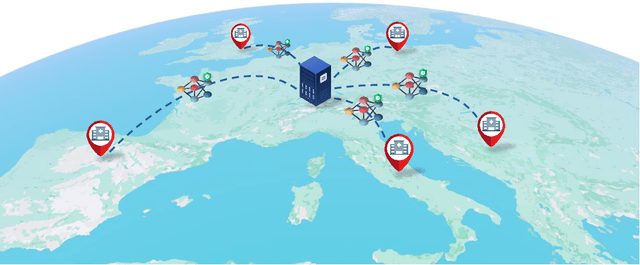
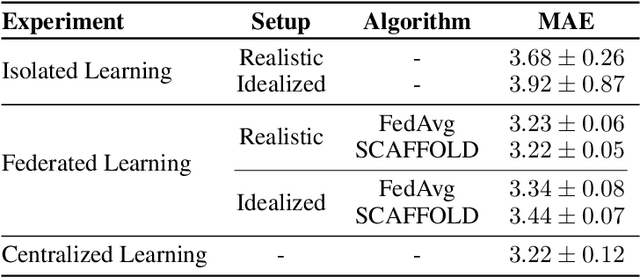

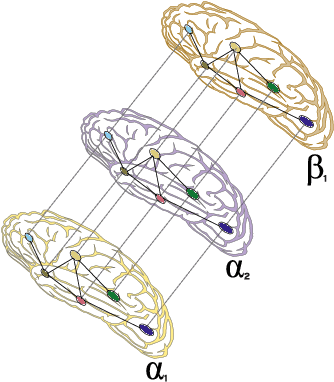
Machine learning (ML) has the potential to become an essential tool in supporting clinical decision-making processes, offering enhanced diagnostic capabilities and personalized treatment plans. However, outsourcing medical records to train ML models using patient data raises legal, privacy, and security concerns. Federated learning has emerged as a promising paradigm for collaborative ML, meeting healthcare institutions' requirements for robust models without sharing sensitive data and compromising patient privacy. This study proposes a novel method that combines federated learning (FL) and Graph Neural Networks (GNNs) to predict stroke severity using electroencephalography (EEG) signals across multiple medical institutions. Our approach enables multiple hospitals to jointly train a shared GNN model on their local EEG data without exchanging patient information. Specifically, we address a regression problem by predicting the National Institutes of Health Stroke Scale (NIHSS), a key indicator of stroke severity. The proposed model leverages a masked self-attention mechanism to capture salient brain connectivity patterns and employs EdgeSHAP to provide post-hoc explanations of the neurological states after a stroke. We evaluated our method on EEG recordings from four institutions, achieving a mean absolute error (MAE) of 3.23 in predicting NIHSS, close to the average error made by human experts (MAE $\approx$ 3.0). This demonstrates the method's effectiveness in providing accurate and explainable predictions while maintaining data privacy.