 Add to Chrome
 Add to Firefox
 Add to Edge
Design of an embedded hardware platform for cell-level diagnostics in commercial battery modules
Mar 31, 2026
While battery aging is commonly studied at the cell-level, evaluating aging and performance within battery modules remains a critical challenge. Testing cells within fully assembled modules requires hardware solutions to access cell-level information without compromising module integrity. In this paper, we design and develop a hardware testing platform to monitor and control the internal cells of battery modules contained in the Audi e-tron battery pack. The testing is performed across all 36 modules of the pack. The platform integrates voltage sensors, balancing circuitry, and a micro-controller to enable safe, simultaneous cell screening without disassembling the modules. Using the proposed testing platform, cell voltage imbalances within each module are constrained to a defined reference value, and cell signals can be safely accessed, enabling accurate and non-invasive cell-level state-of-health assessments. On a broader scale, our solution allows for the quantification of internal heterogeneity within modules, providing valuable insights for both first- and second-life applications and supporting efficient battery pack maintenance and repurposing.

Domain knowledge-guided machine learning framework for state of health estimation in Lithium-ion batteries
Sep 22, 2024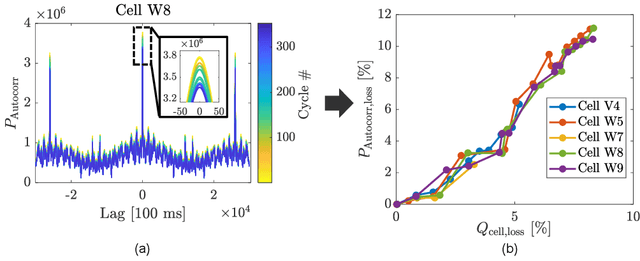
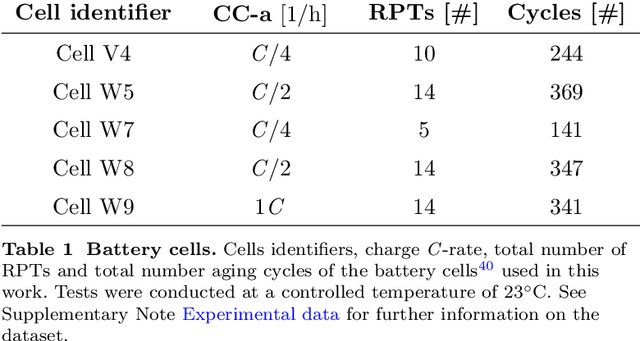
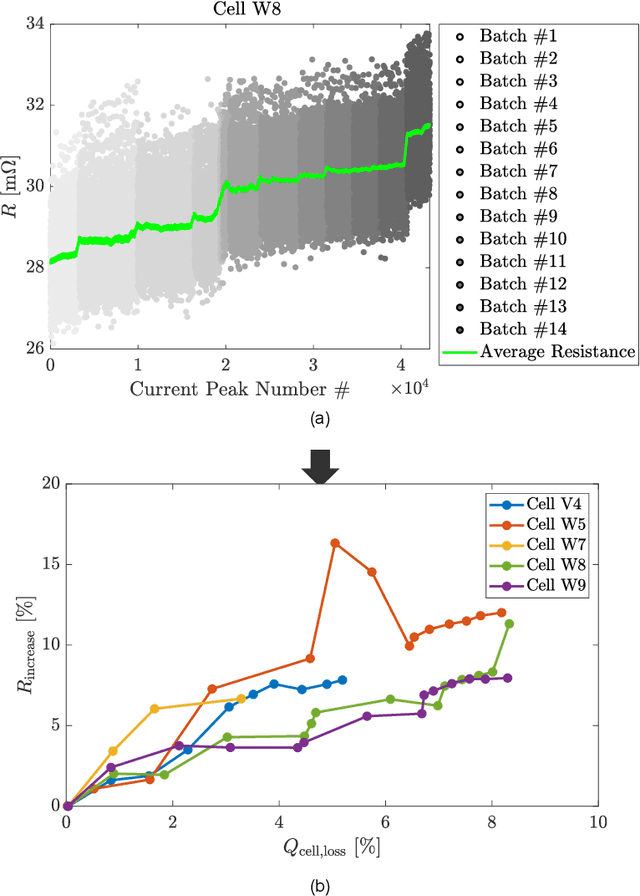
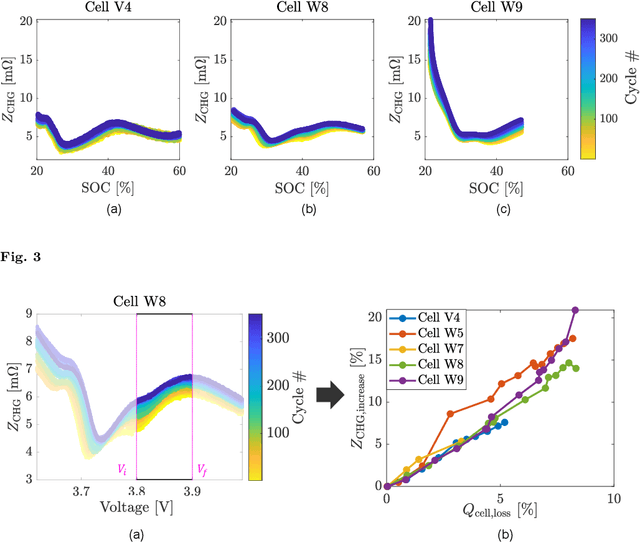
Accurate estimation of battery state of health is crucial for effective electric vehicle battery management. Here, we propose five health indicators that can be extracted online from real-world electric vehicle operation and develop a machine learning-based method to estimate the battery state of health. The proposed indicators provide physical insights into the energy and power fade of the battery and enable accurate capacity estimation even with partially missing data. Moreover, they can be computed for portions of the charging profile and real-world driving discharging conditions, facilitating real-time battery degradation estimation. The indicators are computed using experimental data from five cells aged under electric vehicle conditions, and a linear regression model is used to estimate the state of health. The results show that models trained with power autocorrelation and energy-based features achieve capacity estimation with maximum absolute percentage error within 1.5% to 2.5% .