 Add to Chrome
 Add to Firefox
 Add to Edge
SNPgen: Phenotype-Supervised Genotype Representation and Synthetic Data Generation via Latent Diffusion
Mar 11, 2026
Polygenic risk scores and other genomic analyses require large individual-level genotype datasets, yet strict data access restrictions impede sharing. Synthetic genotype generation offers a privacy-preserving alternative, but most existing methods operate unconditionally, producing samples without phenotype alignment, or rely on unsupervised compression, creating a gap between statistical fidelity and downstream task utility. We present SNPgen, a two-stage conditional latent diffusion framework for generating phenotype-supervised synthetic genotypes. SNPgen combines GWAS-guided variant selection (1,024-2,048 trait-associated SNPs) with a variational autoencoder for genotype compression and a latent diffusion model conditioned on binary disease labels via classifier-free guidance. Evaluated on 458,724 UK Biobank individuals across four complex diseases (coronary artery disease, breast cancer, type 1 and type 2 diabetes), models trained on synthetic data matched real-data predictive performance in a train-on-synthetic, test-on-real protocol, approaching genome-wide PRS methods that use $2$-$6\times$ more variants. Privacy analysis confirmed zero identical matches, near-random membership inference (AUC $\approx 0.50$), preserved linkage disequilibrium structure, and high allele frequency correlation ($r \geq 0.95$) with source data. A controlled simulation with known causal effects verified faithful recovery of the imposed genetic association structure.

Bridging the Gap: Enhancing the Utility of Synthetic Data via Post-Processing Techniques
May 17, 2023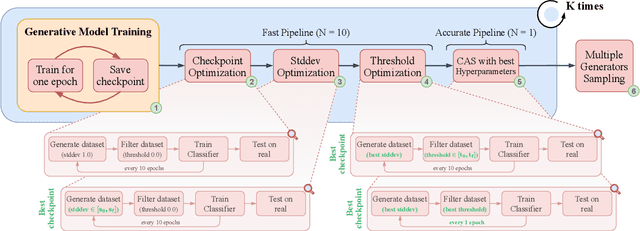

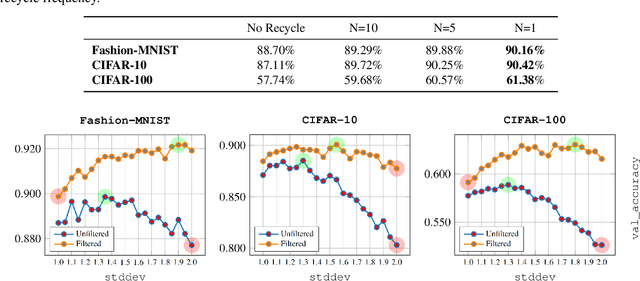
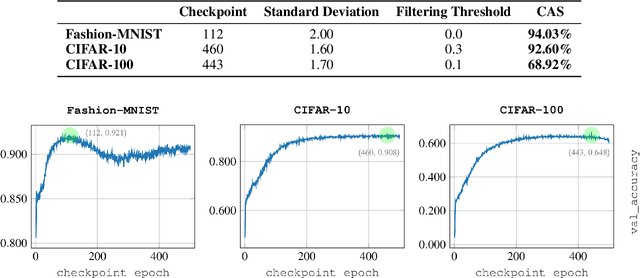
Acquiring and annotating suitable datasets for training deep learning models is challenging. This often results in tedious and time-consuming efforts that can hinder research progress. However, generative models have emerged as a promising solution for generating synthetic datasets that can replace or augment real-world data. Despite this, the effectiveness of synthetic data is limited by their inability to fully capture the complexity and diversity of real-world data. To address this issue, we explore the use of Generative Adversarial Networks to generate synthetic datasets for training classifiers that are subsequently evaluated on real-world images. To improve the quality and diversity of the synthetic dataset, we propose three novel post-processing techniques: Dynamic Sample Filtering, Dynamic Dataset Recycle, and Expansion Trick. In addition, we introduce a pipeline called Gap Filler (GaFi), which applies these techniques in an optimal and coordinated manner to maximise classification accuracy on real-world data. Our experiments show that GaFi effectively reduces the gap with real-accuracy scores to an error of 2.03%, 1.78%, and 3.99% on the Fashion-MNIST, CIFAR-10, and CIFAR-100 datasets, respectively. These results represent a new state of the art in Classification Accuracy Score and highlight the effectiveness of post-processing techniques in improving the quality of synthetic datasets.