 Add to Chrome
 Add to Firefox
 Add to Edge
Relational Knowledge Distillation Using Fine-tuned Function Vectors
Jan 13, 2026
Representing relations between concepts is a core prerequisite for intelligent systems to make sense of the world. Recent work using causal mediation analysis has shown that a small set of attention heads encodes task representation in in-context learning, captured in a compact representation known as the function vector. We show that fine-tuning function vectors with only a small set of examples (about 20 word pairs) yields better performance on relation-based word-completion tasks than using the original vectors derived from causal mediation analysis. These improvements hold for both small and large language models. Moreover, the fine-tuned function vectors yield improved decoding performance for relation words and show stronger alignment with human similarity judgments of semantic relations. Next, we introduce the composite function vector - a weighted combination of fine-tuned function vectors - to extract relational knowledge and support analogical reasoning. At inference time, inserting this composite vector into LLM activations markedly enhances performance on challenging analogy problems drawn from cognitive science and SAT benchmarks. Our results highlight the potential of activation patching as a controllable mechanism for encoding and manipulating relational knowledge, advancing both the interpretability and reasoning capabilities of large language models.

Synthetic Data Generation with LLM for Improved Depression Prediction
Nov 26, 2024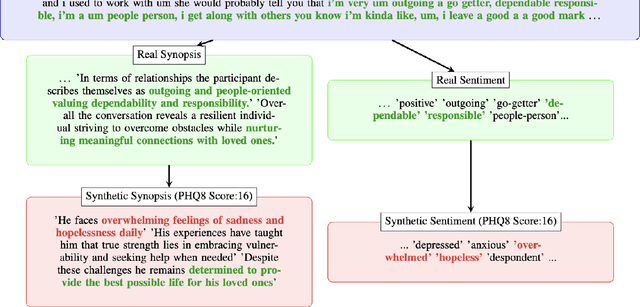
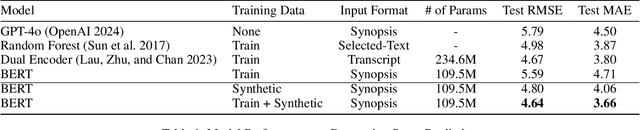
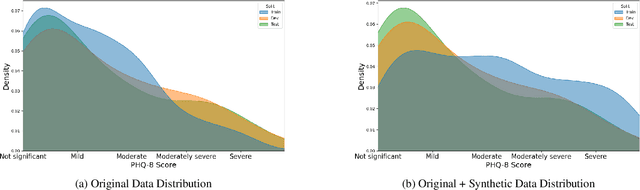
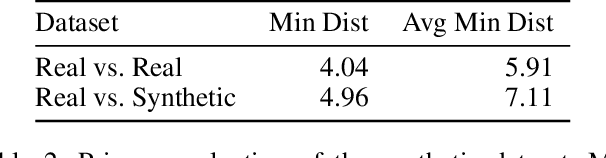
Automatic detection of depression is a rapidly growing field of research at the intersection of psychology and machine learning. However, with its exponential interest comes a growing concern for data privacy and scarcity due to the sensitivity of such a topic. In this paper, we propose a pipeline for Large Language Models (LLMs) to generate synthetic data to improve the performance of depression prediction models. Starting from unstructured, naturalistic text data from recorded transcripts of clinical interviews, we utilize an open-source LLM to generate synthetic data through chain-of-thought prompting. This pipeline involves two key steps: the first step is the generation of the synopsis and sentiment analysis based on the original transcript and depression score, while the second is the generation of the synthetic synopsis/sentiment analysis based on the summaries generated in the first step and a new depression score. Not only was the synthetic data satisfactory in terms of fidelity and privacy-preserving metrics, it also balanced the distribution of severity in the training dataset, thereby significantly enhancing the model's capability in predicting the intensity of the patient's depression. By leveraging LLMs to generate synthetic data that can be augmented to limited and imbalanced real-world datasets, we demonstrate a novel approach to addressing data scarcity and privacy concerns commonly faced in automatic depression detection, all while maintaining the statistical integrity of the original dataset. This approach offers a robust framework for future mental health research and applications.