 Add to Chrome
 Add to Firefox
 Add to Edge
ORICF -- Open Robotics Inference and Control Framework
May 10, 2026
Recent advances in artificial intelligence (AI) have enabled effective perception and language models for robots, but their deployment remains computationally expensive, increasing latency and energy use. This work presents the Open Robotics Inference and Control Framework (ORICF), a modular, declarative, and model-agnostic platform for composing multimodal robotic inference pipelines. ORICF integrates input/output (I/O) adapters, pluggable inference back ends, and post-processing logic, while lightweight YAML specifications allow models, hardware targets, and data channels to be changed without code modification. The framework also supports edge offloading, i.e., executing inference on nearby external computers instead of onboard the robot. ORICF is evaluated on a mobile robot that answers spoken queries about people detected in its camera stream by combining automatic speech recognition (ASR), a large language model (LLM), and a convolutional neural network (CNN) detector through Robot Operating System 2 (ROS2). Compared with onboard execution, ORICF-based edge deployment reduces robot-side compute utilization by up to 83.16% and estimated energy consumption by 65.8%, while preserving modularity and reproducibility.

6G Empowering Future Robotics: A Vision for Next-Generation Autonomous Systems
Feb 12, 2026The convergence of robotics and next-generation communication is a critical driver of technological advancement. As the world transitions from 5G to 6G, the foundational capabilities of wireless networks are evolving to support increasingly complex and autonomous robotic systems. This paper examines the transformative impact of 6G on enhancing key robotics functionalities. It provides a systematic mapping of IMT-2030 key performance indicators to robotic functional blocks including sensing, perception, cognition, actuation and self-learning. Building upon this mapping, we propose a high-level architectural framework integrating robotic, intelligent, and network service planes, underscoring the need for a holistic approach. As an example use case, we present a real-time, dynamic safety framework enabled by IMT-2030 capabilities for safe and efficient human-robot collaboration in shared spaces.
Task Allocation in Mobile Robot Fleets: A review
Jan 15, 2025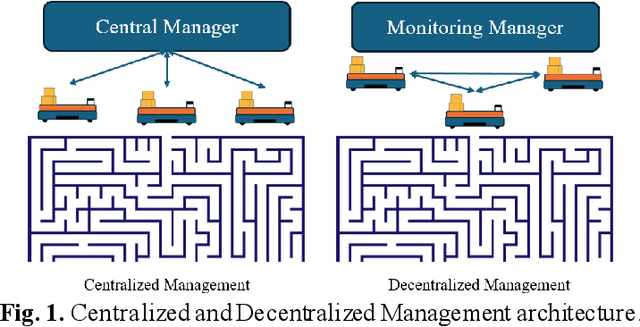
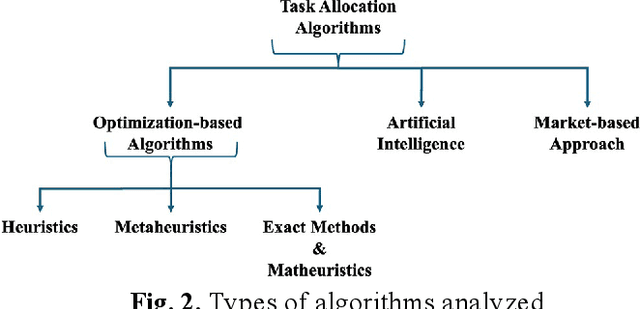
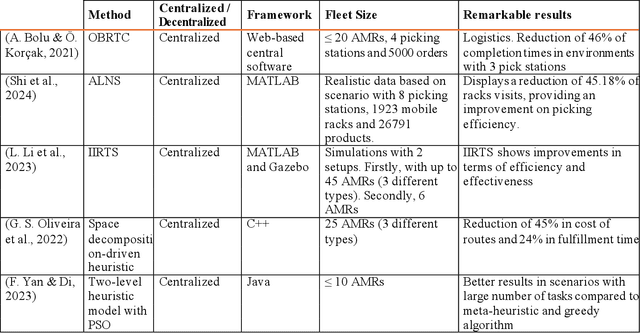
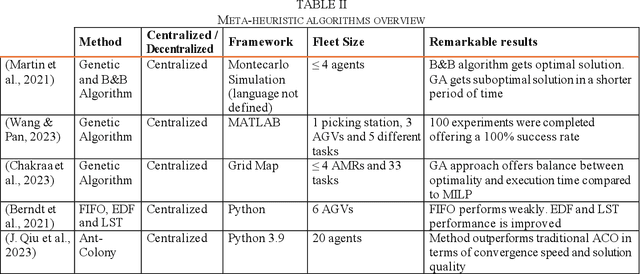
Mobile robot fleets are currently used in different scenarios such as medical environments or logistics. The management of these systems provides different challenges that vary from the control of the movement of each robot to the allocation of tasks to be performed. Task Allocation (TA) problem is a key topic for the proper management of mobile robot fleets to ensure the minimization of energy consumption and quantity of necessary robots. Solutions on this aspect are essential to reach economic and environmental sustainability of robot fleets, mainly in industry applications such as warehouse logistics. The minimization of energy consumption introduces TA problem as an optimization issue which has been treated in recent studies. This work focuses on the analysis of current trends in solving TA of mobile robot fleets. Main TA optimization algorithms are presented, including novel methods based on Artificial Intelligence (AI). Additionally, this work showcases most important results extracted from simulations, including frameworks utilized for the development of the simulations. Finally, some conclusions are obtained from the analysis to target on gaps that must be treated in the future.