 Add to Chrome
 Add to Firefox
 Add to Edge
Learning the Value Systems of Societies with Preference-based Multi-objective Reinforcement Learning
Feb 09, 2026
Value-aware AI should recognise human values and adapt to the value systems (value-based preferences) of different users. This requires operationalization of values, which can be prone to misspecification. The social nature of values demands their representation to adhere to multiple users while value systems are diverse, yet exhibit patterns among groups. In sequential decision making, efforts have been made towards personalization for different goals or values from demonstrations of diverse agents. However, these approaches demand manually designed features or lack value-based interpretability and/or adaptability to diverse user preferences. We propose algorithms for learning models of value alignment and value systems for a society of agents in Markov Decision Processes (MDPs), based on clustering and preference-based multi-objective reinforcement learning (PbMORL). We jointly learn socially-derived value alignment models (groundings) and a set of value systems that concisely represent different groups of users (clusters) in a society. Each cluster consists of a value system representing the value-based preferences of its members and an approximately Pareto-optimal policy that reflects behaviours aligned with this value system. We evaluate our method against a state-of-the-art PbMORL algorithm and baselines on two MDPs with human values.

Learning the Value Systems of Agents with Preference-based and Inverse Reinforcement Learning
Feb 04, 2026Agreement Technologies refer to open computer systems in which autonomous software agents interact with one another, typically on behalf of humans, in order to come to mutually acceptable agreements. With the advance of AI systems in recent years, it has become apparent that such agreements, in order to be acceptable to the involved parties, must remain aligned with ethical principles and moral values. However, this is notoriously difficult to ensure, especially as different human users (and their software agents) may hold different value systems, i.e. they may differently weigh the importance of individual moral values. Furthermore, it is often hard to specify the precise meaning of a value in a particular context in a computational manner. Methods to estimate value systems based on human-engineered specifications, e.g. based on value surveys, are limited in scale due to the need for intense human moderation. In this article, we propose a novel method to automatically \emph{learn} value systems from observations and human demonstrations. In particular, we propose a formal model of the \emph{value system learning} problem, its instantiation to sequential decision-making domains based on multi-objective Markov decision processes, as well as tailored preference-based and inverse reinforcement learning algorithms to infer value grounding functions and value systems. The approach is illustrated and evaluated by two simulated use cases.
* 42 pages, 5 figures. Published in Journal of Autonomous Agents and Multi-Agent Systems
Learning the Value Systems of Societies from Preferences
Jul 28, 2025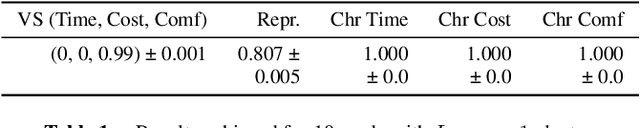
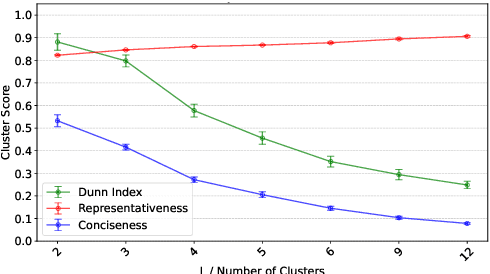
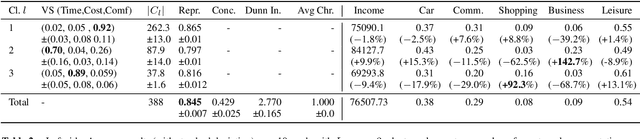
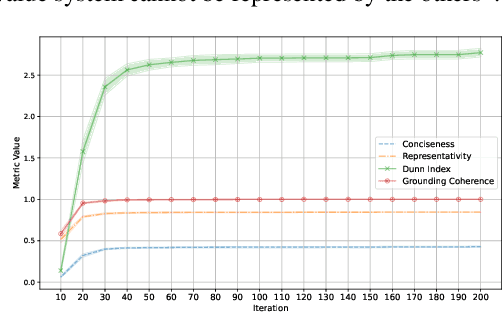
Aligning AI systems with human values and the value-based preferences of various stakeholders (their value systems) is key in ethical AI. In value-aware AI systems, decision-making draws upon explicit computational representations of individual values (groundings) and their aggregation into value systems. As these are notoriously difficult to elicit and calibrate manually, value learning approaches aim to automatically derive computational models of an agent's values and value system from demonstrations of human behaviour. Nonetheless, social science and humanities literature suggest that it is more adequate to conceive the value system of a society as a set of value systems of different groups, rather than as the simple aggregation of individual value systems. Accordingly, here we formalize the problem of learning the value systems of societies and propose a method to address it based on heuristic deep clustering. The method learns socially shared value groundings and a set of diverse value systems representing a given society by observing qualitative value-based preferences from a sample of agents. We evaluate the proposal in a use case with real data about travelling decisions.
Algorithms for learning value-aligned policies considering admissibility relaxation
Jun 07, 2024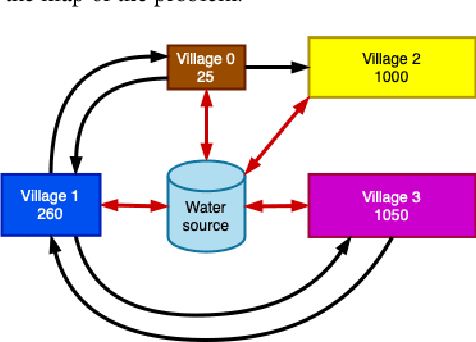
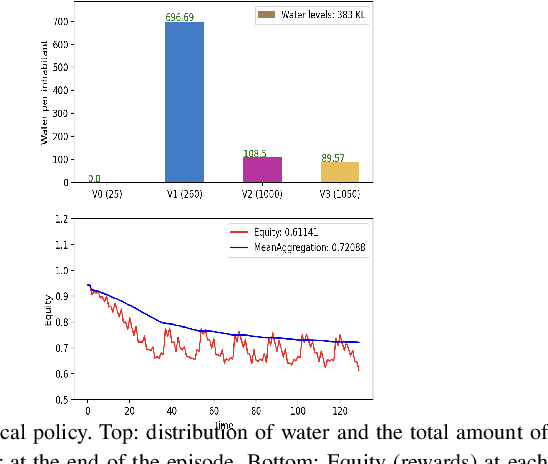
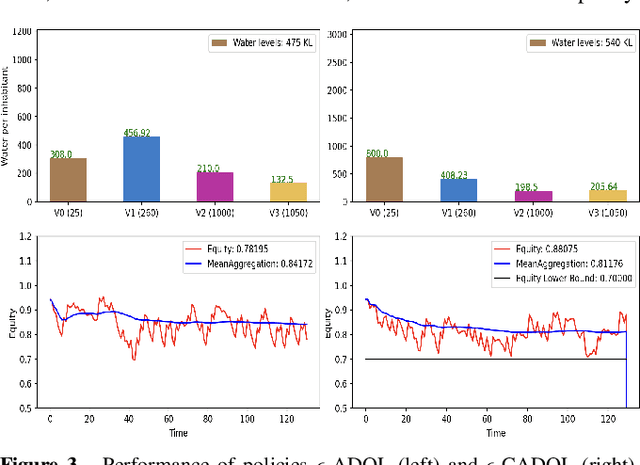

The emerging field of \emph{value awareness engineering} claims that software agents and systems should be value-aware, i.e. they must make decisions in accordance with human values. In this context, such agents must be capable of explicitly reasoning as to how far different courses of action are aligned with these values. For this purpose, values are often modelled as preferences over states or actions, which are then aggregated to determine the sequences of actions that are maximally aligned with a certain value. Recently, additional value admissibility constraints at this level have been considered as well. However, often relaxed versions of these constraints are needed, and this increases considerably the complexity of computing value-aligned policies. To obtain efficient algorithms that make value-aligned decisions considering admissibility relaxation, we propose the use of learning techniques, in particular, we have used constrained reinforcement learning algorithms. In this paper, we present two algorithms, $\epsilon\text{-}ADQL$ for strategies based on local alignment and its extension $\epsilon\text{-}CADQL$ for a sequence of decisions. We have validated their efficiency in a water distribution problem in a drought scenario.