 Add to Chrome
 Add to Firefox
 Add to Edge
Natural Riemannian gradient for learning functional tensor networks
Apr 10, 2026
We consider machine learning tasks with low-rank functional tree tensor networks (TTN) as the learning model. While in the case of least-squares regression, low-rank functional TTNs can be efficiently optimized using alternating optimization, this is not directly possible in other problems, such as multinomial logistic regression. We propose a natural Riemannian gradient descent type approach applicable to arbitrary losses which is based on the natural gradient by Amari. In particular, the search direction obtained by the natural gradient is independent of the choice of basis of the underlying functional tensor product space. Our framework applies to both the factorized and manifold-based approach for representing the functional TTN. For practical application, we propose a hierarchy of efficient approximations to the true natural Riemannian gradient for computing the updates in the parameter space. Numerical experiments confirm our theoretical findings on common classification datasets and show that using natural Riemannian gradient descent for learning considerably improves convergence behavior when compared to standard Riemannian gradient methods.

Convergence results for projected line-search methods on varieties of low-rank matrices via Łojasiewicz inequality
Apr 22, 2015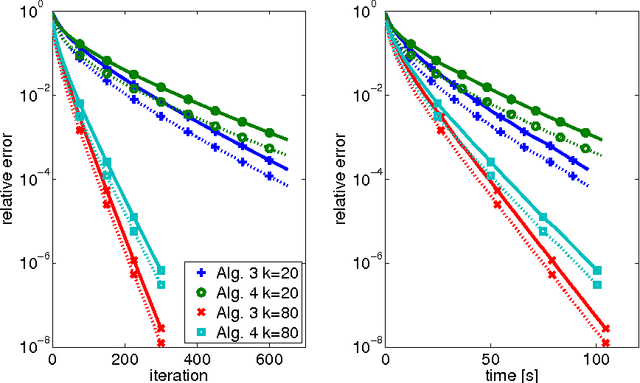
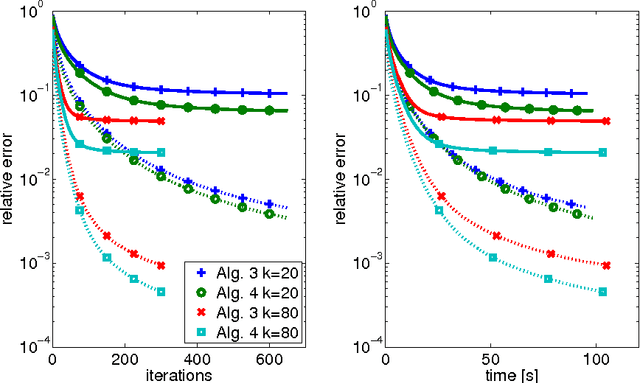
The aim of this paper is to derive convergence results for projected line-search methods on the real-algebraic variety $\mathcal{M}_{\le k}$ of real $m \times n$ matrices of rank at most $k$. Such methods extend Riemannian optimization methods, which are successfully used on the smooth manifold $\mathcal{M}_k$ of rank-$k$ matrices, to its closure by taking steps along gradient-related directions in the tangent cone, and afterwards projecting back to $\mathcal{M}_{\le k}$. Considering such a method circumvents the difficulties which arise from the nonclosedness and the unbounded curvature of $\mathcal{M}_k$. The pointwise convergence is obtained for real-analytic functions on the basis of a \L{}ojasiewicz inequality for the projection of the antigradient to the tangent cone. If the derived limit point lies on the smooth part of $\mathcal{M}_{\le k}$, i.e. in $\mathcal{M}_k$, this boils down to more or less known results, but with the benefit that asymptotic convergence rate estimates (for specific step-sizes) can be obtained without an a priori curvature bound, simply from the fact that the limit lies on a smooth manifold. At the same time, one can give a convincing justification for assuming critical points to lie in $\mathcal{M}_k$: if $X$ is a critical point of $f$ on $\mathcal{M}_{\le k}$, then either $X$ has rank $k$, or $\nabla f(X) = 0$.