 Add to Chrome
 Add to Firefox
 Add to Edge
Non-asymptotic quantisation of spherically symmetric distributions
May 12, 2026
Zador's celebrated theorem is a cornerstone of optimal quantisation, establishing both the weak limit of the empirical distribution of an $n$-point optimal quantiser in $R^d$ and the decay rate of the associated $L_s$-mean quantisation error. However, for large dimensions $d$, observing this asymptotic behaviour demands an astronomically large sample size $n$, which grows super-exponentially with $d$. Through a detailed analysis of the quantisation problem for spherically symmetric distributions, we demonstrate that for moderate $n$ random quantisers uniformly distributed on a sphere of suitable radius $r$ achieve exceptional performance. The expected distortion, expressed as a triple integral, can be computed with arbitrary precision, and the optimal radius $r$ can be efficiently determined numerically. Leveraging results from extreme-value theory, we derive approximations for $r$, particularly in scenarios where $n$ scales with $d$. Depending on the growth rate of $n$, $r$ may either converge to zero or approach a limiting value that is independent of $s$.

Maximum mean discrepancies of Farey sequences
Jul 14, 2024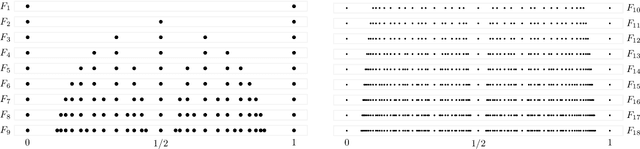
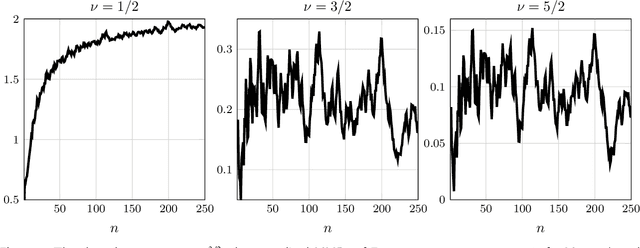
We identify a large class of positive-semidefinite kernels for which a certain polynomial rate of convergence of maximum mean discrepancies of Farey sequences is equivalent to the Riemann hypothesis. This class includes all Mat\'ern kernels of order at least one-half.
Quasi-uniform designs with optimal and near-optimal uniformity constant
Dec 20, 2021

A design is a collection of distinct points in a given set $X$, which is assumed to be a compact subset of $R^d$, and the mesh-ratio of a design is the ratio of its fill distance to its separation radius. The uniformity constant of a sequence of nested designs is the smallest upper bound for the mesh-ratios of the designs. We derive a lower bound on this uniformity constant and show that a simple greedy construction achieves this lower bound. We then extend this scheme to allow more flexibility in the design construction.