 Add to Chrome
 Add to Firefox
 Add to Edge
Computational Phenomenology of Temporal Experience in Autism: Quantifying the Emotional and Narrative Characteristics of Lived Unpredictability
Feb 13, 2026
Disturbances in temporality, such as desynchronization with the social environment and its unpredictability, are considered core features of autism with a deep impact on relationships. However, limitations regarding research on this issue include: 1) the dominance of deficit-based medical models of autism, 2) sample size in qualitative research, and 3) the lack of phenomenological anchoring in computational research. To bridge the gap between phenomenological and computational approaches and overcome sample-size limitations, our research integrated three methodologies. Study A: structured phenomenological interviews with autistic individuals using the Transdiagnostic Assessment of Temporal Experience. Study B: computational analysis of an autobiographical corpus of autistic narratives built for this purpose. Study C: a replication of a computational study using narrative flow measures to assess the perceived phenomenological authenticity of autistic autobiographies. Interviews revealed that the most significant differences between the autistic and control groups concerned unpredictability of experience. Computational results mirrored these findings: the temporal lexicon in autistic narratives was significantly more negatively valenced - particularly the "Immediacy & Suddenness" category. Outlier analysis identified terms associated with perceived discontinuity (unpredictably, precipitously, and abruptly) as highly negative. The computational analysis of narrative flow found that the autistic narratives contained within the corpus quantifiably resemble autobiographical stories more than imaginary ones. Overall, the temporal challenges experienced by autistic individuals were shown to primarily concern lived unpredictability and stem from the contents of lived experience, and not from autistic narrative construction.

Visual Stereotypes of Autism Spectrum in DALL-E, Stable Diffusion, SDXL, and Midjourney
Jul 24, 2024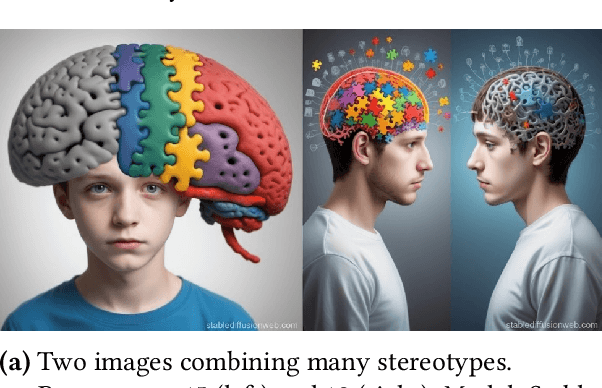
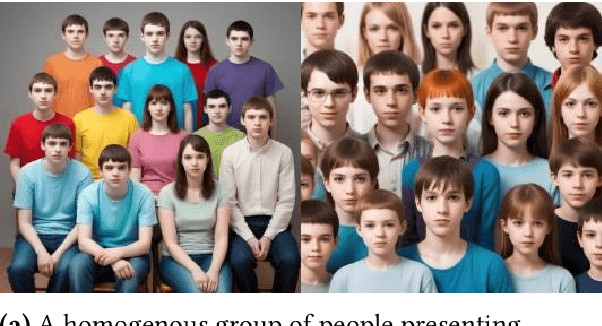
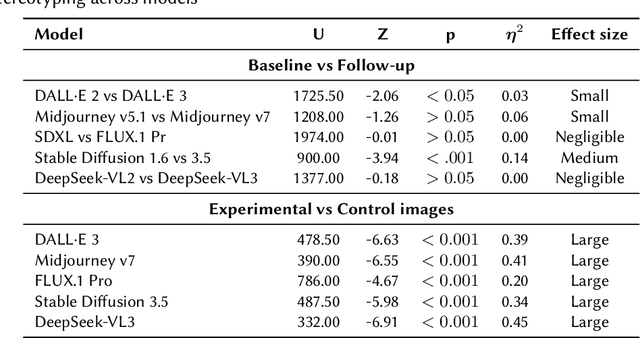
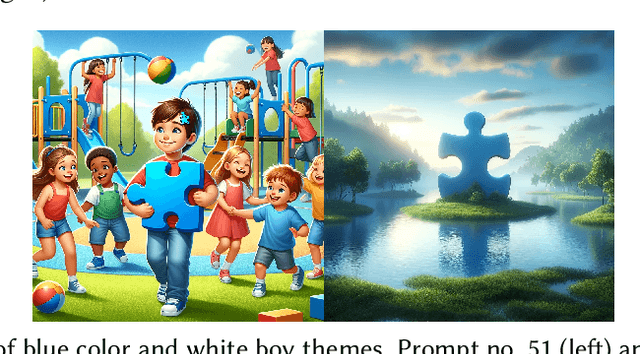
Avoiding systemic discrimination requires investigating AI models' potential to propagate stereotypes resulting from the inherent biases of training datasets. Our study investigated how text-to-image models unintentionally perpetuate non-rational beliefs regarding autism. The research protocol involved generating images based on 53 prompts aimed at visualizing concrete objects and abstract concepts related to autism across four models: DALL-E, Stable Diffusion, SDXL, and Midjourney (N=249). Expert assessment of results was performed via a framework of 10 deductive codes representing common stereotypes contested by the community regarding their presence and spatial intensity, quantified on ordinal scales and subject to statistical analysis of inter-rater reliability and size effects. The models frequently utilised controversial themes and symbols which were unevenly distributed, however, with striking homogeneity in terms of skin colour, gender, and age, with autistic individuals portrayed as engaged in solitary activities, interacting with objects rather than people, and displaying stereotypical emotional expressions such as pale, anger, or sad. Secondly we observed representational insensitivity regarding autism images despite directional prompting aimed at falsifying the above results. Additionally, DALL-E explicitly denied perpetuating stereotypes. We interpret this as ANNs mirroring the human cognitive architecture regarding the discrepancy between background and reflective knowledge, as justified by our previous research on autism-related stereotypes in humans.