 Add to Chrome
 Add to Firefox
 Add to Edge
Fronthaul Network Planning for Hierarchical and Radio-Stripes-Enabled CF-mMIMO in O-RAN
Mar 29, 2026
The deployment of ultra-dense networks (UDNs), particularly cell-free massive MIMO (CF-mMIMO), is mainly hindered by costly and capacity-limited fronthaul links. This work proposes a two-tiered optimization framework for cost-effective hybrid fronthaul planning, comprising a Near-Optimal Fronthaul Association and Configuration (NOFAC) algorithm in the first tier and an Integer Linear Program (ILP) in the second, integrating fiber optics, millimeter-wave (mmWave), and free-space optics (FSO) technologies. The proposed framework accommodates various functional split (FS) options (7.2x and 8), decentralized processing levels, and network configurations. We introduce the hierarchical scheme (HS) as a resilient, cost-effective fronthaul solution for CF-mMIMO and compare its performance with radio-stripes (RS)-enabled CF-mMIMO, validating both across diverse dense topologies within the open radio access network (O-RAN) architecture. Results show that the proposed framework achieves better cost-efficiency and higher capacity compared to traditional benchmark schemes such as all-fiber fronthaul network. Our key findings reveal fiber dominance in highly decentralized deployments, mmWave suitability in moderately centralized scenarios, and FSO complements both by bridging deployment gaps. Additionally, FS7.2x consistently outperforms FS8, offering greater capacity at lower cost, affirming its role as the preferred O-RAN functional split. Most importantly, our study underscores the importance of hybrid fronthaul effective planning for UDNs in minimizing infrastructural redundancy, and ensuring scalability to meet current and future traffic demands.

Traffic-Aware Cost-Optimized Fronthaul Planning for Ultra-Dense Networks
Dec 20, 2024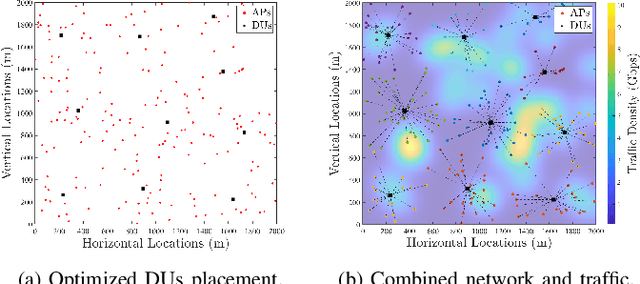
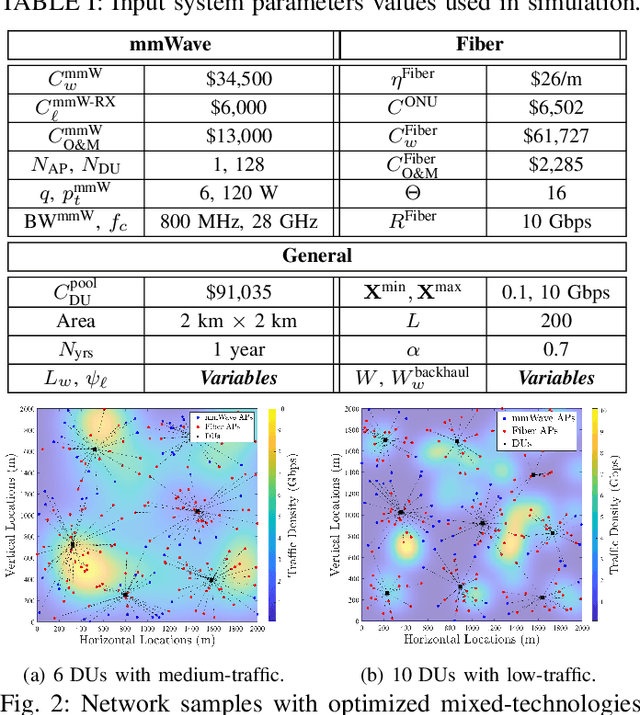
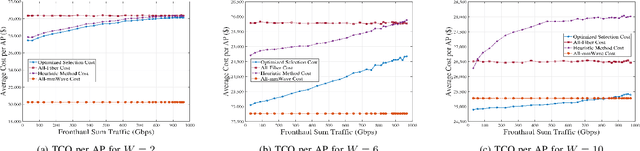
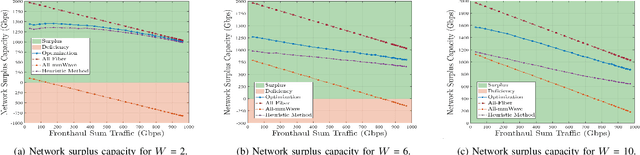
The cost and limited capacity of fronthaul links pose significant challenges for the deployment of ultra-dense networks (UDNs), specifically for cell-free massive MIMO systems. Hence, cost-effective planning of reliable fronthaul networks is crucial for the future deployment of UDNs. We propose an optimization framework for traffic-aware hybrid fronthaul network planning, aimed at minimizing total costs through a mixed-integer linear program (MILP) that considers fiber optics and mmWave, along with optimizing key performance metrics. The results demonstrate superiority of the proposed approach, highlighting the cost-effectiveness and performance advantages when compared to different deployment schemes. Moreover, our results also reveal different trends that are critical for Service Providers (SPs) during the fronthaul planning phase of future-proof networks that can adapt to evolving traffic demands.