 Add to Chrome
 Add to Firefox
 Add to Edge
EchoGuard: An Agentic Framework with Knowledge-Graph Memory for Detecting Manipulative Communication in Longitudinal Dialogue
Mar 05, 2026
Manipulative communication, such as gaslighting, guilt-tripping, and emotional coercion, is often difficult for individuals to recognize. Existing agentic AI systems lack the structured, longitudinal memory to track these subtle, context-dependent tactics, often failing due to limited context windows and catastrophic forgetting. We introduce EchoGuard, an agentic AI framework that addresses this gap by using a Knowledge Graph (KG) as the agent's core episodic and semantic memory. EchoGuard employs a structured Log-Analyze-Reflect loop: (1) users log interactions, which the agent structures as nodes and edges in a personal, episodic KG (capturing events, emotions, and speakers); (2) the system executes complex graph queries to detect six psychologically-grounded manipulation patterns (stored as a semantic KG); and (3) an LLM generates targeted Socratic prompts grounded by the subgraph of detected patterns, guiding users toward self-discovery. This framework demonstrates how the interplay between agentic architectures and Knowledge Graphs can empower individuals in recognizing manipulative communication while maintaining personal autonomy and safety. We present the theoretical foundation, framework design, a comprehensive evaluation strategy, and a vision to validate this approach.

Emergent learning in physical systems as feedback-based aging in a glassy landscape
Sep 08, 2023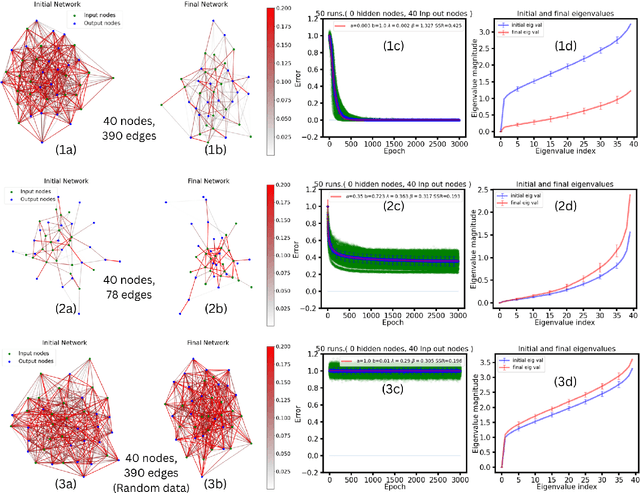


By training linear physical networks to learn linear transformations, we discern how their physical properties evolve due to weight update rules. Our findings highlight a striking similarity between the learning behaviors of such networks and the processes of aging and memory formation in disordered and glassy systems. We show that the learning dynamics resembles an aging process, where the system relaxes in response to repeated application of the feedback boundary forces in presence of an input force, thus encoding a memory of the input-output relationship. With this relaxation comes an increase in the correlation length, which is indicated by the two-point correlation function for the components of the network. We also observe that the square root of the mean-squared error as a function of epoch takes on a non-exponential form, which is a typical feature of glassy systems. This physical interpretation suggests that by encoding more detailed information into input and feedback boundary forces, the process of emergent learning can be rather ubiquitous and, thus, serve as a very early physical mechanism, from an evolutionary standpoint, for learning in biological systems.