 Add to Chrome
 Add to Firefox
 Add to Edge
Stability vs. Manipulability: Evaluating Robustness Under Post-Decision Interaction in LLM Judges
Jun 03, 2026
LLM-as-judge evaluation is widely used in benchmarking pipelines, where model outputs are compared and ranked using automated evaluators. These pipelines typically assume that judgments are stable properties of fixed inputs. We show that this assumption does not hold under interaction. We study post-decision manipulability: the extent to which an evaluation outcome can be altered through subsequent conversation with the judge after an initial decision has been made. Across controlled experiments on MT-Bench and AlpacaEval, we find that LLM judges are highly stable under repeated and neutral reevaluation, yet become substantially reversible under targeted post-decision challenge. An anti-baseline challenge protocol shows that stable judgments can be overturned through motivated interaction, while a counterbalanced target-validation protocol separates this reversibility from net target-directed steering. These reversals have practical consequences: they can degrade agreement with human preferences, shift benchmark rankings, and produce harmful evaluation changes despite high self-reported confidence. Authority framing is especially destabilizing, and revised judgments are often accompanied by low-overlap justifications, suggesting post hoc rationalization rather than reliable error correction. We introduce the Evaluation Robustness Score (ERS) to quantify interactional robustness by combining reversal susceptibility with counterbalanced directional effects. Our findings identify post-decision interaction as a distinct failure mode for LLM-as-judge evaluation and motivate evaluation protocols that measure not only static agreement, but robustness under challenge.

EchoGuard: An Agentic Framework with Knowledge-Graph Memory for Detecting Manipulative Communication in Longitudinal Dialogue
Mar 05, 2026Manipulative communication, such as gaslighting, guilt-tripping, and emotional coercion, is often difficult for individuals to recognize. Existing agentic AI systems lack the structured, longitudinal memory to track these subtle, context-dependent tactics, often failing due to limited context windows and catastrophic forgetting. We introduce EchoGuard, an agentic AI framework that addresses this gap by using a Knowledge Graph (KG) as the agent's core episodic and semantic memory. EchoGuard employs a structured Log-Analyze-Reflect loop: (1) users log interactions, which the agent structures as nodes and edges in a personal, episodic KG (capturing events, emotions, and speakers); (2) the system executes complex graph queries to detect six psychologically-grounded manipulation patterns (stored as a semantic KG); and (3) an LLM generates targeted Socratic prompts grounded by the subgraph of detected patterns, guiding users toward self-discovery. This framework demonstrates how the interplay between agentic architectures and Knowledge Graphs can empower individuals in recognizing manipulative communication while maintaining personal autonomy and safety. We present the theoretical foundation, framework design, a comprehensive evaluation strategy, and a vision to validate this approach.
Equilibrium Dynamics and Mitigation of Gender Bias in Synthetically Generated Data
Nov 12, 2025Recursive prompting with large language models enables scalable synthetic dataset generation but introduces the risk of bias amplification. We investigate gender bias dynamics across three generations of recursive text generation using three complementary evaluation frameworks: rule-based pattern matching, embedding-based semantic similarity, and downstream task performance. Experiments with three initial bias levels (0.1, 0.3, 0.6) and four mitigation strategies reveal equilibrium dynamics rather than monotonic amplification. The low initial bias amplifies toward the model's inherent bias level (+36%), whereas the high initial bias decays toward it (-26%). Among mitigation methods, contrastive augmentation, which introduces gender-swapped variants, achieves significant downstream bias reduction (98.8% for low initial bias and 91% on average) despite producing higher embedding-based bias scores. This paradox demonstrates that semantic similarity metrics may diverge from behavioral fairness outcomes, highlighting the need for multidimensional evaluation in responsible synthetic data generation.
Time Series Viewmakers for Robust Disruption Prediction
Oct 14, 2024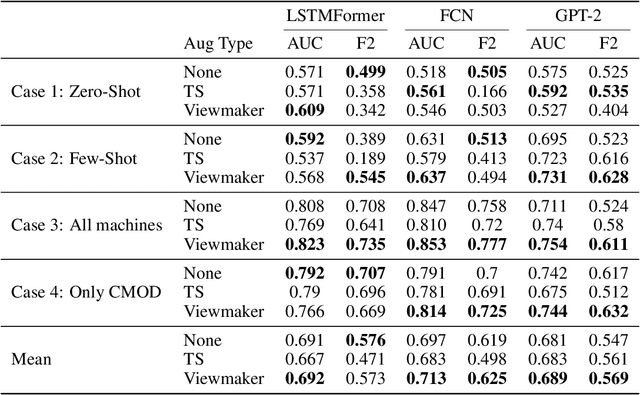


Machine Learning guided data augmentation may support the development of technologies in the physical sciences, such as nuclear fusion tokamaks. Here we endeavor to study the problem of detecting disruptions i.e. plasma instabilities that can cause significant damages, impairing the reliability and efficiency required for their real world viability. Machine learning (ML) prediction models have shown promise in detecting disruptions for specific tokamaks, but they often struggle in generalizing to the diverse characteristics and dynamics of different machines. This limits the effectiveness of ML models across different tokamak designs and operating conditions, which is a critical barrier to scaling fusion technology. Given the success of data augmentation in improving model robustness and generalizability in other fields, this study explores the use of a novel time series viewmaker network to generate diverse augmentations or "views" of training data. Our results show that incorporating views during training improves AUC and F2 scores on DisruptionBench tasks compared to standard or no augmentations. This approach represents a promising step towards developing more broadly applicable ML models for disruption avoidance, which is essential for advancing fusion technology and, ultimately, addressing climate change through reliable and sustainable energy production.