 Add to Chrome
 Add to Firefox
 Add to Edge
Revisiting the Generic Transformer: Deconstructing a Strong Baseline for Time Series Foundation Models
Feb 06, 2026
The recent surge in Time Series Foundation Models has rapidly advanced the field, yet the heterogeneous training setups across studies make it difficult to attribute improvements to architectural innovations versus data engineering. In this work, we investigate the potential of a standard patch Transformer, demonstrating that this generic architecture achieves state-of-the-art zero-shot forecasting performance using a straightforward training protocol. We conduct a comprehensive ablation study that covers model scaling, data composition, and training techniques to isolate the essential ingredients for high performance. Our findings identify the key drivers of performance, while confirming that the generic architecture itself demonstrates excellent scalability. By strictly controlling these variables, we provide comprehensive empirical results on model scaling across multiple dimensions. We release our open-source model and detailed findings to establish a transparent, reproducible baseline for future research.

Abstracted Shapes as Tokens -- A Generalizable and Interpretable Model for Time-series Classification
Nov 01, 2024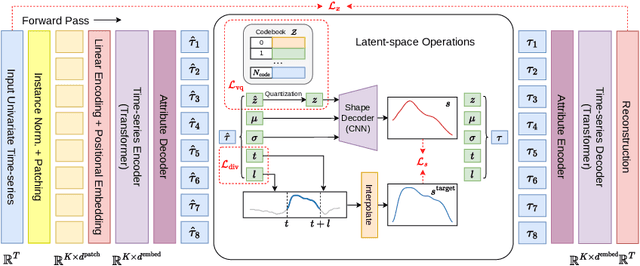
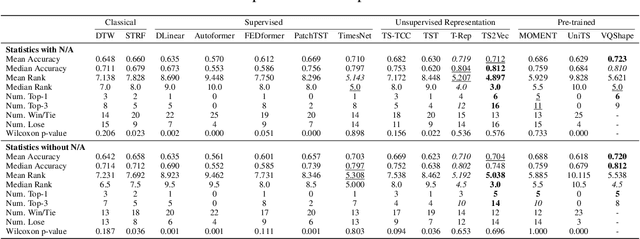
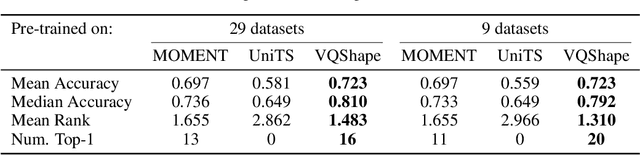
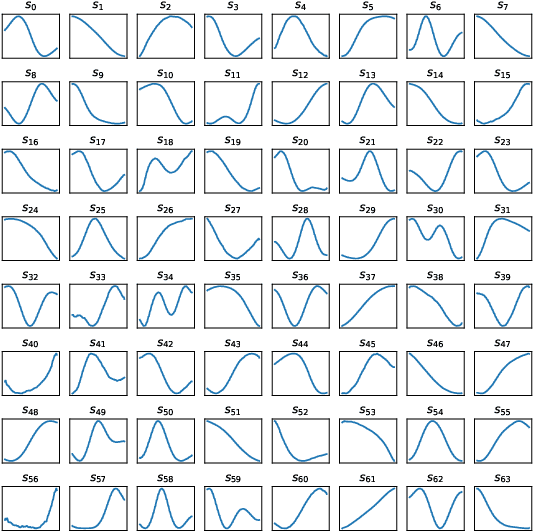
In time-series analysis, many recent works seek to provide a unified view and representation for time-series across multiple domains, leading to the development of foundation models for time-series data. Despite diverse modeling techniques, existing models are black boxes and fail to provide insights and explanations about their representations. In this paper, we present VQShape, a pre-trained, generalizable, and interpretable model for time-series representation learning and classification. By introducing a novel representation for time-series data, we forge a connection between the latent space of VQShape and shape-level features. Using vector quantization, we show that time-series from different domains can be described using a unified set of low-dimensional codes, where each code can be represented as an abstracted shape in the time domain. On classification tasks, we show that the representations of VQShape can be utilized to build interpretable classifiers, achieving comparable performance to specialist models. Additionally, in zero-shot learning, VQShape and its codebook can generalize to previously unseen datasets and domains that are not included in the pre-training process. The code and pre-trained weights are available at https://github.com/YunshiWen/VQShape.