 Add to Chrome
 Add to Firefox
 Add to Edge
In-Context Reinforcement Learning through Bayesian Fusion of Context and Value Prior
Jan 06, 2026
In-context reinforcement learning (ICRL) promises fast adaptation to unseen environments without parameter updates, but current methods either cannot improve beyond the training distribution or require near-optimal data, limiting practical adoption. We introduce SPICE, a Bayesian ICRL method that learns a prior over Q-values via deep ensemble and updates this prior at test-time using in-context information through Bayesian updates. To recover from poor priors resulting from training on sub-optimal data, our online inference follows an Upper-Confidence Bound rule that favours exploration and adaptation. We prove that SPICE achieves regret-optimal behaviour in both stochastic bandits and finite-horizon MDPs, even when pretrained only on suboptimal trajectories. We validate these findings empirically across bandit and control benchmarks. SPICE achieves near-optimal decisions on unseen tasks, substantially reduces regret compared to prior ICRL and meta-RL approaches while rapidly adapting to unseen tasks and remaining robust under distribution shift.

HVAC-DPT: A Decision Pretrained Transformer for HVAC Control
Nov 29, 2024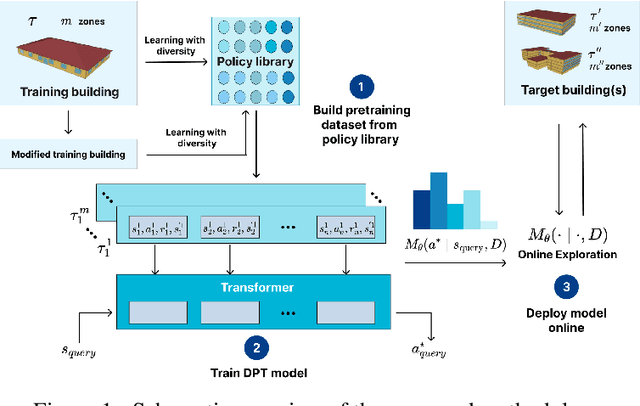
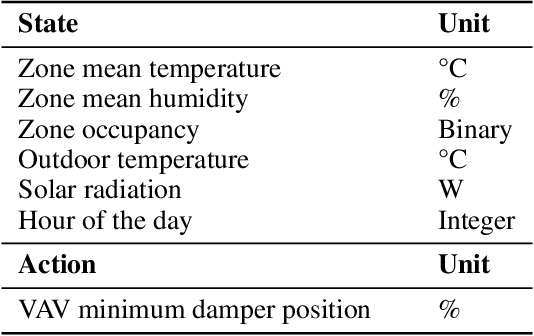
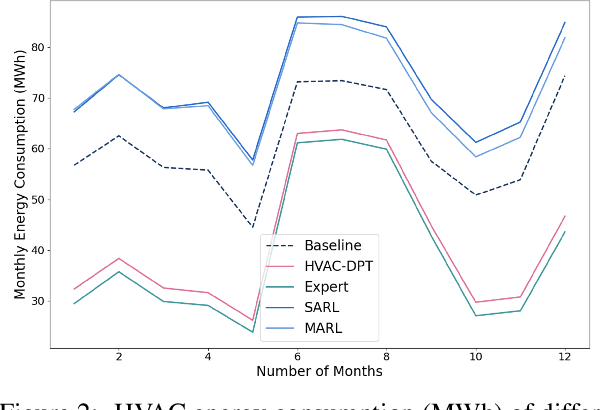
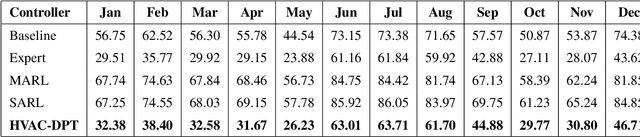
Building operations consume approximately 40% of global energy, with Heating, Ventilation, and Air Conditioning (HVAC) systems responsible for up to 50% of this consumption. As HVAC energy demands are expected to rise, optimising system efficiency is crucial for reducing future energy use and mitigating climate change. Existing control strategies lack generalisation and require extensive training and data, limiting their rapid deployment across diverse buildings. This paper introduces HVAC-DPT, a Decision-Pretrained Transformer using in-context Reinforcement Learning (RL) for multi-zone HVAC control. HVAC-DPT frames HVAC control as a sequential prediction task, training a causal transformer on interaction histories generated by diverse RL agents. This approach enables HVAC-DPT to refine its policy in-context, without modifying network parameters, allowing for deployment across different buildings without the need for additional training or data collection. HVAC-DPT reduces energy consumption in unseen buildings by 45% compared to the baseline controller, offering a scalable and effective approach to mitigating the increasing environmental impact of HVAC systems.