 Add to Chrome
 Add to Firefox
 Add to Edge
Mapping the Political Discourse in the Brazilian Chamber of Deputies: A Multi-Faceted Computational Approach
Apr 23, 2026
Analyses of legislative behavior often rely on voting records, overlooking the rich semantic and rhetorical content of political speech. In this paper, we ask three complementary questions about parliamentary discourse: how things are said, what is being said, and who is speaking in discursively similar ways. To answer these questions, we introduce a scalable and generalizable computational framework that combines diachronic stylometric analysis, contextual topic modeling, and semantic clustering of deputies' speeches. We apply this framework to a large-scale case study of the Brazilian Chamber of Deputies, using a corpus of over 450,000 speeches from 2003 to 2025. Our results show a long-term stylistic shift toward shorter and more direct speeches, a legislative agenda that reorients sharply in response to national crises, and a granular map of discursive alignments in which regional and gender identities often prove more salient than formal party affiliation. More broadly, this work offers a robust methodology for analyzing parliamentary discourse as a multidimensional phenomenon that complements traditional vote-based approaches.

Predicting User Emotional Tone in Mental Disorder Online Communities
May 15, 2020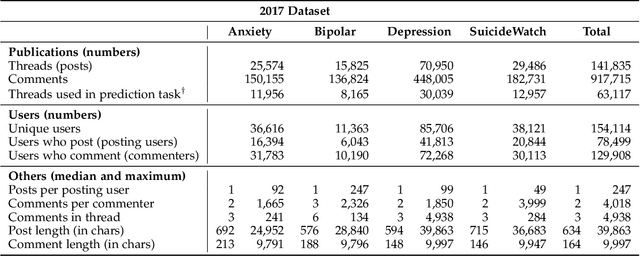
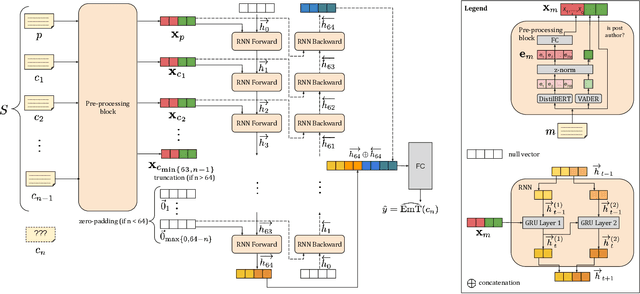
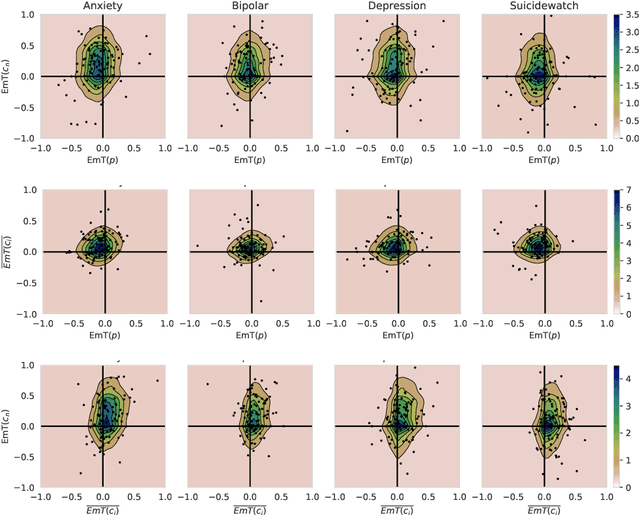

Online Social Networks have become an important medium for communication among people who suffer from mental disorders to share moments of hardship and to seek support. Here we analyze how Reddit discussions can help improve the health conditions of its users. Using emotional tone of user publications as a proxy for his emotional state, we uncover relationships between state changes and interactions he has in a given community. We observe that authors of negative posts often write more positive comments after engaging in discussions. Second, we build models based on state-of-the-art embedding techniques and RNNs to predict shifts in emotional tone. We show that it is possible to predict with good accuracy the reaction of users of mental disorder online communities to the interactions experienced in these platforms. Our models could assist in interventions promoted by health care professionals to provide support to people suffering from mental health illnesses.