 Add to Chrome
 Add to Firefox
 Add to Edge
System Design for a Data-driven and Explainable Customer Sentiment Monitor
Jan 11, 2021
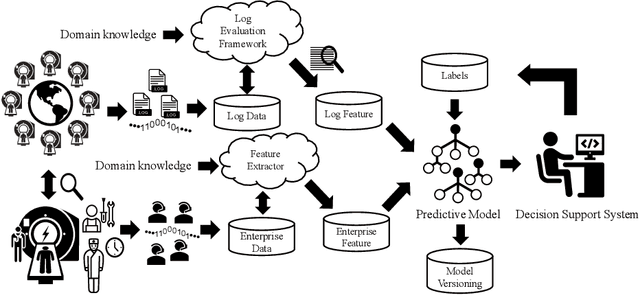
The most important goal of customer services is to keep the customer satisfied. However, service resources are always limited and must be prioritized. Therefore, it is important to identify customers who potentially become unsatisfied and might lead to escalations. Today this prioritization of customers is often done manually. Data science on IoT data (esp. log data) for machine health monitoring, as well as analytics on enterprise data for customer relationship management (CRM) have mainly been researched and applied independently. In this paper, we present a framework for a data-driven decision support system which combines IoT and enterprise data to model customer sentiment. Such decision support systems can help to prioritize customers and service resources to effectively troubleshoot problems or even avoid them. The framework is applied in a real-world case study with a major medical device manufacturer. This includes a fully automated and interpretable machine learning pipeline designed to meet the requirements defined with domain experts and end users. The overall framework is currently deployed, learns and evaluates predictive models from terabytes of IoT and enterprise data to actively monitor the customer sentiment for a fleet of thousands of high-end medical devices. Furthermore, we provide an anonymized industrial benchmark dataset for the research community.

Sampled Nonlocal Gradients for Stronger Adversarial Attacks
Nov 05, 2020
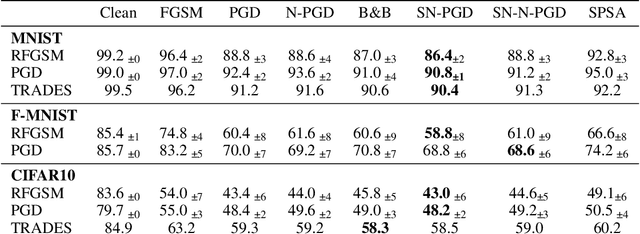


The vulnerability of deep neural networks to small and even imperceptible perturbations has become a central topic in deep learning research. The evaluation of new defense mechanisms for these so-called adversarial attacks has proven to be challenging. Although several sophisticated defense mechanisms were introduced, most of them were later shown to be ineffective. However, a reliable evaluation of model robustness is mandatory for deployment in safety-critical real-world scenarios. We propose a simple yet effective modification to the gradient calculation of state-of-the-art first-order adversarial attacks, which increases their success rate and thus leads to more accurate robustness estimates. Normally, the gradient update of an attack is directly calculated for the given data point. In general, this approach is sensitive to noise and small local optima of the loss function. Inspired by gradient sampling techniques from non-convex optimization, we propose to calculate the gradient direction of the adversarial attack as the weighted average over multiple points in the local vicinity. We empirically show that by incorporating this additional gradient information, we are able to give a more accurate estimation of the global descent direction on noisy and non-convex loss surfaces. Additionally, we show that the proposed method achieves higher success rates than a variety of state-of-the-art attacks on the benchmark datasets MNIST, Fashion-MNIST, and CIFAR10.
Conformance Checking for a Medical Training Process Using Petri net Simulation and Sequence Alignment
Oct 21, 2020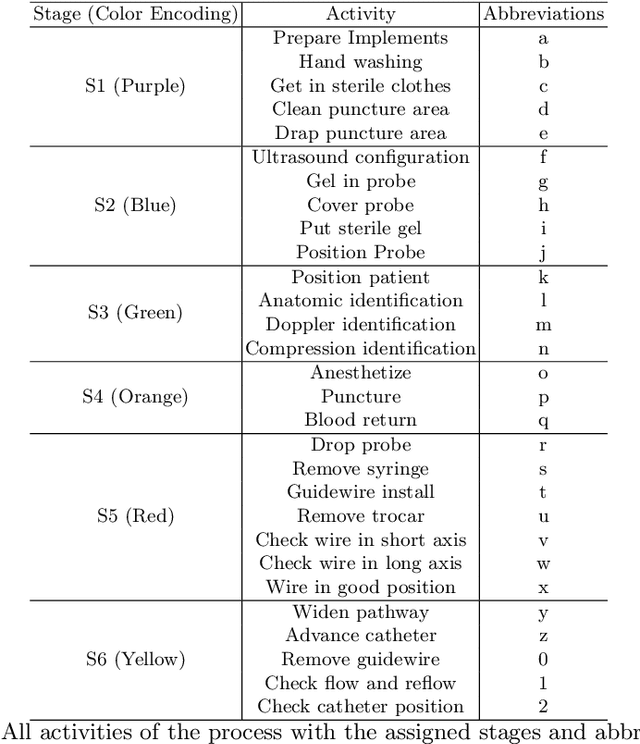

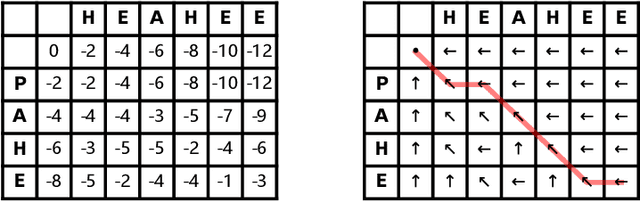

Process Mining has recently gained popularity in healthcare due to its potential to provide a transparent, objective and data-based view on processes. Conformance checking is a sub-discipline of process mining that has the potential to answer how the actual process executions deviate from existing guidelines. In this work, we analyze a medical training process for a surgical procedure. Ten students were trained to install a Central Venous Catheters (CVC) with ultrasound. Event log data was collected directly after instruction by the supervisors during a first test run and additionally after a subsequent individual training phase. In order to provide objective performance measures, we formulate an optimal, global sequence alignment problem inspired by approaches in bioinformatics. Therefore, we use the Petri net model representation of the medical process guideline to simulate a representative set of guideline conform sequences. Next, we calculate the optimal, global sequence alignment of the recorded and simulated event logs. Finally, the output measures and visualization of aligned sequences are provided for objective feedback.
Time Matters: Time-Aware LSTMs for Predictive Business Process Monitoring
Oct 16, 2020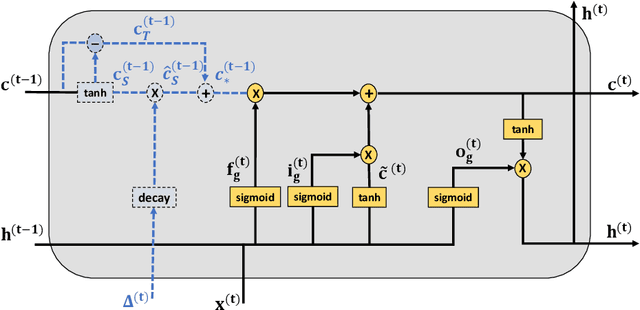
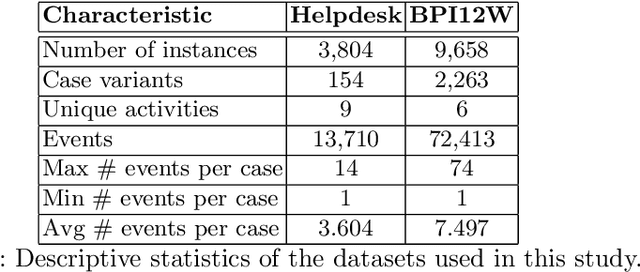
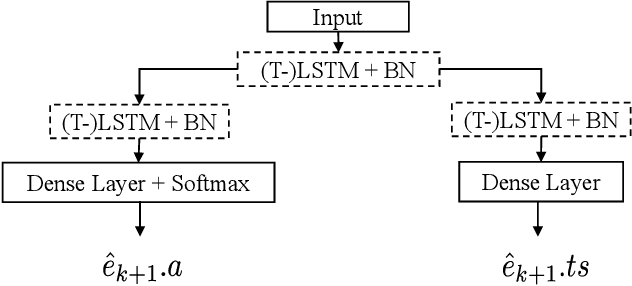
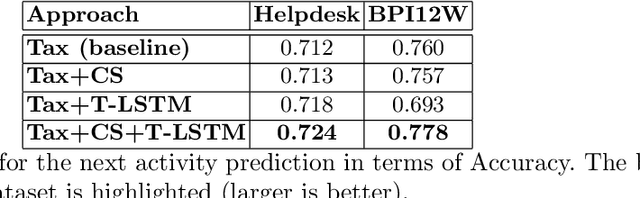
Predictive business process monitoring (PBPM) aims to predict future process behavior during ongoing process executions based on event log data. Especially, techniques for the next activity and timestamp prediction can help to improve the performance of operational business processes. Recently, many PBPM solutions based on deep learning were proposed by researchers. Due to the sequential nature of event log data, a common choice is to apply recurrent neural networks with long short-term memory (LSTM) cells. We argue, that the elapsed time between events is informative. However, current PBPM techniques mainly use 'vanilla' LSTM cells and hand-crafted time-related control flow features. To better model the time dependencies between events, we propose a new PBPM technique based on time-aware LSTM (T-LSTM) cells. T-LSTM cells incorporate the elapsed time between consecutive events inherently to adjust the cell memory. Furthermore, we introduce cost-sensitive learning to account for the common class imbalance in event logs. Our experiments on publicly available benchmark event logs indicate the effectiveness of the introduced techniques.