 Add to Chrome
 Add to Firefox
 Add to Edge
AMAR: Lightweight Attention-Based Multi-User Activity Recognition from Wi-Fi CSI
May 20, 2026
Wi-Fi-based human activity recognition (HAR) has emerged as a promising approach for contactless sensing, leveraging channel state information (CSI) collected from wireless transceivers. While existing studies have primarily concentrated on single-user scenarios, real-world deployments often involve multi-user settings where concurrent users' movements induce overlapping CSI patterns that challenge conventional classification methods. To address this limitation, this paper introduces an attention-based multi-user activity recognition (AMAR) framework that formulates HAR as a set prediction problem. The transformer-based architecture in AMAR leverages learnable query embeddings acting as specialized activity detectors, enabling the simultaneous identification of multiple activities from composite CSI representations. Moreover, to address deployment constraints, AMAR is designed in an edge-cloud split architecture form where lightweight convolutional networks on edge devices perform initial feature extraction, followed by residual vector quantization that achieves substantial bandwidth reduction while preserving activity-discriminative information. The cloud component performs final activity prediction through attention-based set matching, enabling the system to handle varying occupancy levels. Across classroom, meeting-room, and empty-room environments, on average AMAR nearly doubles the rate of perfectly predicting all concurrent activities compared to the best baseline. Moreover, it achieves an $F_1$-score of 53.4% compared to 45.6% for the best benchmark, and reduces occupancy estimation error by 74%, while minimizing bandwidth substantially.

Personalized Federated Learning via Active Sampling
Sep 03, 2024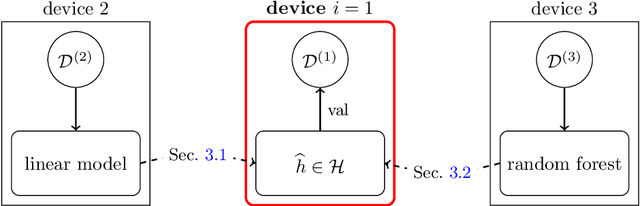
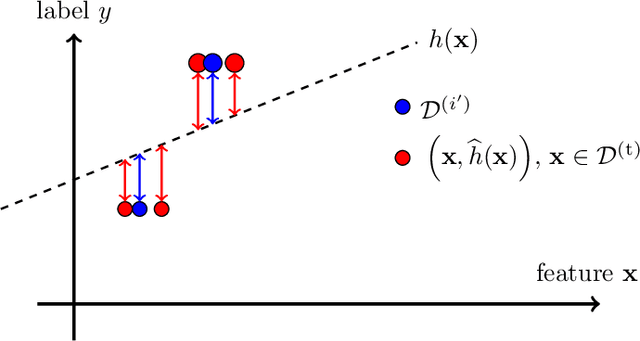
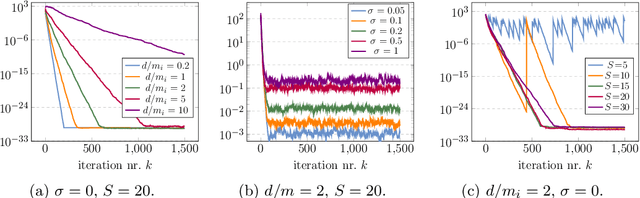
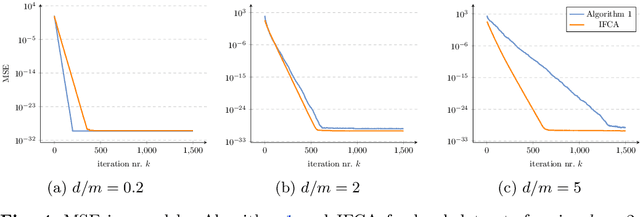
Consider a collection of data generators which could represent, e.g., humans equipped with a smart-phone or wearables. We want to train a personalized (or tailored) model for each data generator even if they provide only small local datasets. The available local datasets might fail to provide sufficient statistical power to train high-dimensional models (such as deep neural networks) effectively. One possible solution is to identify similar data generators and pool their local datasets to obtain a sufficiently large training set. This paper proposes a novel method for sequentially identifying similar (or relevant) data generators. Our method is similar in spirit to active sampling methods but does not require exchange of raw data. Indeed, our method evaluates the relevance of a data generator by evaluating the effect of a gradient step using its local dataset. This evaluation can be performed in a privacy-friendly fashion without sharing raw data. We extend this method to non-parametric models by a suitable generalization of the gradient step to update a hypothesis using the local dataset provided by a data generator.
ACO-tagger: A Novel Method for Part-of-Speech Tagging using Ant Colony Optimization
Mar 27, 2023
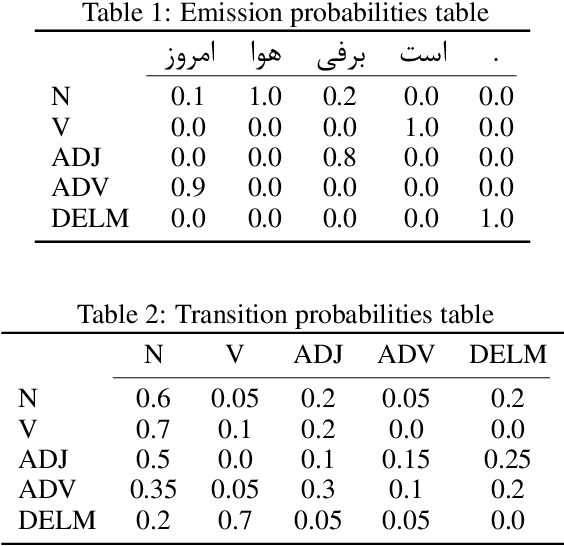
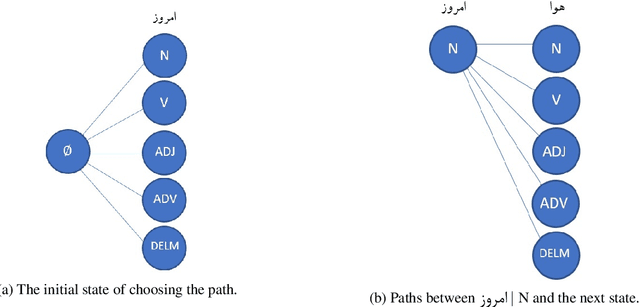

Swarm Intelligence algorithms have gained significant attention in recent years as a means of solving complex and non-deterministic problems. These algorithms are inspired by the collective behavior of natural creatures, and they simulate this behavior to develop intelligent agents for computational tasks. One such algorithm is Ant Colony Optimization (ACO), which is inspired by the foraging behavior of ants and their pheromone laying mechanism. ACO is used for solving difficult problems that are discrete and combinatorial in nature. Part-of-Speech (POS) tagging is a fundamental task in natural language processing that aims to assign a part-of-speech role to each word in a sentence. In this research paper, proposed a high-performance POS-tagging method based on ACO called ACO-tagger. This method achieved a high accuracy rate of 96.867%, outperforming several state-of-the-art methods. The proposed method is fast and efficient, making it a viable option for practical applications.