 Add to Chrome
 Add to Firefox
 Add to Edge
HairPort: In-context 3D-aware Hair Import and Transfer for Images
Jun 10, 2026
Transferring hairstyles between images is an important but challenging task in computer graphics, computer vision, and visual effects. It enables users to explore new looks without physically altering their hair, with applications in virtual try-on systems, augmented reality, and entertainment. Most prior works operate best under small pose gaps, and they fall short under large viewpoint and scale differences, where missing hair content must be synthesized rather than transferred. We propose HairPort, a 3D-aware hairstyle transfer framework that attempts to solve these issues by explicitly separating hair removal from transfer and enforcing geometric consistency before synthesis. We introduce a Bald Converter, which produces realistic bald versions of faces through LoRA-based in-context adaptation of FLUX.1 Kontext. To train our Bald Converter, we introduce a new dataset, Baldy, containing 6,000 paired bald and original images across diverse identities and conditions. We also use a 3D-Aware Transfer Pipeline that reconstructs and re-renders the reference hairstyle from the target viewpoint before compositing it onto the source image. Being 3D aware, our method supports large pose and scale discrepancies between the source and target. Finally, a conditional flow-matching generator synthesizes the transferred result from the bald source and geometry-aligned reference guidance. Together, our method enables accurate, pose-consistent, and identity-preserving hairstyle transfer, outperforming existing methods both qualitatively and quantitatively.

SMITE: Segment Me In TimE
Oct 24, 2024
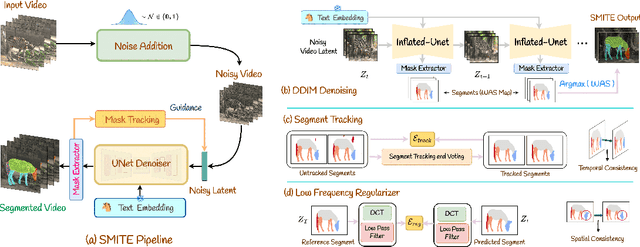
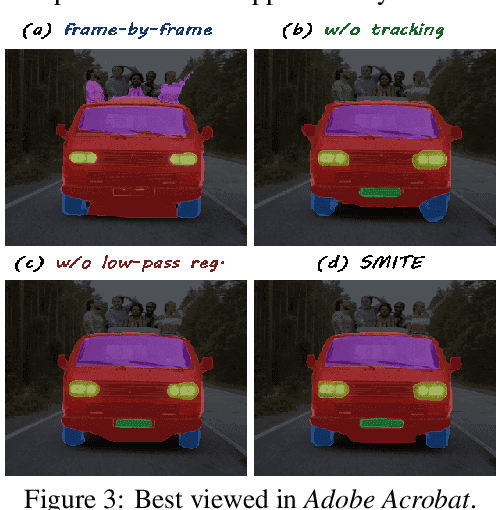
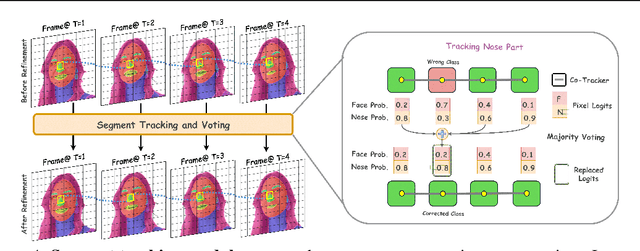
Segmenting an object in a video presents significant challenges. Each pixel must be accurately labelled, and these labels must remain consistent across frames. The difficulty increases when the segmentation is with arbitrary granularity, meaning the number of segments can vary arbitrarily, and masks are defined based on only one or a few sample images. In this paper, we address this issue by employing a pre-trained text to image diffusion model supplemented with an additional tracking mechanism. We demonstrate that our approach can effectively manage various segmentation scenarios and outperforms state-of-the-art alternatives.
Toward Reliable Human Pose Forecasting with Uncertainty
Apr 13, 2023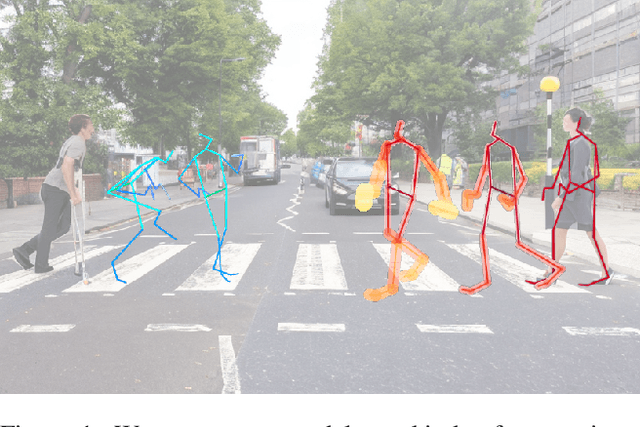
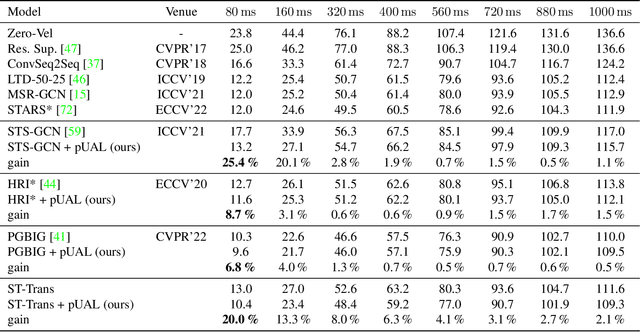
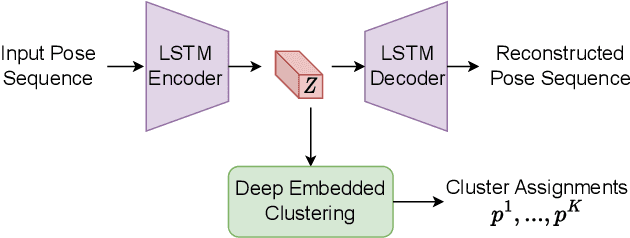
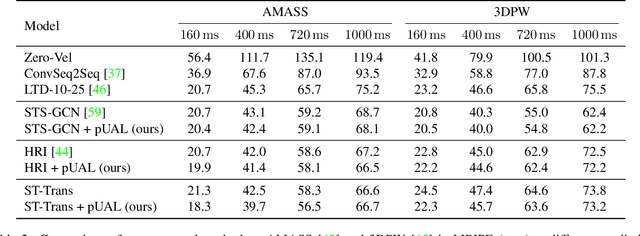
Recently, there has been an arms race of pose forecasting methods aimed at solving the spatio-temporal task of predicting a sequence of future 3D poses of a person given a sequence of past observed ones. However, the lack of unified benchmarks and limited uncertainty analysis have hindered progress in the field. To address this, we first develop an open-source library for human pose forecasting, featuring multiple models, datasets, and standardized evaluation metrics, with the aim of promoting research and moving toward a unified and fair evaluation. Second, we devise two types of uncertainty in the problem to increase performance and convey better trust: 1) we propose a method for modeling aleatoric uncertainty by using uncertainty priors to inject knowledge about the behavior of uncertainty. This focuses the capacity of the model in the direction of more meaningful supervision while reducing the number of learned parameters and improving stability; 2) we introduce a novel approach for quantifying the epistemic uncertainty of any model through clustering and measuring the entropy of its assignments. Our experiments demonstrate up to $25\%$ improvements in accuracy and better performance in uncertainty estimation.