 Add to Chrome
 Add to Firefox
 Add to Edge
Robust Control under Stationary Ambiguity
Aug 05, 2026
Control policies optimized in simulation can perform poorly in the real system when the parameters $x$ of the simulator are estimated from limited data but the resulting parameter uncertainty is not represented inside the simulation. A common way to incorporate such ambiguity is to simulate each trajectory of the system under a randomly drawn value for $x$. Since the policy cannot observe the drawn value, it must initially choose controls that perform well across many possible parameter values. However, if the policy progressively observes the system, it can often gradually infer the value of $x$, so that ambiguity vanishes. Over time, the policy then specializes to its estimate of $x$ and loses its robustness. This is undesirable in many real systems, where latent factors are expected to shift. In financial markets, for example, a policy hedging a derivative payoff should remain robust to changes in the volatility regime. To induce such continual robustness, we propose training policies in simulators where ambiguity varies with the system's state but does not systematically decay over time. We formalize this requirement as stationary ambiguity: the simulator should induce a stationary filter process over the latent state. We show how to construct such simulators and demonstrate, on hedging problems, that policies trained under stationary ambiguity preserve robustness to latent factors over time, leading to strong performance on real market data. As a modeling principle, stationary ambiguity informs many simulator design decisions: which models make realistic simulators, how their parameters should be randomized, and how simulator and policy should be initialized. While our experiments focus on hedging, stationary ambiguity may also be useful for other sequential control problems driven by exogenous stochastic processes with shifting latent structure.

Fast Deep Hedging with Second-Order Optimization
Oct 29, 2024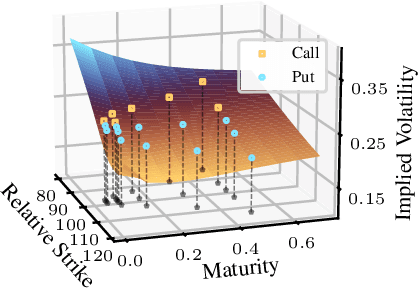
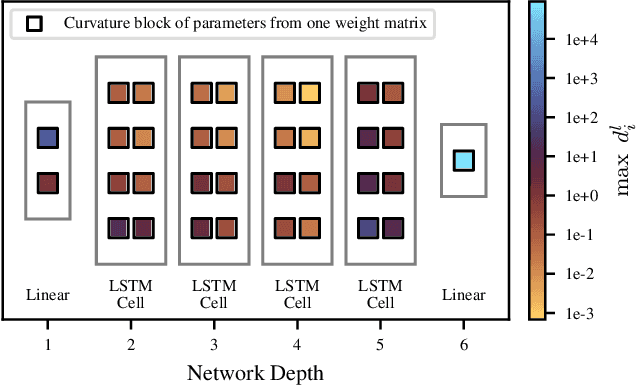
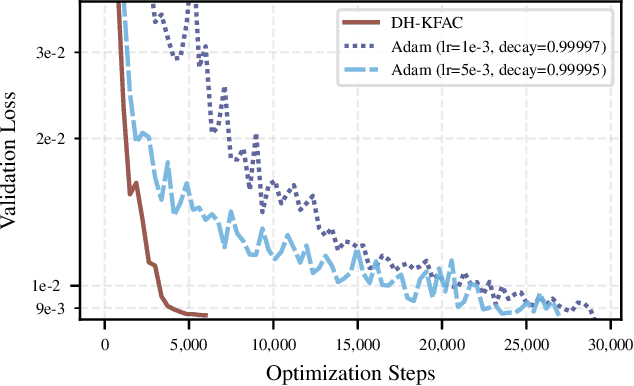
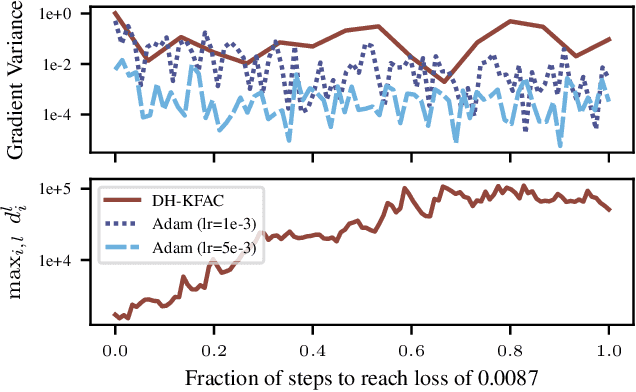
Hedging exotic options in presence of market frictions is an important risk management task. Deep hedging can solve such hedging problems by training neural network policies in realistic simulated markets. Training these neural networks may be delicate and suffer from slow convergence, particularly for options with long maturities and complex sensitivities to market parameters. To address this, we propose a second-order optimization scheme for deep hedging. We leverage pathwise differentiability to construct a curvature matrix, which we approximate as block-diagonal and Kronecker-factored to efficiently precondition gradients. We evaluate our method on a challenging and practically important problem: hedging a cliquet option on a stock with stochastic volatility by trading in the spot and vanilla options. We find that our second-order scheme can optimize the policy in 1/4 of the number of steps that standard adaptive moment-based optimization takes.