 Add to Chrome
 Add to Firefox
 Add to Edge
SKILL.nb: Selective Formalization and Gated Execution for Durable Agent Workflows
Jun 06, 2026
AI agents increasingly turn past experience into reusable artifacts such as code, workflows, and procedural memories. Reuse can improve efficiency, but it also creates a lifecycle reliability problem: artifacts that succeed once may fail under environment drift, underspecified tasks, or changing task distributions, especially in web automation. We introduce SKILL.nb, a framework for governing reusable agent workflows with evidence-calibrated lifecycle policies. SKILL.nb uses selective formalization: execution evidence decides which workflow steps should become executable code, which should remain natural-language guided, and when those choices should be revised. Workflows are stored as auditable, versioned notebooks that interleave natural-language guidance, multi-language executable cells, validation gates, fallback paths, and multimodal evidence such as outputs, screenshots, and error traces. At runtime, gate-conditioned execution lets each step run code when its gates validate, or fall back locally when drift invalidates the executable realization. On WebArena-Verified, SKILL.nb achieves 53.7% single-round success, improving over the strongest baseline by 3.9 percentage points. Across three re-executions, it retains 91.7% of initially successful tasks, 15.5 points above the next best method. Under bounded repair, it recovers 72.9% of subsequent failures while limiting post-repair regressions to 4.2%, compared with 15.0% to 17.0% for persistent baselines. It also leads on Mind2Web cross-website and cross-domain splits. In a GitLab migration test, SKILL.nb preserves performance when reusing frozen state learned on GitLab 15.7, with frozen-versus-fresh target-version gaps of -1.7 points on GitLab 16.11 and +0.6 points on GitLab 18.9. These results identify lifecycle governance and gate-conditioned execution as reliability axes beyond one-shot task success.

Workflow Discovery from Dialogues in the Low Data Regime
May 24, 2022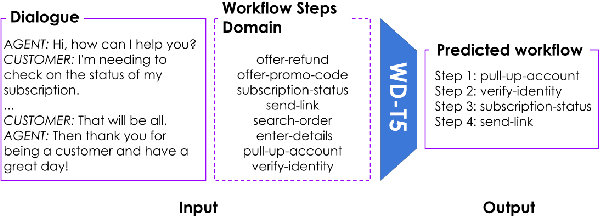
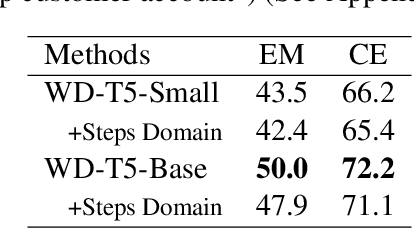
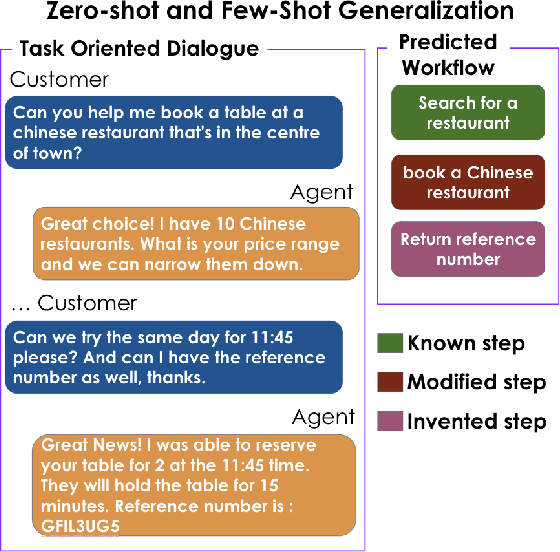
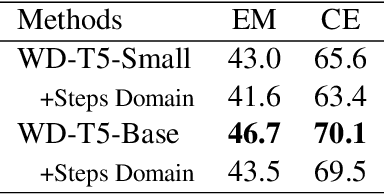
Text-based dialogues are now widely used to solve real-world problems. In cases where solution strategies are already known, they can sometimes be codified into workflows and used to guide humans or artificial agents through the task of helping clients. We are interested in the situation where a formal workflow may not yet exist, but we wish to discover the steps of actions that have been taken to resolve problems. We examine a novel transformer-based approach for this situation and we present experiments where we summarize dialogues in the Action-Based Conversations Dataset (ABCD) with workflows. Since the ABCD dialogues were generated using known workflows to guide agents we can evaluate our ability to extract such workflows using ground truth sequences of action steps, organized as workflows. We propose and evaluate an approach that conditions models on the set of allowable action steps and we show that using this strategy we can improve workflow discovery (WD) performance. Our conditioning approach also improves zero-shot and few-shot WD performance when transferring learned models to entirely new domains (i.e. the MultiWOZ setting). Further, a modified variant of our architecture achieves state-of-the-art performance on the related but different problems of Action State Tracking (AST) and Cascading Dialogue Success (CDS) on the ABCD.