 Add to Chrome
 Add to Firefox
 Add to Edge
CPT: Controllable and Editable Design Variations with Language Models
Apr 06, 2026
Designing visually diverse and high-quality designs remains a manual, time-consuming process, limiting scalability and personalization in creative workflows. We present a system for generating editable design variations using a decoder-only language model, the Creative Pre-trained Transformer (CPT), trained to predict visual style attributes in design templates. At the core of our approach is a new representation called Creative Markup Language (CML), a compact, machine-learning-friendly format that captures canvas-level structure, page layout, and element-level details (text, images, and vector graphics), including both content and style. We fine-tune CPT on a large corpus of design templates authored by professional designers, enabling it to learn meaningful, context-aware predictions for attributes such as color schemes and font choices. The model produces semantically structured and stylistically coherent outputs, preserving internal consistency across elements. Unlike generative image models, our system yields fully editable design documents rather than pixel-only images, allowing users to iterate and personalize within a design editor. In experiments, our approach generates contextual color and font variations for existing templates and shows promise in adjusting layouts while maintaining design principles.

Multiple Instance Fuzzy Inference Neural Networks
Oct 17, 2016


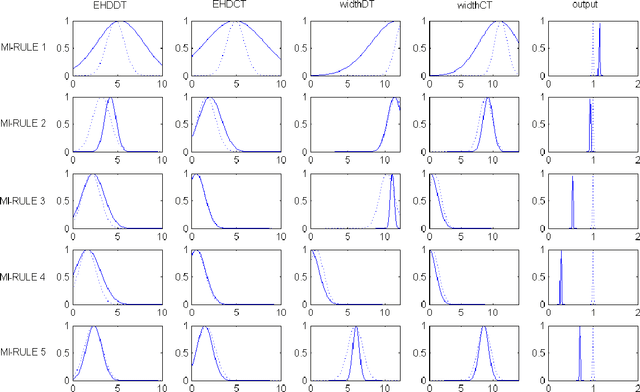
Fuzzy logic is a powerful tool to model knowledge uncertainty, measurements imprecision, and vagueness. However, there is another type of vagueness that arises when data have multiple forms of expression that fuzzy logic does not address quite well. This is the case for multiple instance learning problems (MIL). In MIL, an object is represented by a collection of instances, called a bag. A bag is labeled negative if all of its instances are negative, and positive if at least one of its instances is positive. Positive bags encode ambiguity since the instances themselves are not labeled. In this paper, we introduce fuzzy inference systems and neural networks designed to handle bags of instances as input and capable of learning from ambiguously labeled data. First, we introduce the Multiple Instance Sugeno style fuzzy inference (MI-Sugeno) that extends the standard Sugeno style inference to handle reasoning with multiple instances. Second, we use MI-Sugeno to define and develop Multiple Instance Adaptive Neuro Fuzzy Inference System (MI-ANFIS). We expand the architecture of the standard ANFIS to allow reasoning with bags and derive a learning algorithm using backpropagation to identify the premise and consequent parameters of the network. The proposed inference system is tested and validated using synthetic and benchmark datasets suitable for MIL problems. We also apply the proposed MI-ANFIS to fuse the output of multiple discrimination algorithms for the purpose of landmine detection using Ground Penetrating Radar.