 Add to Chrome
 Add to Firefox
 Add to Edge
Contextualized Counterspeech Can Be More Persuasive Than Generic Counterspeech
Jul 28, 2026
AI-generated counterspeech offers a scalable and effective strategy to mitigate online toxicity by promoting more constructive dialogue. Yet, existing approaches adopt a generic, one-size-fits-all paradigm, overlooking the conversational context and characteristics of the targeted users. Here, we propose and evaluate multiple strategies for generating contextualized counterspeech that is adapted to the moderation setting and personalized to the moderated user. In detail, we explore a range of configurations that integrate different forms of contextual information and fine-tuning techniques. We conduct a comprehensive evaluation combining quantitative indicators with a pre-registered, mixed-design crowdsourcing experiment. To ensure robustness, we implement algorithmic measures of counterspeech quality based on ROUGE, BLEU, and BERTScore, observing overall consistent results across metrics. Furthermore, we analyze which characteristics of both the generated counterspeech and the moderated toxic message most strongly influence perceived persuasiveness, yielding insights into how contextualized interventions can be made more effective. Our findings show that personalization can be effective, but not uniformly so. Lightweight strategies combining conversational context and user history improve perceived adequacy and persuasiveness, whereas several other contextualization strategies degrade human-perceived counterspeech quality. Taken together, these results provide actionable directions for developing more personalized, effective, and responsible counterspeech systems, ultimately advancing human-AI collaboration in online content moderation.

Contextualized Counterspeech: Strategies for Adaptation, Personalization, and Evaluation
Dec 10, 2024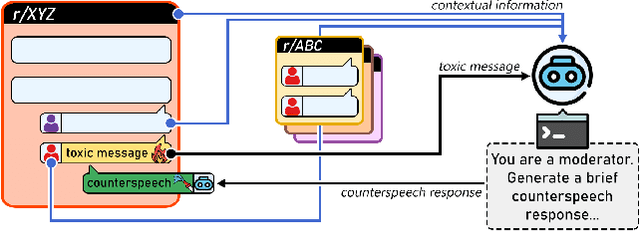
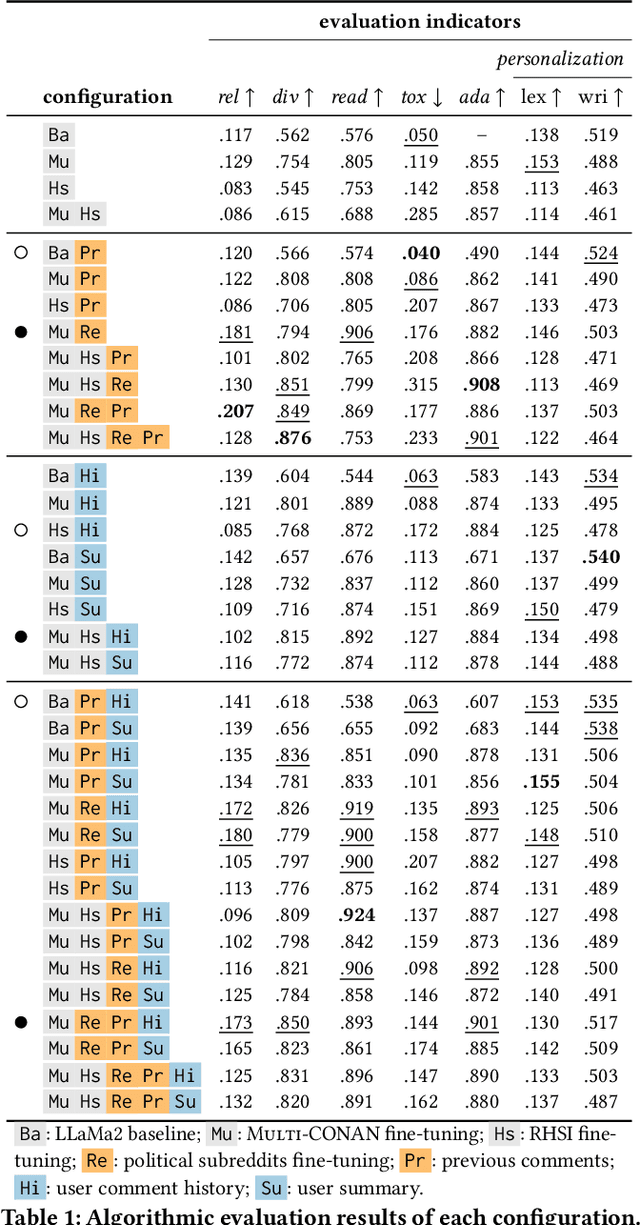
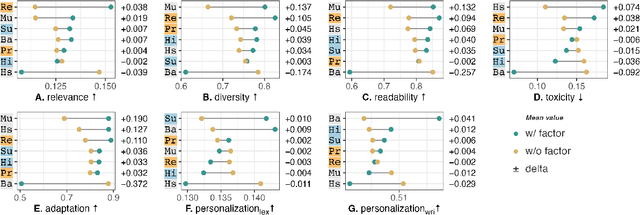
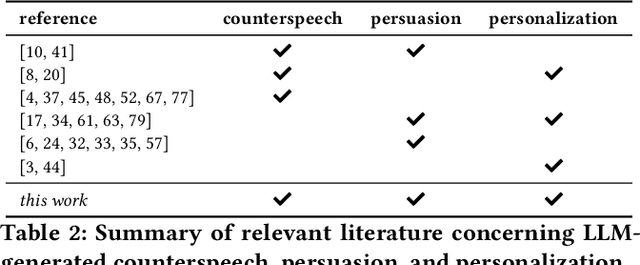
AI-generated counterspeech offers a promising and scalable strategy to curb online toxicity through direct replies that promote civil discourse. However, current counterspeech is one-size-fits-all, lacking adaptation to the moderation context and the users involved. We propose and evaluate multiple strategies for generating tailored counterspeech that is adapted to the moderation context and personalized for the moderated user. We instruct an LLaMA2-13B model to generate counterspeech, experimenting with various configurations based on different contextual information and fine-tuning strategies. We identify the configurations that generate persuasive counterspeech through a combination of quantitative indicators and human evaluations collected via a pre-registered mixed-design crowdsourcing experiment. Results show that contextualized counterspeech can significantly outperform state-of-the-art generic counterspeech in adequacy and persuasiveness, without compromising other characteristics. Our findings also reveal a poor correlation between quantitative indicators and human evaluations, suggesting that these methods assess different aspects and highlighting the need for nuanced evaluation methodologies. The effectiveness of contextualized AI-generated counterspeech and the divergence between human and algorithmic evaluations underscore the importance of increased human-AI collaboration in content moderation.
The DSA Transparency Database: Auditing Self-reported Moderation Actions by Social Media
Dec 16, 2023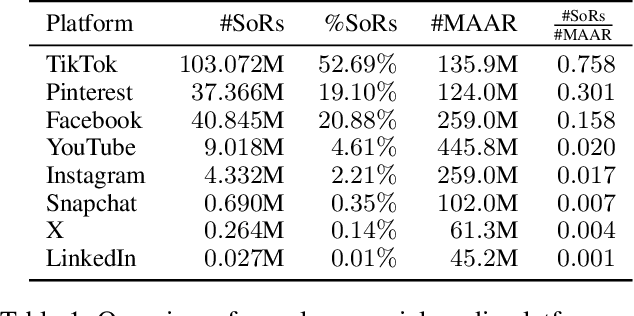
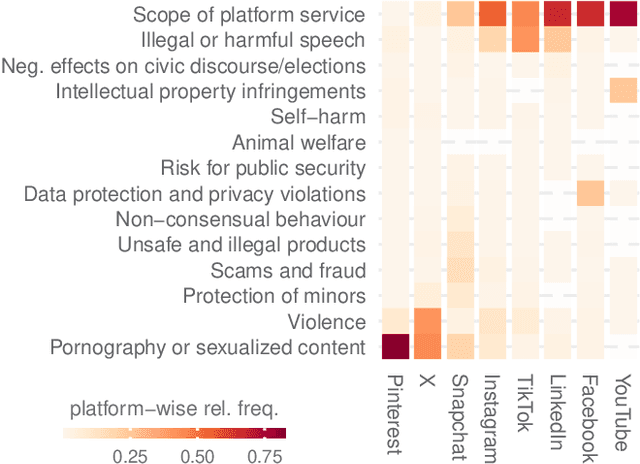
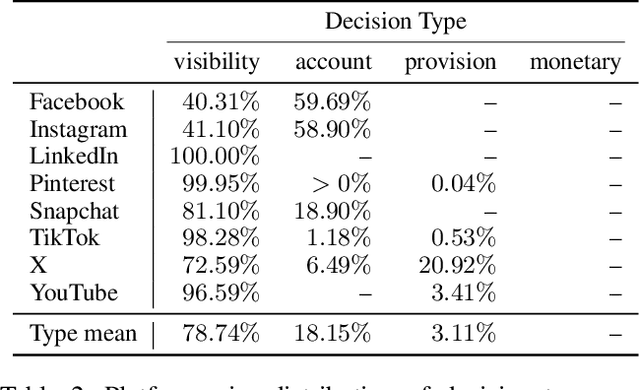
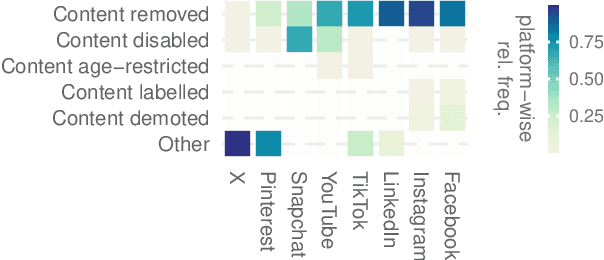
Since September 2023, the Digital Services Act (DSA) obliges large online platforms to submit detailed data on each moderation action they take within the European Union (EU) to the DSA Transparency Database. From its inception, this centralized database has sparked scholarly interest as an unprecedented and potentially unique trove of data on real-world online moderation. Here, we thoroughly analyze all 195.61M records submitted by the eight largest social media platforms in the EU during the first 60 days of the database. Specifically, we conduct a platform-wise comparative study of their: volume of moderation actions, grounds for decision, types of applied restrictions, types of moderated content, timeliness in undertaking and submitting moderation actions, and use of automation. Furthermore, we systematically cross-check the contents of the database with the platforms' own transparency reports. Our analyses reveal that (i) the platforms adhered only in part to the philosophy and structure of the database, (ii) the structure of the database is partially inadequate for the platforms' reporting needs, (iii) the platforms exhibited substantial differences in their moderation actions, (iv) a remarkable fraction of the database data is inconsistent, (v) the platform X (formerly Twitter) presents the most inconsistencies. Our findings have far-reaching implications for policymakers and scholars across diverse disciplines. They offer guidance for future regulations that cater to the reporting needs of online platforms in general, but also highlight opportunities to improve and refine the database itself.
Personalized Interventions for Online Moderation
May 19, 2022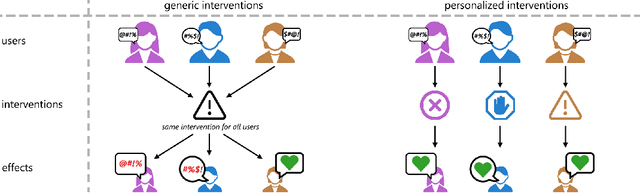
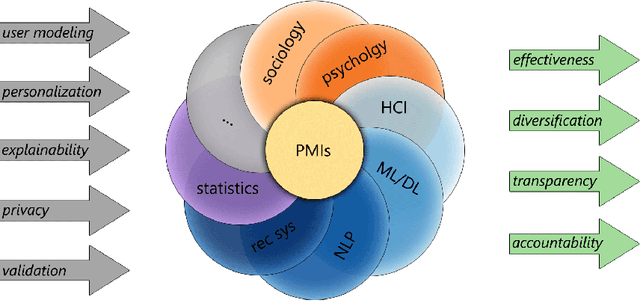
Current online moderation follows a one-size-fits-all approach, where each intervention is applied in the same way to all users. This naive approach is challenged by established socio-behavioral theories and by recent empirical results that showed the limited effectiveness of such interventions. We propose a paradigm-shift in online moderation by moving towards a personalized and user-centered approach. Our multidisciplinary vision combines state-of-the-art theories and practices in diverse fields such as computer science, sociology and psychology, to design personalized moderation interventions (PMIs). In outlining the path leading to the next-generation of moderation interventions, we also discuss the most prominent challenges introduced by such a disruptive change.