 Add to Chrome
 Add to Firefox
 Add to Edge
ASMa: Asymmetric Spatio-temporal Masking for Skeleton Action Representation Learning
Feb 05, 2026
Self-supervised learning (SSL) has shown remarkable success in skeleton-based action recognition by leveraging data augmentations to learn meaningful representations. However, existing SSL methods rely on data augmentations that predominantly focus on masking high-motion frames and high-degree joints such as joints with degree 3 or 4. This results in biased and incomplete feature representations that struggle to generalize across varied motion patterns. To address this, we propose Asymmetric Spatio-temporal Masking (ASMa) for Skeleton Action Representation Learning, a novel combination of masking to learn a full spectrum of spatio-temporal dynamics inherent in human actions. ASMa employs two complementary masking strategies: one that selectively masks high-degree joints and low-motion, and another that masks low-degree joints and high-motion frames. These masking strategies ensure a more balanced and comprehensive skeleton representation learning. Furthermore, we introduce a learnable feature alignment module to effectively align the representations learned from both masked views. To facilitate deployment in resource-constrained settings and on low-resource devices, we compress the learned and aligned representation into a lightweight model using knowledge distillation. Extensive experiments on NTU RGB+D 60, NTU RGB+D 120, and PKU-MMD datasets demonstrate that our approach outperforms existing SSL methods with an average improvement of 2.7-4.4% in fine-tuning and up to 5.9% in transfer learning to noisy datasets and achieves competitive performance compared to fully supervised baselines. Our distilled model achieves 91.4% parameter reduction and 3x faster inference on edge devices while maintaining competitive accuracy, enabling practical deployment in resource-constrained scenarios.

InfGraND: An Influence-Guided GNN-to-MLP Knowledge Distillation
Jan 12, 2026Graph Neural Networks (GNNs) are the go-to model for graph data analysis. However, GNNs rely on two key operations - aggregation and update, which can pose challenges for low-latency inference tasks or resource-constrained scenarios. Simple Multi-Layer Perceptrons (MLPs) offer a computationally efficient alternative. Yet, training an MLP in a supervised setting often leads to suboptimal performance. Knowledge Distillation (KD) from a GNN teacher to an MLP student has emerged to bridge this gap. However, most KD methods either transfer knowledge uniformly across all nodes or rely on graph-agnostic indicators such as prediction uncertainty. We argue this overlooks a more fundamental, graph-centric inquiry: "How important is a node to the structure of the graph?" We introduce a framework, InfGraND, an Influence-guided Graph KNowledge Distillation from GNN to MLP that addresses this by identifying and prioritizing structurally influential nodes to guide the distillation process, ensuring that the MLP learns from the most critical parts of the graph. Additionally, InfGraND embeds structural awareness in MLPs through one-time multi-hop neighborhood feature pre-computation, which enriches the student MLP's input and thus avoids inference-time overhead. Our rigorous evaluation in transductive and inductive settings across seven homophilic graph benchmark datasets shows InfGraND consistently outperforms prior GNN to MLP KD methods, demonstrating its practicality for numerous latency-critical applications in real-world settings.
SDA-GRIN for Adaptive Spatial-Temporal Multivariate Time Series Imputation
Oct 04, 2024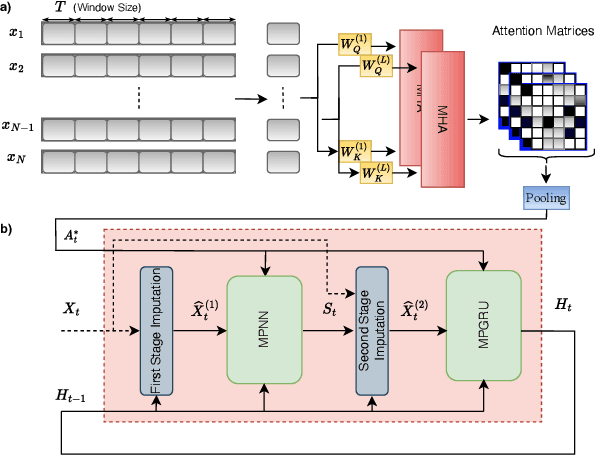
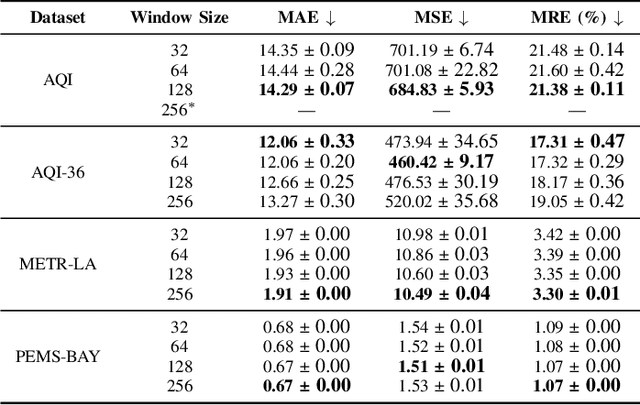
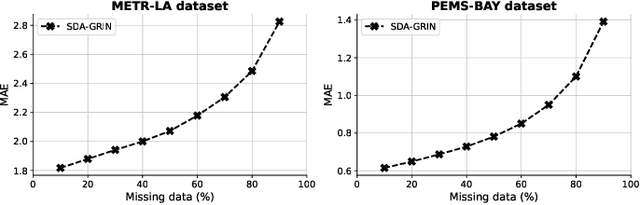
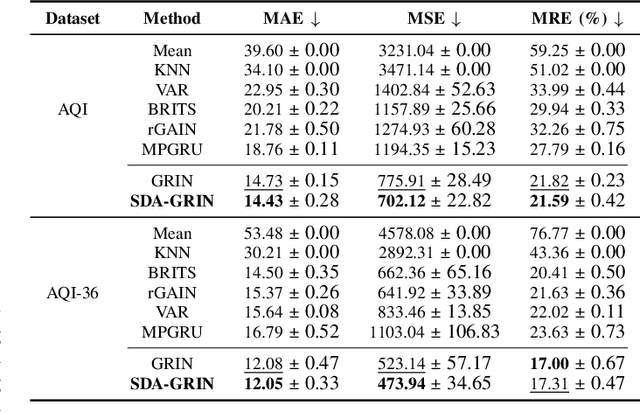
In various applications, the multivariate time series often suffers from missing data. This issue can significantly disrupt systems that rely on the data. Spatial and temporal dependencies can be leveraged to impute the missing samples. Existing imputation methods often ignore dynamic changes in spatial dependencies. We propose a Spatial Dynamic Aware Graph Recurrent Imputation Network (SDA-GRIN) which is capable of capturing dynamic changes in spatial dependencies.SDA-GRIN leverages a multi-head attention mechanism to adapt graph structures with time. SDA-GRIN models multivariate time series as a sequence of temporal graphs and uses a recurrent message-passing architecture for imputation. We evaluate SDA-GRIN on four real-world datasets: SDA-GRIN improves MSE by 9.51% for the AQI and 9.40% for AQI-36. On the PEMS-BAY dataset, it achieves a 1.94% improvement in MSE. Detailed ablation study demonstrates the effect of window sizes and missing data on the performance of the method. Project page:https://ameskandari.github.io/sda-grin/
Survey: Transformer-based Models in Data Modality Conversion
Aug 08, 2024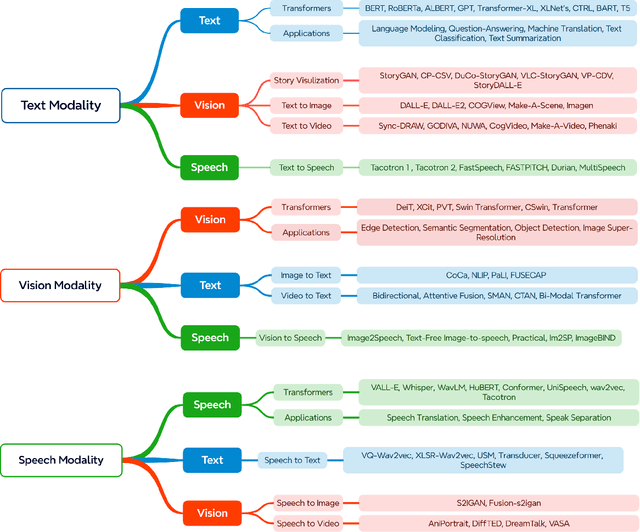
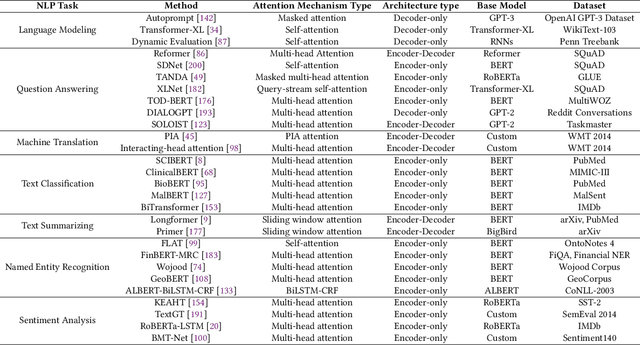

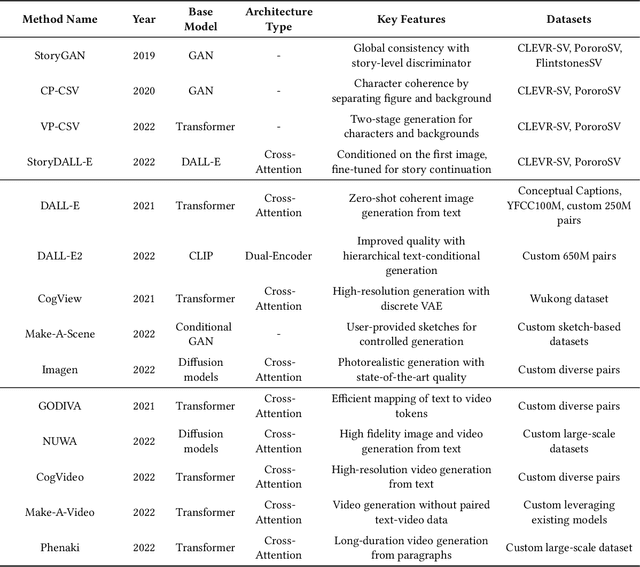
Transformers have made significant strides across various artificial intelligence domains, including natural language processing, computer vision, and audio processing. This success has naturally garnered considerable interest from both academic and industry researchers. Consequently, numerous Transformer variants (often referred to as X-formers) have been developed for these fields. However, a thorough and systematic review of these modality-specific conversions remains lacking. Modality Conversion involves the transformation of data from one form of representation to another, mimicking the way humans integrate and interpret sensory information. This paper provides a comprehensive review of transformer-based models applied to the primary modalities of text, vision, and speech, discussing their architectures, conversion methodologies, and applications. By synthesizing the literature on modality conversion, this survey aims to underline the versatility and scalability of transformers in advancing AI-driven content generation and understanding.