 Add to Chrome
 Add to Firefox
 Add to Edge
NAP: Attention-Based Late Fusion for Automatic Sleep Staging
Nov 05, 2025
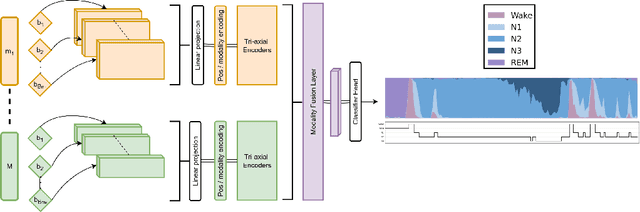
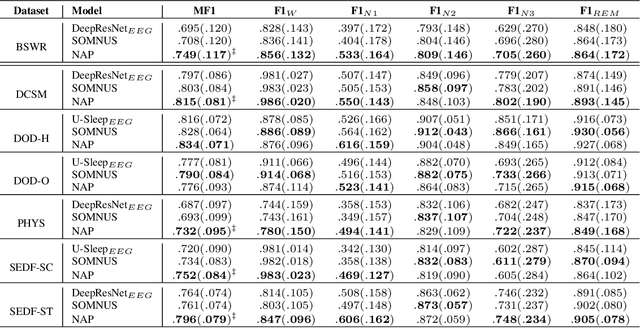
Polysomnography signals are highly heterogeneous, varying in modality composition (e.g., EEG, EOG, ECG), channel availability (e.g., frontal, occipital EEG), and acquisition protocols across datasets and clinical sites. Most existing models that process polysomnography data rely on a fixed subset of modalities or channels and therefore neglect to fully exploit its inherently multimodal nature. We address this limitation by introducing NAP (Neural Aggregator of Predictions), an attention-based model which learns to combine multiple prediction streams using a tri-axial attention mechanism that captures temporal, spatial, and predictor-level dependencies. NAP is trained to adapt to different input dimensions. By aggregating outputs from frozen, pretrained single-channel models, NAP consistently outperforms individual predictors and simple ensembles, achieving state-of-the-art zero-shot generalization across multiple datasets. While demonstrated in the context of automated sleep staging from polysomnography, the proposed approach could be extended to other multimodal physiological applications.

SLEEPYLAND: trust begins with fair evaluation of automatic sleep staging models
Jun 11, 2025Despite advances in deep learning for automatic sleep staging, clinical adoption remains limited due to challenges in fair model evaluation, generalization across diverse datasets, model bias, and variability in human annotations. We present SLEEPYLAND, an open-source sleep staging evaluation framework designed to address these barriers. It includes more than 220'000 hours in-domain (ID) sleep recordings, and more than 84'000 hours out-of-domain (OOD) sleep recordings, spanning a broad range of ages, sleep-wake disorders, and hardware setups. We release pre-trained models based on high-performing SoA architectures and evaluate them under standardized conditions across single- and multi-channel EEG/EOG configurations. We introduce SOMNUS, an ensemble combining models across architectures and channel setups via soft voting. SOMNUS achieves robust performance across twenty-four different datasets, with macro-F1 scores between 68.7% and 87.2%, outperforming individual models in 94.9% of cases. Notably, SOMNUS surpasses previous SoA methods, even including cases where compared models were trained ID while SOMNUS treated the same data as OOD. Using a subset of the BSWR (N=6'633), we quantify model biases linked to age, gender, AHI, and PLMI, showing that while ensemble improves robustness, no model architecture consistently minimizes bias in performance and clinical markers estimation. In evaluations on OOD multi-annotated datasets (DOD-H, DOD-O), SOMNUS exceeds the best human scorer, i.e., MF1 85.2% vs 80.8% on DOD-H, and 80.2% vs 75.9% on DOD-O, better reproducing the scorer consensus than any individual expert (k = 0.89/0.85 and ACS = 0.95/0.94 for healthy/OSA cohorts). Finally, we introduce ensemble disagreement metrics - entropy and inter-model divergence based - predicting regions of scorer disagreement with ROC AUCs up to 0.828, offering a data-driven proxy for human uncertainty.