 Add to Chrome
 Add to Firefox
 Add to Edge
Harmonization mitigates diffusion MRI scanner effects in infancy: insights from the HEALthy Brain and Childhood Development (HBCD) study
Mar 31, 2026
The HEALthy Brain and Childhood Development (HBCD) Study is an ongoing longitudinal initiative to understand population-level brain maturation; however, large-scale studies must overcome site-related variance and preserve biologically relevant signal. In addition to diffusion-weighted magnetic resonance imaging images, the HBCD dataset offers analysis-ready derivatives for scientists to conduct their analysis, including scalar diffusion tensor (DTI) metrics in a predetermined set of bundles. The purpose of this study is to characterize HBCD-specific site effects in diffusion MRI data, which have not been systematically reported. In this work, we investigate the sensitivity of HBCD bundle metrics to scanner model-related variance and address these variations with ComBat-GAM harmonization within the current HBCD data release 1.1 across six scanner models. Following ComBat-GAM, we observe zero statistically significant differences between the distributions from any scanner model following FDR correction and reduce Cohen's f effect sizes across all metrics. Our work underscores the importance of rigorous harmonization efforts in large-scale studies, and we encourage future investigations of HBCD data to control for these effects.

MRI correlates of chronic symptoms in mild traumatic brain injury
Dec 06, 2019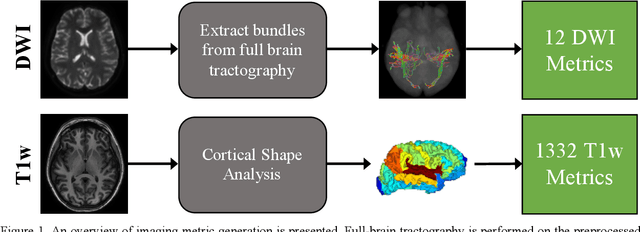
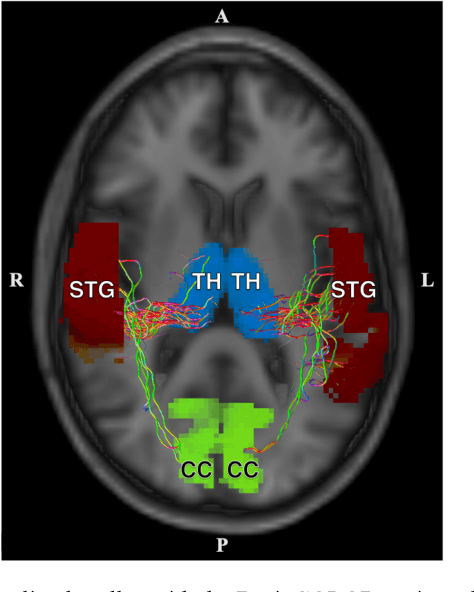
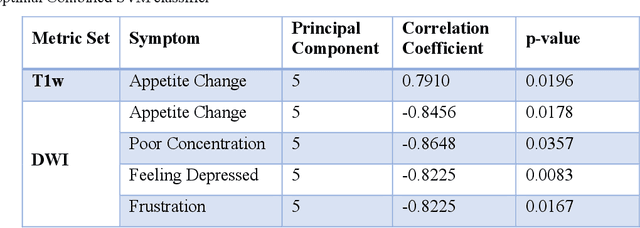
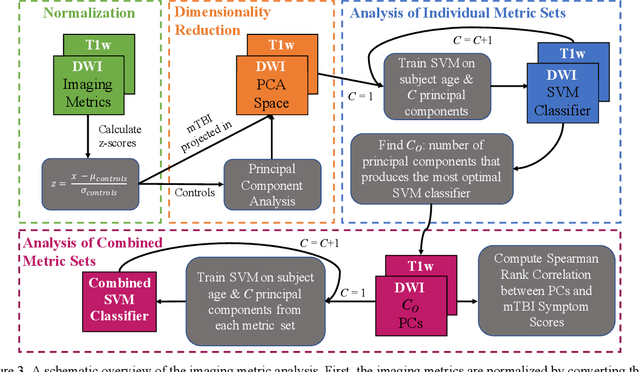
Veterans with mild traumatic brain injury (mTBI) have reported auditory and visual dysfunction that persists beyond the acute incident. The etiology behind these symptoms is difficult to characterize with current clinical imaging. These functional deficits may be caused by shear injury or micro-bleeds, which can be detected with special imaging modalities. We explore these hypotheses in a pilot study of multi-parametric MRI. We extract over 1,000 imaging and clinical metrics and project them to a low-dimensional space, where we can discriminate between healthy controls and patients with mTBI. We also show correlations between the metric representations and patient symptoms.