 Add to Chrome
 Add to Firefox
 Add to Edge
Infra-Bayesian Reinforcement Learning Agents Outperform Classical RL For Worst-Case Robustness
May 22, 2026
Classical reinforcement learning assumes the agent interacts with a fixed environment whose behavior does not depend on the agent's policy. This assumption breaks down in non-realizable settings where other actors might anticipate the agent's behavior, including environments crucial to AI safety, where the agent interacts with predictors, humans, other AI agents, and institutions. In such settings, the agent's model class fails to capture the world in which it operates. Under such misspecification, classical Bayesian methods can produce confidently wrong posteriors, unreliable decisions, and unbounded regret, as realizability fails to obtain. Infra-Bayesianism is a decision-theoretic framework that addresses these failures by distinguishing ordinary probabilistic uncertainty, where priors can be reasonably chosen, from Knightian uncertainty, where no grounds exist for the construction of such a prior. It does so by evaluating actions on their worst-case outcomes, rather than from posterior expectations or weighted averaging. We present the first proof-of-concept implementation of an infra-Bayesian reinforcement learning architecture for finite-outcome stateless decision problems. Our agent maintains a set of imprecise hypotheses, updates them using infra-Bayesian conditioning, and selects actions by maximizing worst-case expected value. We apply this implementation of the infra-Bayesian maximin decision process to an environment with Knightian uncertainty, and demonstrate a lower worst-case regret as compared to classical reinforcement learning agents. We also investigate Newcomb's problem and show that the infra-Bayesian agent picks the optimal strategy, outperforming classical decision theory agents. Our results provide a step towards reinforcement learning agents that remain robust under model misspecification and policy-dependent uncertainty.

Private Selection with Heterogeneous Sensitivities
Jan 09, 2025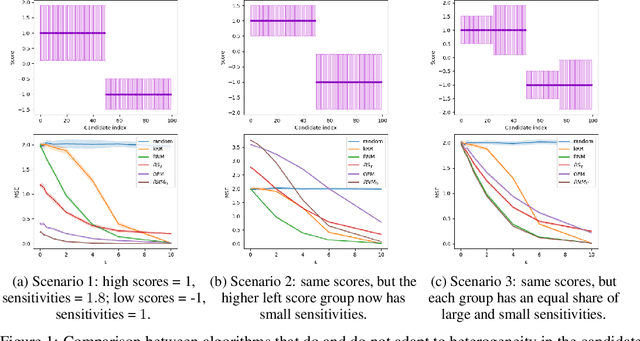
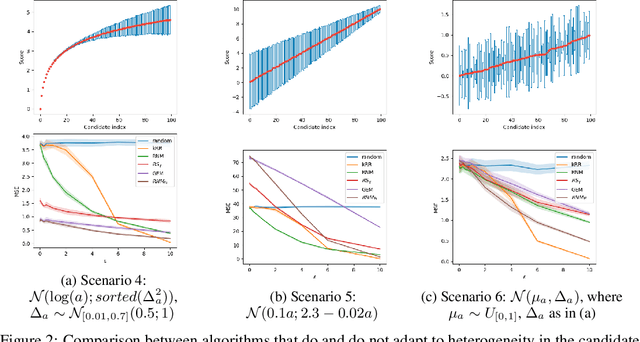
Differentially private (DP) selection involves choosing a high-scoring candidate from a finite candidate pool, where each score depends on a sensitive dataset. This problem arises naturally in a variety of contexts including model selection, hypothesis testing, and within many DP algorithms. Classical methods, such as Report Noisy Max (RNM), assume all candidates' scores are equally sensitive to changes in a single individual's data, but this often isn't the case. To address this, algorithms like the Generalised Exponential Mechanism (GEM) leverage variability in candidate sensitivities. However, we observe that while these algorithms can outperform RNM in some situations, they may underperform in others - they can even perform worse than random selection. In this work, we explore how the distribution of scores and sensitivities impacts DP selection mechanisms. In all settings we study, we find that there exists a mechanism that utilises heterogeneity in the candidate sensitivities that outperforms standard mechanisms like RNM. However, no single mechanism uniformly outperforms RNM. We propose using the correlation between the scores and sensitivities as the basis for deciding which DP selection mechanism to use. Further, we design a slight variant of GEM, modified GEM that generally performs well whenever GEM performs poorly. Relying on the correlation heuristic we propose combined GEM, which adaptively chooses between GEM and modified GEM and outperforms both in polarised settings.
Randomized algorithms for precise measurement of differentially-private, personalized recommendations
Aug 08, 2023


Personalized recommendations form an important part of today's internet ecosystem, helping artists and creators to reach interested users, and helping users to discover new and engaging content. However, many users today are skeptical of platforms that personalize recommendations, in part due to historically careless treatment of personal data and data privacy. Now, businesses that rely on personalized recommendations are entering a new paradigm, where many of their systems must be overhauled to be privacy-first. In this article, we propose an algorithm for personalized recommendations that facilitates both precise and differentially-private measurement. We consider advertising as an example application, and conduct offline experiments to quantify how the proposed privacy-preserving algorithm affects key metrics related to user experience, advertiser value, and platform revenue compared to the extremes of both (private) non-personalized and non-private, personalized implementations.