 Add to Chrome
 Add to Firefox
 Add to Edge
Exploiting Expertise of Non-Expert and Diverse Agents in Social Bandit Learning: A Free Energy Approach
Mar 12, 2026
Personalized AI-based services involve a population of individual reinforcement learning agents. However, most reinforcement learning algorithms focus on harnessing individual learning and fail to leverage the social learning capabilities commonly exhibited by humans and animals. Social learning integrates individual experience with observing others' behavior, presenting opportunities for improved learning outcomes. In this study, we focus on a social bandit learning scenario where a social agent observes other agents' actions without knowledge of their rewards. The agents independently pursue their own policy without explicit motivation to teach each other. We propose a free energy-based social bandit learning algorithm over the policy space, where the social agent evaluates others' expertise levels without resorting to any oracle or social norms. Accordingly, the social agent integrates its direct experiences in the environment and others' estimated policies. The theoretical convergence of our algorithm to the optimal policy is proven. Empirical evaluations validate the superiority of our social learning method over alternative approaches in various scenarios. Our algorithm strategically identifies the relevant agents, even in the presence of random or suboptimal agents, and skillfully exploits their behavioral information. In addition to societies including expert agents, in the presence of relevant but non-expert agents, our algorithm significantly enhances individual learning performance, where most related methods fail. Importantly, it also maintains logarithmic regret.

Convolutional Neural Network-Based Image Watermarking using Discrete Wavelet Transform
Oct 08, 2022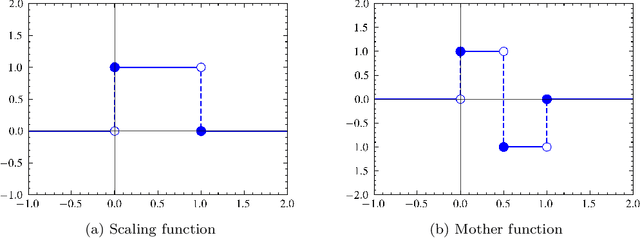
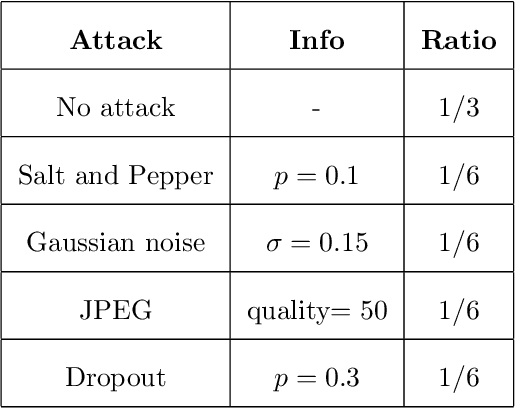
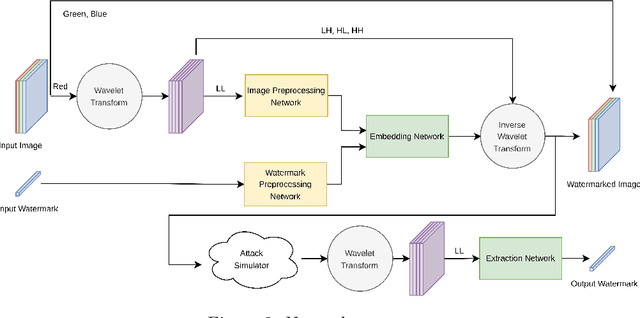
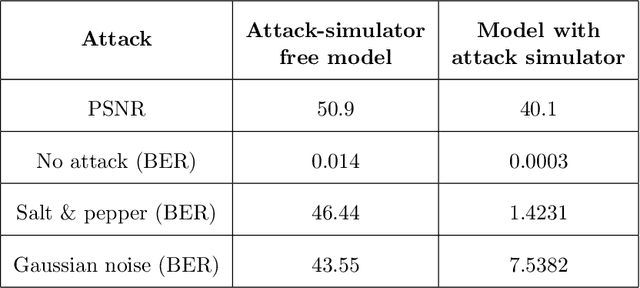
As the Internet becomes more popular, digital images are used and transferred more frequently. Although this phenomenon facilitates easy access to information, it also creates security concerns and violates intellectual property rights by allowing illegal use, copying, and digital content theft. Using watermarks (WMs) in digital images is one of the most common ways to maintain security. Watermarking is proving and declaring ownership of an image by adding a digital watermark to the original image. Watermarks can be either text or an image placed overtly or covertly in an image and are expected to be challenging to remove. This paper proposes a combination of convolutional neural networks (CNNs) and wavelet transforms to obtain a watermarking network for embedding and extracting watermarks. The network is independent of the host image resolution, can accept all kinds of watermarks, and has only 11 CNN layers while keeping performance. Two terms measure performance; the similarity between the extracted watermark and the original one and the similarity between the host image and the watermarked one.